

Our Verdict
Neither local nor cloud processing is universally superior - each suits different priorities. Local processing wins on reliability, privacy, and independence, while cloud processing delivers richer features and remote flexibility. The most resilient smart homes typically use both, reserving local processing for security-critical devices and leaning on the cloud where convenience matters more.
| Best for | Recommended |
|---|---|
| Those prioritizing reliability and offline functionality | Local processing |
| Those wanting advanced features, remote access, and voice AI | Cloud processing |
| Those building a long-term, future-proof smart home | Hybrid (local + cloud) approach |
What Local and Cloud Processing Actually Mean
Every smart home device has to process data somewhere - whether that's recognizing a motion sensor trigger, responding to a voice command, or deciding when to turn on a light. Where that computation happens defines whether a device is locally processed or cloud processed.
With local processing, all the decision-making happens inside hardware on your home network - typically the device itself, a dedicated hub, or a local server like a NAS (network-attached storage). No internet connection is required for the device to function.
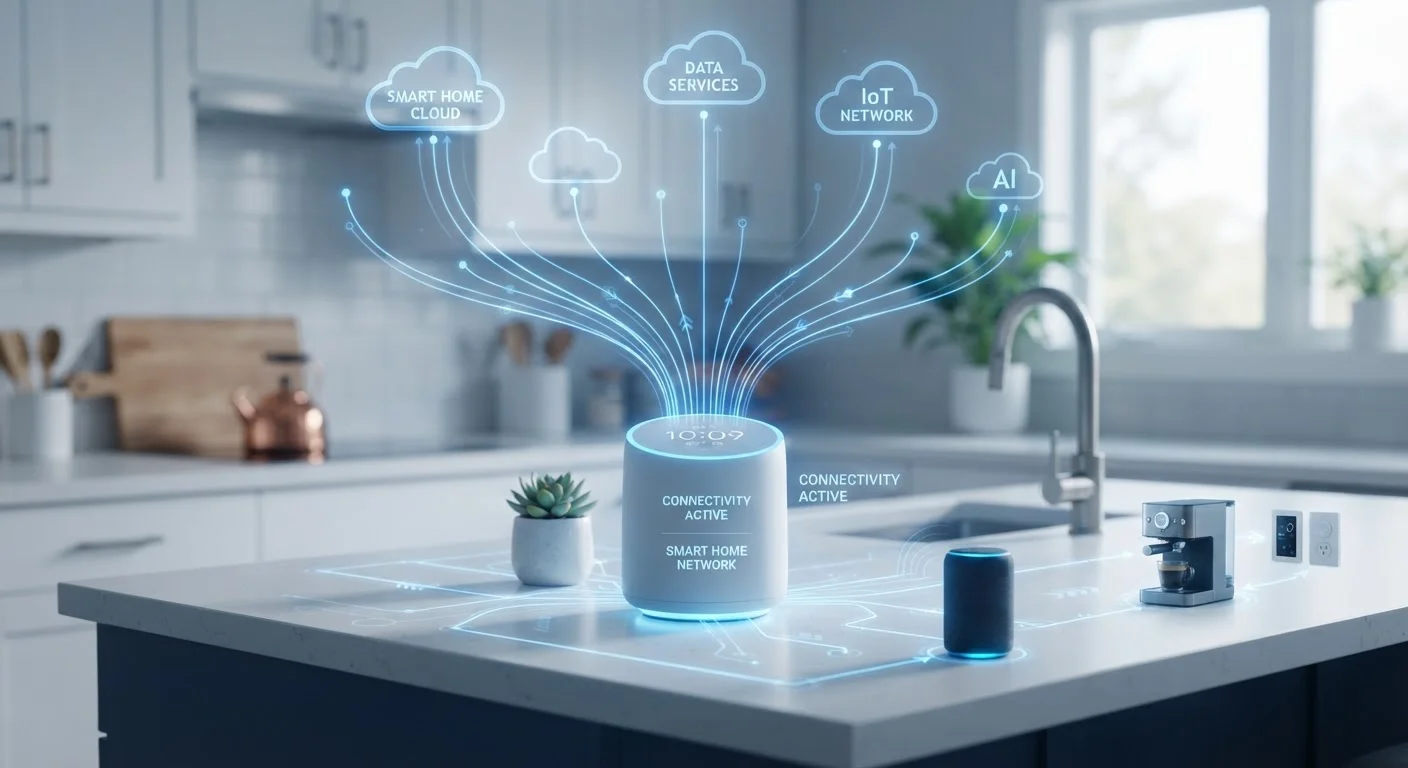
With cloud processing, your device sends data to a remote server operated by the manufacturer. That server does the heavy lifting - interpreting commands, running automations, or applying AI models - then sends a response back to your device. This round-trip usually takes milliseconds, but it requires an active internet connection and a functioning remote server.
Understanding this distinction is foundational to evaluating any smart home purchase. For a deeper look at how connected devices talk to each other, see Smart Home Ecosystems Explained.
The Case for Local Processing
Local processing has a straightforward advantage: your devices keep working when the internet doesn't. If your ISP goes down, or a manufacturer's servers experience an outage, locally processed devices continue operating normally. For reliability-critical applications - smart locks, security cameras, and smoke detector integrations - this independence matters significantly.
Privacy is another compelling argument. Data processed locally never leaves your home network, which means it isn't stored on external servers, potentially accessed in data breaches, or subject to a company's data-retention policies. For context on how cloud-dependent devices can expose you, what smart speakers do with your voice data is worth understanding.
Local systems also tend to respond faster. Without the round-trip to a remote server, commands execute in near-real time. And critically, locally processed devices don't become bricks if a company shuts down its servers or discontinues a product line - a real concern given the pace at which consumer tech companies come and go.
Prioritize Local Processing for Safety Devices
Smart locks, door sensors, and smoke alarm integrations should work even when your internet is down. Before purchasing any security-critical smart device, confirm in the product documentation whether core functions operate locally. A device that goes offline during a power or internet outage may leave you without access or alerts when you need them most.
For smart locks specifically, local processing is worth prioritizing. A lock that stops responding during an internet outage creates a genuine safety risk. See Smart Locks: Understanding Access Control for questions to ask before buying.
The Case for Cloud Processing
Cloud processing unlocks capabilities that local hardware often can't match. Advanced voice recognition, natural language understanding, and machine learning models require substantial computing resources - the kind that live in data centers, not in a small hub sitting on your shelf. This is why voice assistants like those built into smart speakers depend on cloud infrastructure.
Remote access is another key benefit. When your devices are cloud-connected, you can check on them and control them from anywhere in the world via a smartphone app. Local-only systems typically restrict control to your home network unless you set up more complex solutions like a VPN.
Cloud platforms also simplify cross-device integrations and receive feature updates centrally, meaning your devices can gain new capabilities over time without hardware changes. For households where convenience and feature richness outweigh reliability concerns, cloud-based systems often deliver a more polished experience.
| Local Processing | Cloud Processing | |
|---|---|---|
| Works without internet | Yes | No |
| Privacy exposure | Lower - data stays on home network | Higher - data sent to remote servers |
| Response speed | Near-instant | Milliseconds of latency added |
| Advanced AI features | Limited by local hardware | Fully supported |
| Remote access (away from home) | Requires extra setup (e.g. VPN) | Built-in via app |
| Risk if service is discontinued | Low - hardware still functions | High - device may stop working |
| Setup complexity | Often higher (hubs, config) | Typically simpler out of the box |
The Hybrid Reality - and What to Look For
Most modern smart home platforms don't force a binary choice. Many devices use cloud connectivity for remote access and voice AI while falling back to local processing for time-sensitive automations when internet is unavailable. Open standards like Matter - now supported by major platforms - are specifically designed to enable reliable local control while preserving optional cloud features.
When evaluating a device, ask these practical questions: Does it work during an internet outage? What happens if the manufacturer discontinues the product or shuts down its servers? Where is your data stored, and what is the company's retention policy?
Frequent connectivity problems are often a separate issue from processing architecture. If your devices keep dropping off the network, diagnosing smart home disconnections can help you isolate the cause. Network infrastructure also plays a role - a stable, well-configured router or mesh system is the foundation for any smart home setup, whether local or cloud. Mesh Wi-Fi vs a Traditional Router explains when that infrastructure upgrade makes sense.
From a security perspective, cloud-connected devices introduce additional attack surfaces. Practicing good network hygiene - such as isolating IoT devices on a separate network segment - applies regardless of processing model. Keeping Your Smart Home Secure covers the practices most worth implementing.
The content on this site is provided for informational purposes only and should not be considered a substitute for professional advice. While we strive to provide accurate and up-to-date information, we make no guarantees regarding its completeness or accuracy. Always consult a qualified professional for advice specific to your circumstances before making any decisions.