

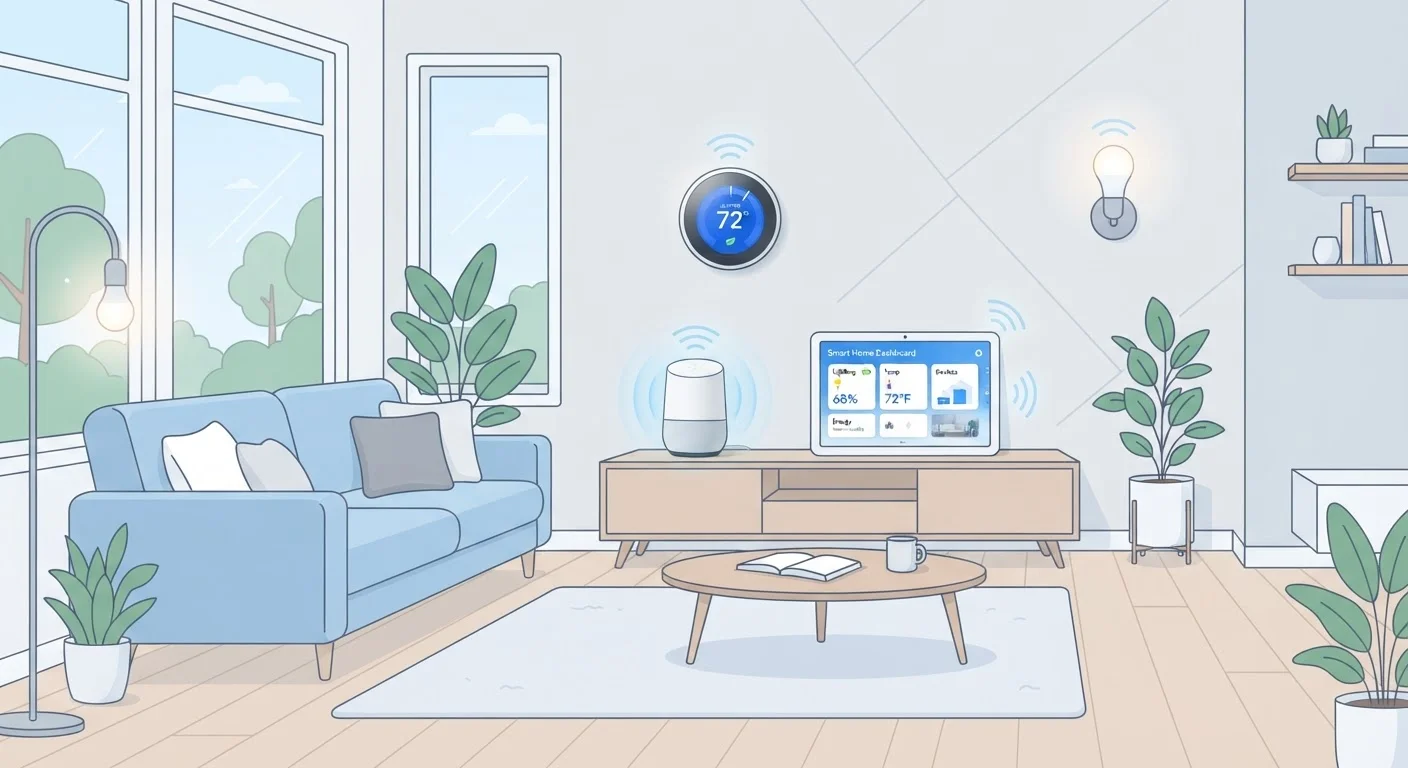
The Problem Smart Home Ecosystems Solve
Walk into any home electronics retailer and you'll find hundreds of smart devices - bulbs, locks, cameras, sensors, thermostats - each promising to make life easier. The challenge is that buying devices without understanding how they communicate can result in a collection of gadgets that don't cooperate with one another.
A smart home ecosystem solves this by providing a shared communication framework. Rather than each device operating through its own proprietary app, an ecosystem connects them under a unified control layer. The result is automation: your porch light turns on when your smart lock senses you've arrived home, or your thermostat adjusts when the last occupancy sensor reports an empty house.
If you're just getting started, smart plugs offer a low-commitment entry point into a connected home without requiring a hub or advanced setup.
How Devices Actually Communicate: The Protocols
At the hardware level, smart devices rely on wireless protocols - standardized rules for how radio signals are structured and exchanged. Each protocol has different strengths:
- Wi-Fi: The most familiar protocol, built into most home routers. Wi-Fi devices connect directly to your network and are easy to set up, but they consume more power and can add congestion if you have dozens of them.
- Zigbee: A low-power mesh protocol operating on the 2.4 GHz band. Zigbee devices relay signals through one another - so the more devices you have, the stronger the network. It requires a compatible hub to connect to your broader home network.
- Z-Wave: Similar in concept to Zigbee but operates on sub-GHz frequencies (around 908 MHz in North America), which reduces interference from Wi-Fi and other 2.4 GHz devices. Also mesh-based and hub-dependent.
- Thread: A newer IPv6-based mesh protocol designed for low-power devices. Thread itself isn't user-facing - it's the foundation that the Matter standard runs on for certain device types.
- Bluetooth and Bluetooth Mesh: Typically used for short-range or setup purposes; some devices use Bluetooth mesh for local control without internet dependency.
600M+
Smart home devices shipped globally in 2023
According to IDC's worldwide smart home device tracker, shipments exceeded 600 million units in 2023, reflecting growing ecosystem adoption.
4,000+
Matter-certified products available
The Connectivity Standards Alliance reported over 4,000 Matter-certified products by mid-2024, spanning lights, locks, sensors, and appliances.
Understanding which protocol a device uses before you buy it helps you avoid compatibility dead ends.
Matter: The Push for Universal Compatibility
For years, smart home interoperability was fragmented - a bulb certified for one platform might not work at all with another. Matter, an open-source connectivity standard developed by the Connectivity Standards Alliance (CSA), is designed to change that. Backed by Apple, Google, Amazon, Samsung, and others, Matter-certified devices are designed to work across all participating platforms simultaneously.
Matter operates at the application layer - the part that defines what a device can do and how platforms interpret it - while Thread or Wi-Fi handle the actual signal transport. A Matter-certified light switch, for example, can be added to Google Home, Apple Home, and Amazon Alexa without choosing between them.
“The goal of Matter is simple: if a device is Matter certified, it should work - regardless of which ecosystem or voice assistant a consumer prefers. Choice shouldn't come with a compatibility penalty.”
— Tobin Richardson, President and CEO, Connectivity Standards Alliance
Importantly, Matter doesn't eliminate Zigbee or Z-Wave. Existing devices using those protocols remain valid choices, and many hubs now act as Matter bridges, translating older protocol devices into the Matter ecosystem.
Platforms: The Management Layer
While protocols determine how devices send radio signals, platforms determine how you manage, automate, and expand your system. The major consumer platforms - Google Home, Amazon Alexa, Apple Home (HomeKit), and Samsung SmartThings - each offer apps, voice control, and automation engines.
Platform choice often comes down to which other devices you already own. Apple Home integrates tightly with iPhones and HomePods but has historically had stricter certification requirements. Google Home works fluidly with Android devices and Nest hardware. Amazon Alexa supports the widest range of third-party devices. Samsung SmartThings is hub-centric and strong on Zigbee and Z-Wave device support.
Some platforms also handle processing locally, which affects reliability. Devices that depend entirely on cloud servers can stop responding when internet access is interrupted - a meaningful consideration for security-critical devices like locks. Our article on local vs. cloud processing explains why this distinction matters for everyday reliability.
If you're experiencing devices dropping off your network unexpectedly, the issue is often related to protocol interference or router configuration - covered in detail in why smart home devices drop off the network.
Practical Compatibility: What to Check Before You Buy
Compatibility isn't just about protocol - it involves three overlapping questions:
- Which protocol does this device use? Check the product listing for Wi-Fi, Zigbee, Z-Wave, Thread, or Matter.
- Does my existing hub or router support that protocol? A Zigbee device requires a Zigbee-compatible hub. A Matter device requires a Matter-compatible controller (most modern smart speakers and displays now include one).
- Which platforms does it work with? A device might support Zigbee but only integrate with one specific platform's hub, limiting future flexibility.
Smart displays - which often serve as central hubs with built-in Matter controllers - are explored in our guide on everything home tech users should know about smart displays.
When in doubt, prioritize devices that carry Matter certification or explicitly list compatibility with multiple major platforms. This approach preserves flexibility as your setup grows and standards continue to evolve.
Frequently Asked Questions
A protocol is the wireless communication language devices use to send signals to each other - examples include Zigbee, Z-Wave, and Matter. A platform is the software ecosystem - like Google Home or Apple Home - that organizes those devices and lets you control them. Think of the protocol as the language and the platform as the directory.
No. Many devices use Zigbee or Z-Wave, which are low-power mesh radio protocols that don't rely on your Wi-Fi network at all. These require a compatible hub to translate signals to your router. Wi-Fi-native devices connect directly but can strain a congested network.
Matter is an open-source connectivity standard developed by the Connectivity Standards Alliance and backed by Apple, Google, Amazon, and others. It allows certified devices to work across multiple major platforms without needing separate bridge hardware. It doesn't replace Zigbee or Z-Wave, but it provides a shared upper layer for certified devices.
Sometimes - it depends on which protocol and platform each device supports. Devices that both support Matter or share the same platform (like Amazon Alexa) can typically work together. Devices locked to proprietary protocols often can't communicate outside their own brand ecosystem.
Not necessarily. Wi-Fi and Matter-over-Thread devices can connect directly to your router and platform without a hub. However, Zigbee and Z-Wave devices do require a compatible hub or controller to bridge their signals to your network and platform.
Devices that rely on cloud processing may become unresponsive when internet or server access is interrupted. Locally-processed devices typically continue to function during outages. Understanding the difference matters for reliability - see our companion piece on local vs. cloud processing for more detail.
The content on this site is provided for informational purposes only and should not be considered a substitute for professional advice. While we strive to provide accurate and up-to-date information, we make no guarantees regarding its completeness or accuracy. Always consult a qualified professional for advice specific to your circumstances before making any decisions.