

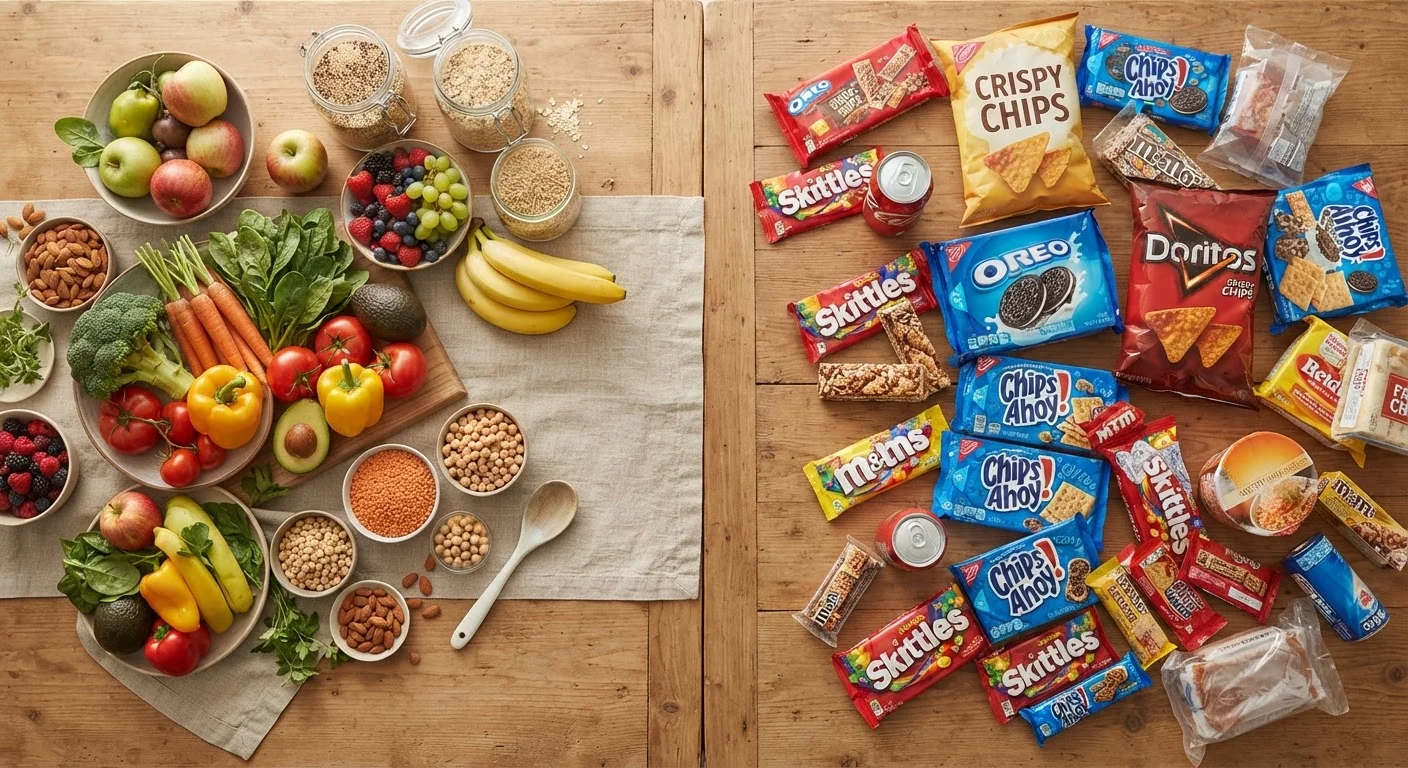
Option A
Whole Foods
The minimally altered, nutrient-dense foundation of most traditional diets.
Best for: People seeking to maximize fiber, vitamins, minerals, and phytonutrients from their daily eating patterns.
Option B
Ultra-Processed Foods
Industrially formulated products engineered for convenience, shelf stability, and palatability.
Best for: Understanding what to look for on labels when convenience foods are unavoidable or when evaluating dietary trade-offs.
Defining the Terms: What 'Whole' and 'Ultra-Processed' Actually Mean
The phrase "whole foods" is used loosely in everyday conversation, but it has a fairly clear working definition: foods that are eaten in or close to their natural state, with little to no industrial transformation. Think of a raw apple, a handful of oats, a piece of grilled salmon, or cooked lentils. What they share is that their cellular structure, fiber content, and original nutrient composition are largely intact.
"Ultra-processed" is a more technical term rooted in the NOVA classification system, developed by researchers at the University of São Paulo. NOVA sorts foods into four groups based on the extent and purpose of processing - not just whether they were heated or frozen, but whether they were industrially reformulated using ingredients and additives that aren't typically found in a home kitchen. Emulsifiers, flavor enhancers, colorants, stabilizers, and modified starches are hallmarks of NOVA Group 4 - the ultra-processed tier.
Ultra-processed foods aren't simply "cooked" or "preserved" foods. A jar of plain tomato passata is processed (Group 2 or 3 under NOVA) but not ultra-processed. A shelf-stable flavored tomato sauce containing high-fructose corn syrup, modified starch, and artificial flavoring would qualify as ultra-processed. The distinction lies in the formulation and the purpose behind it: extending palatability, shelf life, and visual appeal beyond what basic processing achieves. Understanding how food labels use terms like "natural" can help clarify why these distinctions matter in practice.
How They Compare: Nutrition, Ingredients, and Dietary Impact
| Criterion | Whole Foods | Ultra-Processed Foods |
|---|---|---|
| Processing level | Minimal to none | Industrial reformulation |
| Typical ingredient count | One to a few whole ingredients | Often 10+ including additives |
| Fiber content | Generally high (plant foods) | Often low or absent |
| Micronutrient source | Naturally occurring and intact | Often synthetic re-fortification |
| Added sugars | None or naturally present | Frequently added, multiple forms |
| Shelf stability | Often limited without refrigeration | Extended via preservatives or packaging |
| Dietary research associations | Linked to better diet quality outcomes | Associated with poorer health markers in cohort studies |
Whole foods tend to be nutritionally complex by default. A cup of cooked black beans delivers protein, soluble fiber, folate, iron, and resistant starch - all in a single ingredient. Ultra-processed foods are often nutritionally simplified: stripped of fiber and micronutrients during manufacturing, then partially re-fortified with synthetic vitamins to meet labeling requirements. The end result may look adequate on a nutrition panel but behaves differently in the body than food where those nutrients arrived intact.
Research published in peer-reviewed journals - including large cohort studies in Europe and North America - has consistently found associations between high ultra-processed food consumption and elevated risks of cardiovascular disease, type 2 diabetes, obesity, and certain digestive conditions. These are observational findings and do not establish direct causation on their own, but the consistency across large populations is notable. For a deeper look at what those nutrition panels actually reveal, see our guide on reading a nutrition label without getting confused.
~57%
Share of US adult calories from ultra-processed foods
Research published in BMJ Open estimated that ultra-processed foods account for roughly 57% of energy intake among US adults.
95%
American adults falling short of recommended fiber intake
The Dietary Guidelines Advisory Committee has noted that dietary fiber is a nutrient of public health concern, with the vast majority of US adults under-consuming it.
Fiber is one of the starkest differences. Dietary fiber - essential for gut health, blood sugar regulation, and satiety - is predominantly found in minimally processed plant foods. It is routinely absent or minimal in ultra-processed products. This matters because most American adults already fall short of recommended fiber intake, according to data from the Dietary Guidelines Advisory Committee.
How to Spot Ultra-Processed Foods in the Real World
Reading ingredient lists - rather than the nutrition facts panel alone - is the most reliable way to identify ultra-processed products. A useful rule of thumb: if the ingredient list includes substances you wouldn't find in a typical home pantry and that serve primarily cosmetic or textural functions (carrageenan, DATEM, titanium dioxide, acesulfame potassium, maltodextrin), the product likely falls into the ultra-processed category.
Some indicators to watch for:
- Long ingredient lists with many items beyond the core food itself
- Multiple added sugars under different names (corn syrup, dextrose, fruit juice concentrate)
- Emulsifiers and stabilizers (lecithin variants, xanthan gum used as primary texture agents)
- Artificial or "natural" flavors listed as primary flavor sources rather than real food ingredients
It's also worth noting that not all packaged foods are ultra-processed. Plain canned chickpeas, frozen edamame, and rolled oats in a bag are minimally or moderately processed - they retain their whole-food profile. The nutrition facts panel breakdown can complement ingredient-list reading for a more complete picture. For specific product categories like protein bars, ingredient scrutiny matters even more - see our overview of what protein bar ingredient lists actually reveal.
Understanding food quality also ties directly into how calories function differently depending on their source - explored further in our piece on calories vs. nutrient density.
This article is for general informational and educational purposes only and does not constitute medical or dietary advice. Consult a registered dietitian or qualified healthcare professional for personalized nutrition guidance.
The content on this site is provided for informational purposes only and should not be considered a substitute for professional advice. While we strive to provide accurate and up-to-date information, we make no guarantees regarding its completeness or accuracy. Always consult a qualified professional for advice specific to your circumstances before making any decisions.