

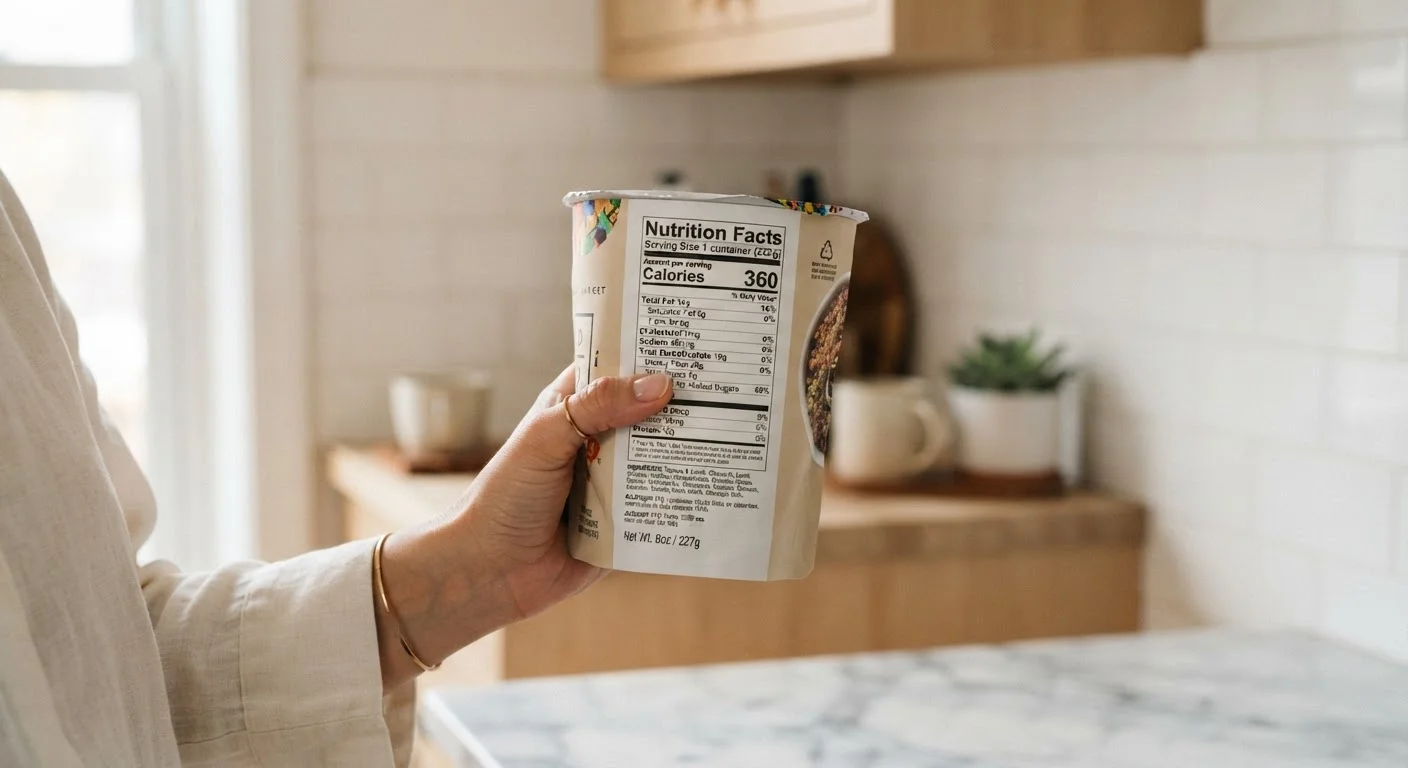
Why the Nutrition Facts Panel Exists
The Nutrition Facts panel on packaged foods in the United States is regulated by the Food and Drug Administration (FDA). Its purpose is straightforward: to give consumers standardized, comparable information about what a food contains before they buy or eat it. The format was last significantly updated in 2016, with full compliance required by most manufacturers by 2020. Key changes included a larger calorie display, the addition of an "Added Sugars" line, and updated serving sizes designed to reflect amounts people actually eat.
Understanding the panel doesn't require a nutrition degree. It does require knowing which numbers matter most for your purposes - and what each one actually represents. For a broader foundation in how foods fit together in a healthy pattern, see our guide to building a balanced plate.
What you will need
How to Work Through the Label, Section by Section
The steps below follow the label from top to bottom, which is also the logical order for interpreting it. Work through each section in sequence when evaluating a new product.
Start with serving size
The very first line of the panel - serving size - controls every number that follows. If a bag of chips lists a serving size of 1 oz (about 28g) but you eat 3 oz, every nutrient figure on the label triples. Serving sizes on updated US labels are set to reflect typical consumption amounts, not idealized portions, but they still vary widely between products.
Also check the servings per container line directly below. A bottle that appears single-serve may contain 2.5 servings, which doubles your actual intake of every listed nutrient.
Read the calorie count in proportion to the serving
Calories measure the energy a food provides per serving. On the updated label format, the calorie count appears in a large, prominent font. This figure is per serving - not per package - unless the package is a single-serving unit.
Calories alone don't determine nutritional value. A food can be calorie-dense and nutrient-rich (nuts, for example) or calorie-moderate and nutrient-poor. Calories are a useful data point, not a verdict. For more on this distinction, see our article on calories and nutrient density.
Assess total fat and its breakdown
The Total Fat line includes all fat types combined. Below it, the panel breaks this down into saturated fat and trans fat. Saturated fat has its own line because current dietary guidance - including from the American Heart Association - generally recommends limiting it. Trans fat from partially hydrogenated oils has been largely eliminated from the US food supply following an FDA ruling, but the line still appears and is worth checking.
Unsaturated fats (monounsaturated and polyunsaturated) may appear as optional lines. They are not broken out by default but can appear voluntarily. These fats are generally associated with beneficial cardiovascular effects in evidence-based dietary research.
Review cholesterol and sodium
Cholesterol is listed in milligrams. Dietary cholesterol's relationship with blood cholesterol is more nuanced than once believed, and current guidance has moved away from strict numeric limits in favor of broader dietary patterns. That said, the line remains on the panel.
Sodium is worth careful attention, particularly for individuals managing blood pressure. The general dietary guidance in the US (from sources such as the Dietary Guidelines for Americans) suggests a daily target of less than 2,300 mg for most adults. Many packaged and processed foods contribute substantially to daily sodium intake, making this one of the more practically useful lines on the label.
Understand total carbohydrates, fiber, and sugars
Total Carbohydrates encompasses all carbohydrate types: starches, dietary fiber, and sugars. Below that line, you'll find:
- Dietary Fiber: Fiber contributes to digestive health and is a nutrient many Americans under-consume. Higher %DV here is generally favorable. Our article on fiber as a frequently overlooked nutrient explores why it matters.
- Total Sugars: Includes both naturally occurring sugars (from fruit, dairy) and added sugars.
- Added Sugars: This line - added in the 2016 update - isolates sugars incorporated during processing. Current US dietary guidance recommends limiting added sugars to less than 10% of daily calories.
Check protein and micronutrients
Protein is listed in grams. No %DV is required for protein in most cases, as deficiency is uncommon in the US. However, the amount is still useful for tracking intake relative to personal goals or dietary patterns.
Below protein, the panel lists selected micronutrients - currently required to include Vitamin D, Calcium, Iron, and Potassium. These were chosen because they represent nutrients that public health data suggests many Americans under-consume. The %DV figures here help you gauge a food's contribution toward recommended daily intakes. For a broader reference on vitamins and minerals, see micronutrients at a glance.
Putting It All in Context
A nutrition label describes one food in isolation. A single food is rarely the full picture of a diet. A product high in sodium may fit comfortably into an otherwise low-sodium day; a food with significant added sugar may appear in a meal that is otherwise nutrient-dense. Context matters more than any one number.
Use the 5% and 20% Rules as Quick Guides
When scanning the % Daily Value column, a figure of 5% DV or less generally indicates a low amount of that nutrient per serving, while 20% DV or more indicates a high amount. These benchmarks - established by the FDA - make it faster to compare products without doing math. They work for both nutrients you may want more of (fiber, calcium) and those you may want to limit (sodium, saturated fat).
The % Daily Value (%DV) column is one of the panel's most useful features precisely because it provides context: 5% DV or less is generally considered low for a nutrient, while 20% DV or more is considered high. Use those benchmarks as quick comparisons rather than pass/fail thresholds.
Labels also don't capture everything nutritionally relevant - phytochemicals, the degree of processing, and how foods are prepared all influence nutritional value in ways a panel cannot convey. For a deeper look at why food quality extends beyond calorie counts, see our article on calories versus nutrient density. And if you're building consistent eating habits, weekly meal planning with nutritional balance in mind offers a practical framework for the bigger picture.
This article provides general nutrition education and is not a substitute for personalized advice from a registered dietitian or qualified healthcare professional.
The content on this site is provided for informational purposes only and should not be considered a substitute for professional advice. While we strive to provide accurate and up-to-date information, we make no guarantees regarding its completeness or accuracy. Always consult a qualified professional for advice specific to your circumstances before making any decisions.