

Why Food Label Language Matters
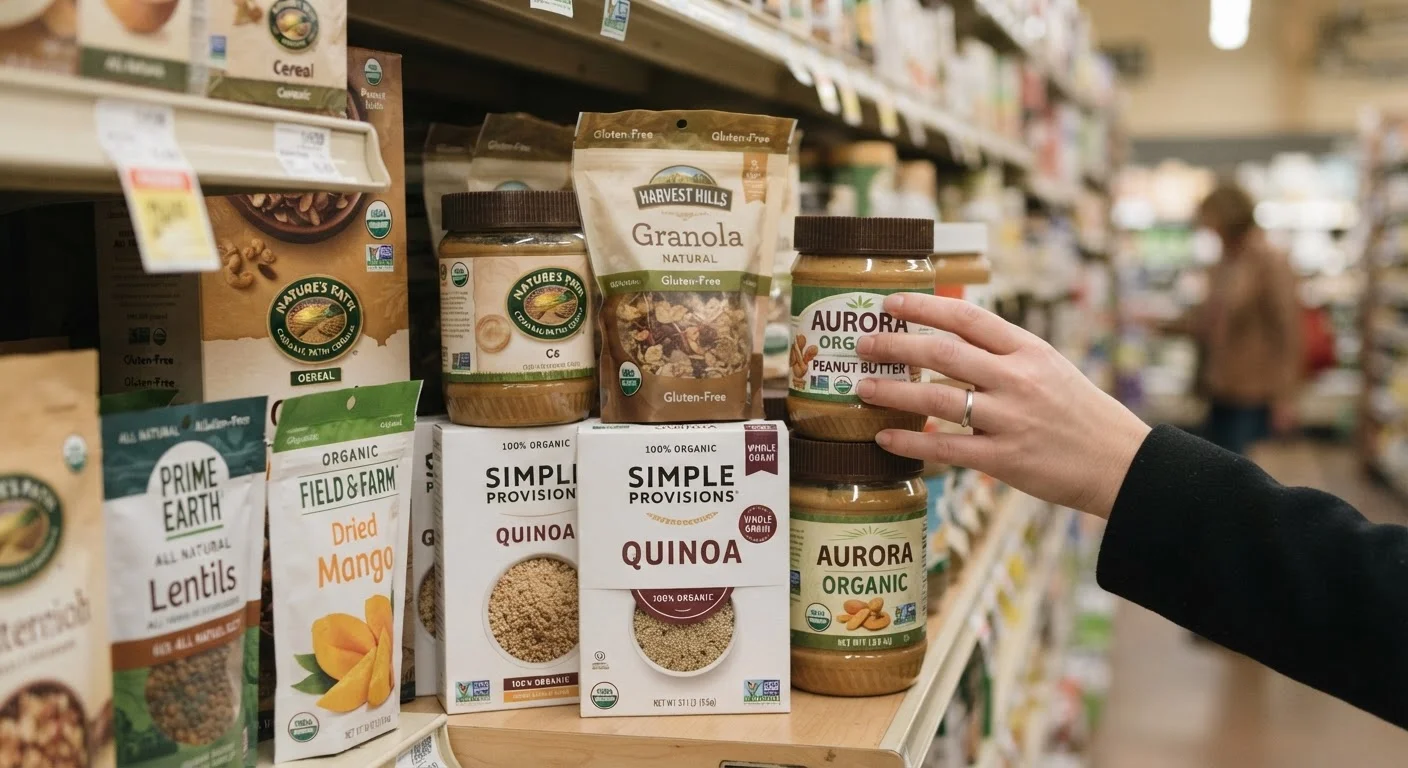
Walk through any grocery store and you'll see 'natural,' 'organic,' 'non-GMO,' and 'clean' plastered across packaging in reassuring fonts and earthy colors. These words feel meaningful - and some of them are. But others carry no regulated definition at all, which means marketers can deploy them freely to influence purchasing decisions without making any verifiable claim.
Understanding which labels are legally defined and which are essentially decorative is one of the most practical skills a food shopper can develop. It doesn't require a nutrition degree - just a clear picture of how the regulatory landscape actually works. For a deeper look at decoding what's on packaging, reading a nutrition label without getting confused is a useful companion guide.
Myth
'Natural' on a food label means the product is minimally processed and free of artificial ingredients.
Fact
The FDA has not established a formal definition for 'natural,' meaning manufacturers apply it with almost no regulatory constraint.
The U.S. Food and Drug Administration has repeatedly considered defining 'natural' but has not finalized a standard. In practice, a product labeled 'natural' may contain high-fructose corn syrup, synthetic preservatives, or heavily processed ingredients - as long as the manufacturer judges the term appropriate. The USDA applies a limited definition to meat and poultry (minimally processed, no artificial ingredients), but that standard doesn't extend to the broader food supply. Shoppers who rely on 'natural' as a quality signal are largely reading into the packaging design rather than a regulated claim.
Myth
Organic food is completely pesticide-free.
Fact
Certified organic farming permits the use of certain approved pesticides, typically derived from natural sources.
USDA Organic certification prohibits most synthetic pesticides and fertilizers, but it does allow a defined list of substances considered compatible with organic principles - including some botanical and mineral-based pesticides. Copper sulfate, for example, is approved for organic use despite having documented environmental concerns at high concentrations. 'Organic' means the farming system meets specific standards; it does not mean zero pesticide exposure. Residue levels on organic produce are generally lower than on conventionally grown produce, but the claim of being entirely pesticide-free is not accurate.
Myth
'Non-GMO' and 'organic' mean essentially the same thing.
Fact
These are distinct certifications with different scopes - an organic product isn't necessarily non-GMO verified, and vice versa.
USDA Organic standards do prohibit genetically engineered ingredients, so certified organic products effectively exclude GMOs. However, 'Non-GMO Project Verified' is a separate third-party certification that focuses specifically on GMO avoidance and does not evaluate pesticide use, farming practices, or other factors that organic certification covers. A product can be non-GMO verified while being grown with synthetic pesticides and fertilizers. Treating these labels as interchangeable leads to misplaced assumptions about what you're actually buying.
Myth
Organic food is always more nutritious than conventionally grown food.
Fact
Research on nutritional differences between organic and conventional produce is mixed, and no consistent, significant advantage has been established.
Multiple systematic reviews, including a widely cited 2012 analysis by Stanford researchers, found little strong evidence that organic foods are significantly more nutritious than their conventional counterparts. Some studies suggest marginally higher levels of certain antioxidants in organic produce, possibly due to plants producing more protective compounds when not treated with pesticides. However, nutritional content varies considerably based on variety, soil quality, ripeness at harvest, and storage conditions - factors that cut across both organic and conventional production. Choosing organic for environmental or pesticide-exposure reasons may be reasonable; expecting a measurable nutritional upgrade is harder to justify based on current evidence.
Myth
A higher price tag on labeled products signals better quality or safety.
Fact
Price reflects production costs, certification fees, and marketing - not a reliable indicator of nutritional value or safety.
Organic certification involves real costs: inspection fees, documentation, compliance with stricter farming requirements, and often lower yields. These costs are passed on to consumers, which is why organic products typically cost more. But that premium reflects the process, not necessarily the outcome in your body. A conventionally grown apple from a well-managed local farm may have comparable nutritional value and lower pesticide residue than an organic apple that traveled thousands of miles and sat in storage. Price is a proxy for cost structure, not a direct measure of quality.
Myth
'Made with organic ingredients' means the whole product is certified organic.
Fact
This phrase indicates a lower tier of USDA certification, requiring at least 70% organic ingredients - not full certification.
The USDA's organic labeling rules create four distinct tiers. Products labeled '100% Organic' must contain only organically produced ingredients. Products labeled 'Organic' must be at least 95% organic. 'Made with Organic [Ingredients]' requires at least 70% organic content - and that label cannot display the USDA Organic seal. Products with less than 70% organic ingredients may only identify specific organic components in the ingredient list. Recognizing these distinctions prevents the assumption that any mention of 'organic' on packaging means full certification.
Separating Regulated Terms from Marketing Language
Even once you understand the myths, it helps to know the practical hierarchy of food label claims. USDA Organic is the gold standard for regulated food claims in the U.S. - it requires third-party certification and audited compliance. Terms like 'natural,' 'clean,' and 'wholesome' have no equivalent oversight. 'Non-GMO Project Verified' is a credible third-party certification but is entirely separate from organic standards.
No definition
FDA regulatory status of 'natural' label
As of its most recent guidance, the FDA has not established a formal definition for the term 'natural' as used on food labels.
95%+
Organic ingredient threshold for USDA 'Organic' seal
To carry the USDA Organic seal, a product must contain at least 95% organically produced ingredients by USDA standards.
70%
Minimum organic content for 'Made with Organic' claim
Products using the phrase 'Made with Organic Ingredients' must contain at least 70% certified organic content under USDA rules.
Date labels are another area where consumer confusion runs deep. If you've ever wondered whether 'best by' means a product is unsafe after that date, the difference between 'Best By,' 'Use By,' and 'Sell By' dates breaks down what those terms actually mean. Similarly, claims on juice labels - like 'cold-pressed' - operate in their own murky space; what 'cold-pressed' actually means on a juice label clarifies what that processing term does and doesn't tell you about nutrition.
Certification Requires Third-Party Verification
USDA Organic is not self-reported - producers must be certified by an accredited certifying agent and undergo regular inspections. If a product claims to be organic but doesn't display the USDA Organic seal, check the label carefully for which tier of certification (if any) applies. Unverified organic claims on small or imported products are an area where consumer skepticism is warranted.
Nutrition myths often cluster around label language too - the belief that 'organic' means nutritionally superior, for instance, is part of a broader pattern of food misconceptions. popular nutrition myths that science has largely debunked examines some of the most persistent ones. And if you're thinking about what these distinctions mean at the ingredient level, whole foods vs. ultra-processed foods offers helpful framing around food quality that goes beyond label claims.
The clearest takeaway: treat regulated certifications as meaningful signals and unregulated marketing terms as noise until proven otherwise. Doing so won't guarantee perfect grocery decisions, but it will put you in a much stronger position than most shoppers relying on packaging alone.
The content on this site is provided for informational purposes only and should not be considered a substitute for professional advice. While we strive to provide accurate and up-to-date information, we make no guarantees regarding its completeness or accuracy. Always consult a qualified professional for advice specific to your circumstances before making any decisions.