

Start here
Why the Nutrition Facts Panel Exists
Foundation
Serving Size: The Number That Changes Everything
Core concepts
Calories, Macronutrients, and What They Mean
Go deeper
Percent Daily Value: A Reference, Not a Rule
Details matter
Micronutrients and Added Sugars
Apply it
Putting It All Together at the Store
Why the Nutrition Facts Panel Exists
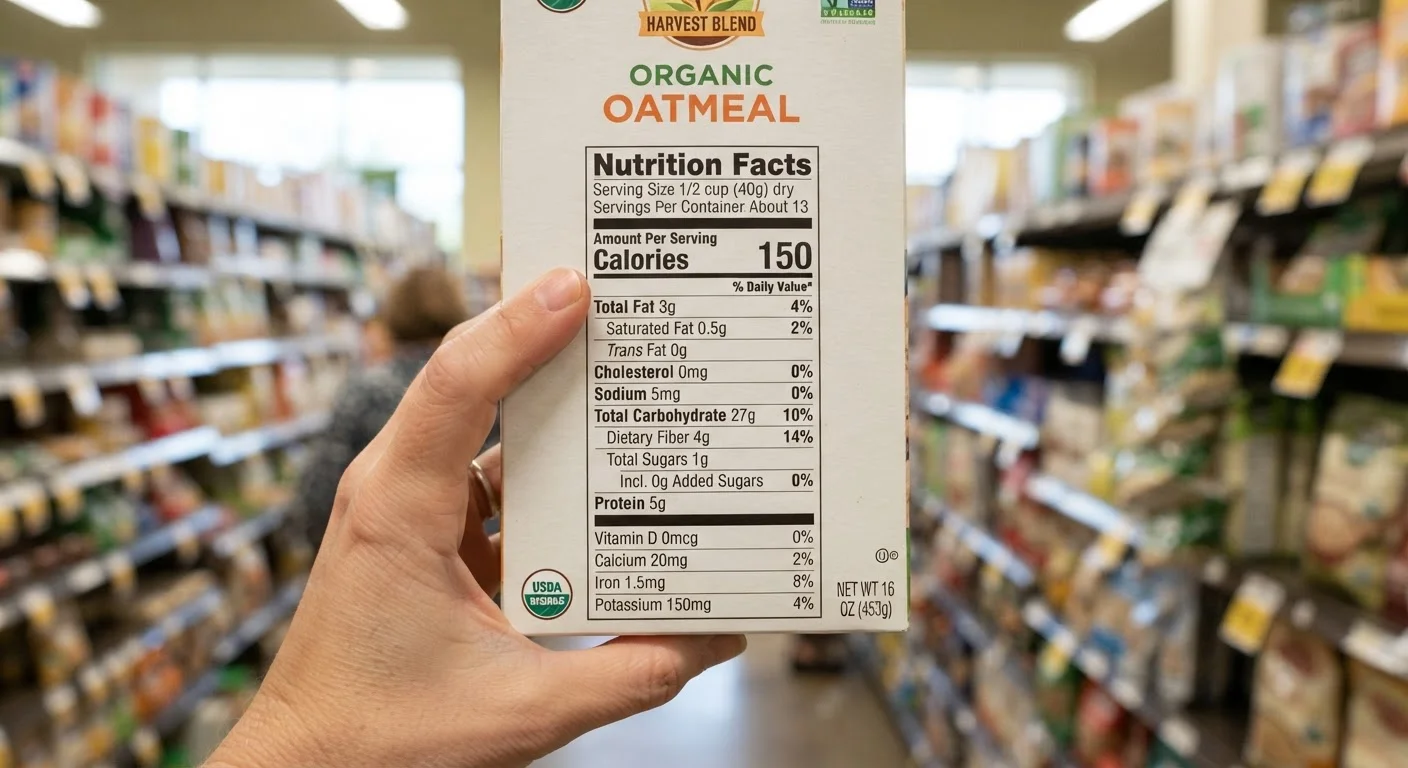
The Nutrition Facts panel is a standardized information block required by the U.S. Food and Drug Administration (FDA) on most packaged foods. Its purpose is straightforward: give consumers a consistent, comparable snapshot of what's in a product. Before this kind of mandatory labeling existed, shoppers had little reliable way to evaluate nutritional content across brands or products.
Understanding the label doesn't require a nutrition degree. It does require knowing what each section is actually measuring - and recognizing how easy it is to misread numbers without that context. This guide covers the label top to bottom so every row makes sense. For a broader foundation on how nutrients function in the body, see the Nutrition Basics hub.
Serving Size: The Number That Changes Everything
The serving size sits at the very top of the panel and controls every figure that follows. All calories, all nutrient amounts, all percentages - every number on the label refers to one serving, not the full package.
This is where many readers go wrong. A bag of crackers might list 140 calories per serving, but if the bag contains four servings and you eat half of it, you've consumed 280 calories. The FDA requires serving sizes to reflect amounts people realistically eat in one sitting (called RACC), so they're grounded in consumption data rather than arbitrary small portions.
Always check the servings per container alongside the serving size. If those two numbers are the foundation of everything below, reading the rest of the label starts to click into place. For a practical application of this principle while shopping, see evaluating a snack food before committing to the full bag.
Compare Labels Side by Side
When choosing between two similar products, make sure you're comparing the same serving size. Manufacturers use different serving amounts, so a lower number per serving doesn't always mean the product is lighter overall. Check servings per container alongside the per-serving figures.
Calories, Macronutrients, and What They Mean
Just below serving size, the calorie count appears in large, bold type - a deliberate design choice from the FDA's label update. Calories measure the energy provided by one serving. They come entirely from the three macronutrients: fat (9 calories per gram), carbohydrates (4 calories per gram), and protein (4 calories per gram).
The label breaks down each macronutrient in grams:
- Total Fat - subdivided into saturated fat and trans fat. Saturated fat has an associated %DV; trans fat does not because there is no established safe daily amount.
- Total Carbohydrate - broken down into dietary fiber and total sugars, with added sugars listed as a further sub-line.
- Protein - listed in grams with no %DV in most cases (the FDA does not require it unless a protein claim is made).
Understanding how calories relate to macronutrient grams helps you see whether a food is calorie-dense from fat, carbohydrates, or a mix. For a deeper look at why calorie count alone doesn't tell the whole story, see calories vs. nutrient density.
Serving Size
The standardized amount the FDA uses as a reference for all numbers on the label. It reflects how much people typically eat at one time, not necessarily a recommended portion.
Percent Daily Value (%DV)
A percentage showing how much one serving of a food contributes to a full day's intake of a given nutrient, based on a 2,000-calorie diet.
Added Sugars
Sugars and syrups added to foods during processing or preparation, as opposed to sugars that occur naturally in ingredients like fruit or milk.
Macronutrients
The three main energy-providing nutrients in food: carbohydrates, protein, and fat. All calorie counts on a label come from these three sources.
Saturated Fat
A type of fat found mainly in animal products and some plant oils. Dietary guidelines generally recommend keeping saturated fat intake moderate.
Daily Value (DV)
The reference amount of a nutrient established by the FDA for use on food labels. It represents an approximate daily target based on a 2,000-calorie diet.
Percent Daily Value: A Reference, Not a Rule
The right-hand column of the label shows Percent Daily Value (%DV) for most listed nutrients. This figure tells you how much one serving contributes to a full day's intake, based on a 2,000-calorie diet. A quick benchmark the FDA provides: 5% DV or less is low for a nutrient; 20% DV or more is high.
Use %DV to compare products and to gauge whether a food is a strong or weak source of a particular nutrient - not as a personal prescription. A 2,000-calorie baseline is a population-level reference. Your individual needs may differ based on age, size, activity level, and health status. A registered dietitian is the appropriate resource for personal dietary guidance.
Label Format Was Updated in 2020
The FDA updated the Nutrition Facts label format with a phased rollout that was largely complete by 2021 for larger manufacturers. Key changes included a larger calorie display, a new 'added sugars' line, and updated Daily Values for several nutrients. Older inventory may still carry the previous format.
Micronutrients and Added Sugars
The lower portion of the label lists key micronutrients: vitamin D, calcium, iron, and potassium. These appear because surveys have identified them as nutrients Americans commonly fall short on. The FDA requires their disclosure precisely because they're worth seeking out rather than limiting.
Added sugars deserve particular attention. Unlike the older label format, the current version requires manufacturers to distinguish between total sugars and added sugars. A plain yogurt might show 12 grams of total sugars - all from naturally occurring lactose - with 0 grams added. A flavored version of the same product might show 22 grams total with 10 grams added. That line reveals what the manufacturer put in, separate from what's naturally there.
For context on the vitamins and minerals tracked here, micronutrients at a glance provides a useful reference on their functions and food sources.
Don't Rely on the Front Panel Alone
Claims on the front of packaging - 'low fat,' 'natural,' 'multigrain' - are marketing language and not regulated in the same way as the Nutrition Facts panel. A product labeled 'low fat' can still be high in added sugars or sodium. Always flip to the back and read the actual label.
Putting It All Together at the Store
Reading a nutrition label in real time doesn't mean scrutinizing every row. In practice, a quick scan covers the most ground: check the serving size first, note calories and the number of servings, then look at saturated fat, sodium, and added sugars - nutrients most dietary guidelines suggest limiting - before glancing at fiber and the micronutrient section.
The Nutrition Facts panel works alongside the ingredient list, not instead of it. A food can have modest sodium per serving but list salt high up in the ingredients, signaling it's a significant component. Neither source alone tells the complete story. For more on making sense of date labels and other packaging information, the article on Best By, Use By, and Sell By dates covers the rest of the package. And for a more critical look at how food research is reported, translating nutrition research helps put label claims in broader scientific context.
This article is for general informational and educational purposes only and is not a substitute for advice from a registered dietitian or qualified healthcare professional. Individual nutritional needs vary; consult a professional for personalized guidance.
Frequently Asked Questions
Total sugars include all sugars in a food - those naturally present (like in fruit or dairy) plus any sugars added during processing. Added sugars appear as a sub-line and reflect sweeteners introduced by the manufacturer. The distinction matters because added sugars offer calories without additional nutritional value.
Percent Daily Value (%DV) is based on a 2,000-calorie daily diet and shows how much a nutrient in one serving contributes to daily intake. A general rule: 5% or less is considered low, 20% or more is considered high. Use it for comparison across products rather than as a precise personal target.
Labels report calories per serving, not per package. If a bag contains three servings and you eat the whole bag, you're consuming three times the listed calorie count. Always check the serving size and number of servings per container first.
The FDA requires Nutrition Facts panels on most packaged foods. Certain small businesses and products like plain coffee, tea, and some raw produce may be exempt, though many voluntarily include labeling. The current label format was updated by the FDA and phased in starting around 2020.
Focus on serving size first, then calories, saturated fat, sodium, and added sugars - nutrients most guidelines suggest limiting. Also glance at fiber, vitamin D, calcium, iron, and potassium, which many Americans fall short on. Context from the ingredient list rounds out the picture.
The content on this site is provided for informational purposes only and should not be considered a substitute for professional advice. While we strive to provide accurate and up-to-date information, we make no guarantees regarding its completeness or accuracy. Always consult a qualified professional for advice specific to your circumstances before making any decisions.