

Option A
Calorie Count
The energy-only measure of what food provides.
Best for: Tracking total energy intake as one factor in weight management or dietary planning.
Option B
Nutrient Density
The holistic measure of how much nutritional value a food delivers per calorie.
Best for: Evaluating the overall quality of food choices - vitamins, minerals, fiber, and protein relative to calories.
What a Calorie Actually Measures
A calorie is a unit of energy - specifically, the amount of heat needed to raise one kilogram of water by one degree Celsius. In nutrition, it represents the energy your body can extract from food. Proteins, carbohydrates, fats, and alcohol each yield a specific number of calories per gram, and that math is consistent regardless of the food source.
What a calorie does not measure is anything beyond energy yield: not vitamins, not minerals, not fiber, not phytonutrients, and not how a food behaves once it enters your digestive system. Two foods can contain an identical calorie count yet trigger entirely different hormonal responses, feed the gut microbiome differently, and vary dramatically in how long they keep you feeling full.
To learn how calorie information appears on packaging alongside other data, see how to read a nutrition label for a practical breakdown.
| Criterion | Calorie Count | Nutrient Density |
|---|---|---|
| What it measures | Energy yield only | Vitamins, minerals, fiber per calorie |
| Appears on food labels | Yes, consistently | Partially (via nutrient panel) |
| Satiety guidance | Limited - energy only | Strong - fiber and protein signal fullness |
| Chronic disease relevance | Indirect (via weight management) | Direct - micronutrients and fiber linked to reduced risk |
| Ease of tracking | High - widely standardized | Moderate - requires label literacy |
| Accounts for food quality | No | Yes |
| Best used for | Energy balance awareness | Overall diet quality evaluation |
Nutrient Density: Getting More From Every Bite
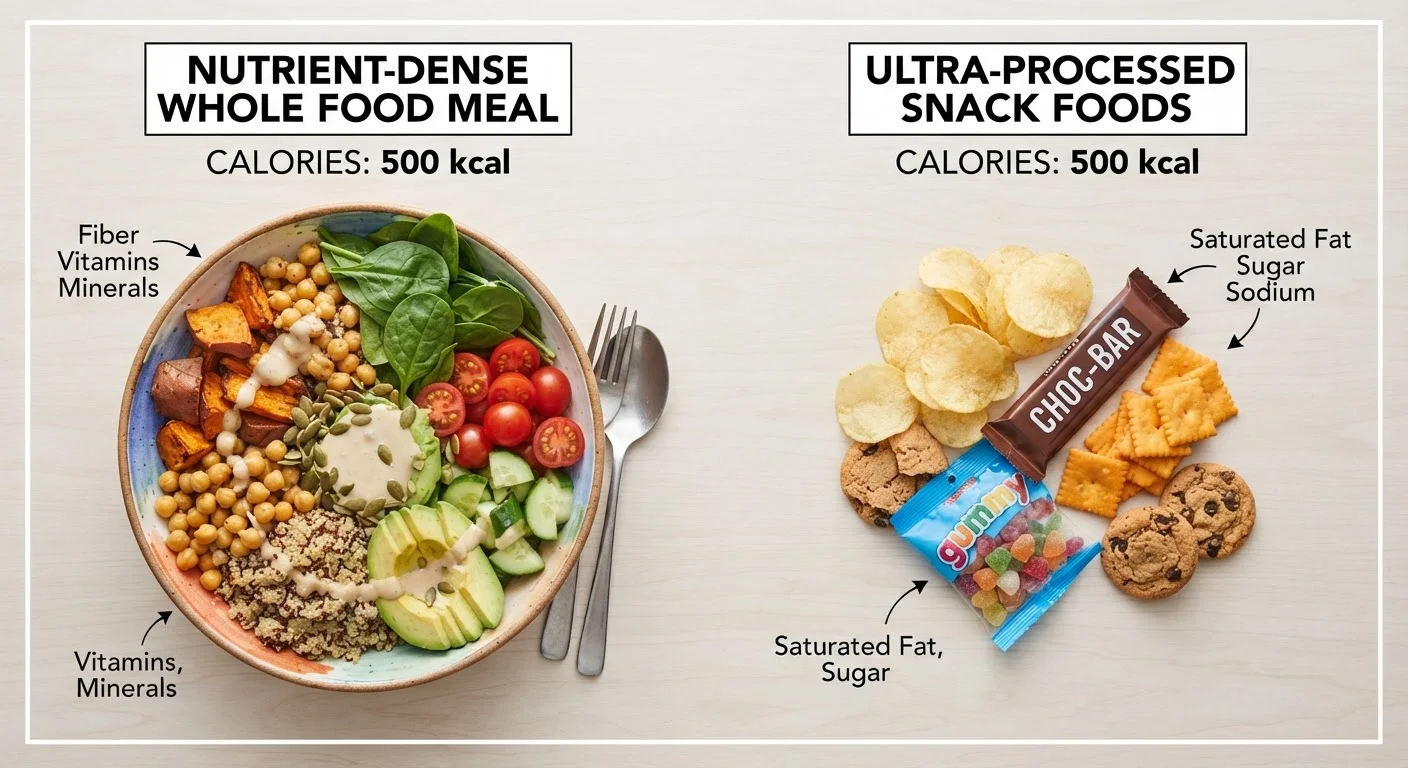
Nutrient density describes how much nutritional value - vitamins, minerals, fiber, protein, and beneficial plant compounds - a food provides relative to its calorie content. A cup of cooked lentils and a small chocolate-frosted doughnut can land near the same calorie total, yet lentils deliver substantial protein, iron, folate, and dietary fiber, while the doughnut contributes little beyond refined carbohydrates and saturated fat.
Dietary fiber is a particularly instructive example: it slows digestion, blunts blood sugar spikes, supports gut bacteria, and promotes satiety - none of which show up in a calorie count. Fiber is among the most overlooked nutrients in the average American diet, yet its effects extend well beyond digestive comfort.
95%
Americans falling short on daily fiber intake
Research published in the American Journal of Lifestyle Medicine estimates that approximately 95% of Americans do not meet recommended daily fiber intakes.
~500 kcal
Daily calorie gap between similar-volume meals
Studies comparing ad libitum intake of ultra-processed versus minimally processed diets have found participants consuming roughly 500 more calories per day on ultra-processed regimens, per a 2019 NIH clinical trial.
30%
Higher thermic effect of protein vs. fat
Protein has a thermic effect of approximately 20-30% of its calories, compared to 0-3% for fat and 5-10% for carbohydrates, according to established metabolic research.
Nutrient-dense eating patterns - such as those emphasizing vegetables, legumes, whole grains, lean proteins, and minimally processed foods - are consistently associated in research with lower rates of cardiovascular disease, type 2 diabetes, and certain cancers. This relationship holds even when total calorie intake is similar across groups.
Why the Source of Calories Matters
The idea that "a calorie is a calorie" holds in a strict thermodynamic sense but oversimplifies how the body actually processes food. The macronutrient composition of a meal influences insulin secretion, appetite-regulating hormones like leptin and ghrelin, and the rate at which nutrients enter the bloodstream. Protein, for instance, has a higher thermic effect than fat or carbohydrate - meaning the body expends more energy digesting it - and it tends to produce greater satiety per calorie.
Ultra-processed foods engineered for palatability are often calorie-dense and nutrient-sparse. They can be designed to override normal satiety cues, making overconsumption easier. Understanding the distinction between whole and ultra-processed foods helps clarify why food quality shapes dietary patterns in ways calorie labels cannot fully communicate.
This also applies when evaluating packaged convenience items. A product marketed as high-protein may still be loaded with added sugars or artificial additives. For a practical illustration, the analysis of what makes a protein bar nutritionally worthwhile shows how ingredient lists tell a more complete story than calorie counts alone.
Using Both Lenses Together
Calorie awareness and nutrient density are not competing frameworks - they address different questions. Calorie information answers "how much energy does this food provide?" while nutrient density answers "what else does this food contribute?" Using both together gives a far more accurate picture of dietary quality than either alone.
A practical approach: use calorie information as a general reference for portion awareness, while prioritizing foods that deliver meaningful nutrients alongside that energy. Foods that score well on both - such as eggs, salmon, leafy greens, legumes, and whole grains - tend to support satiety and metabolic health simultaneously.
Calorie Needs Vary Significantly by Individual
Age, sex, body composition, activity level, and metabolic health all influence how many calories a person needs and how efficiently those calories are used. There is no universal calorie target that applies to everyone. Nutrition information presented here is general and educational - individual requirements are best assessed with a registered dietitian or physician.
For anyone navigating a specific health condition, managing a chronic illness, or considering significant dietary changes, consulting a registered dietitian or qualified healthcare professional is strongly recommended. General nutrition education like this article is a starting point, not a substitute for personalized guidance.
This article is for general informational purposes only and does not constitute medical or dietary advice. Consult a qualified healthcare professional before making significant changes to your diet, especially if you have an existing health condition.
The content on this site is provided for informational purposes only and should not be considered a substitute for professional advice. While we strive to provide accurate and up-to-date information, we make no guarantees regarding its completeness or accuracy. Always consult a qualified professional for advice specific to your circumstances before making any decisions.