

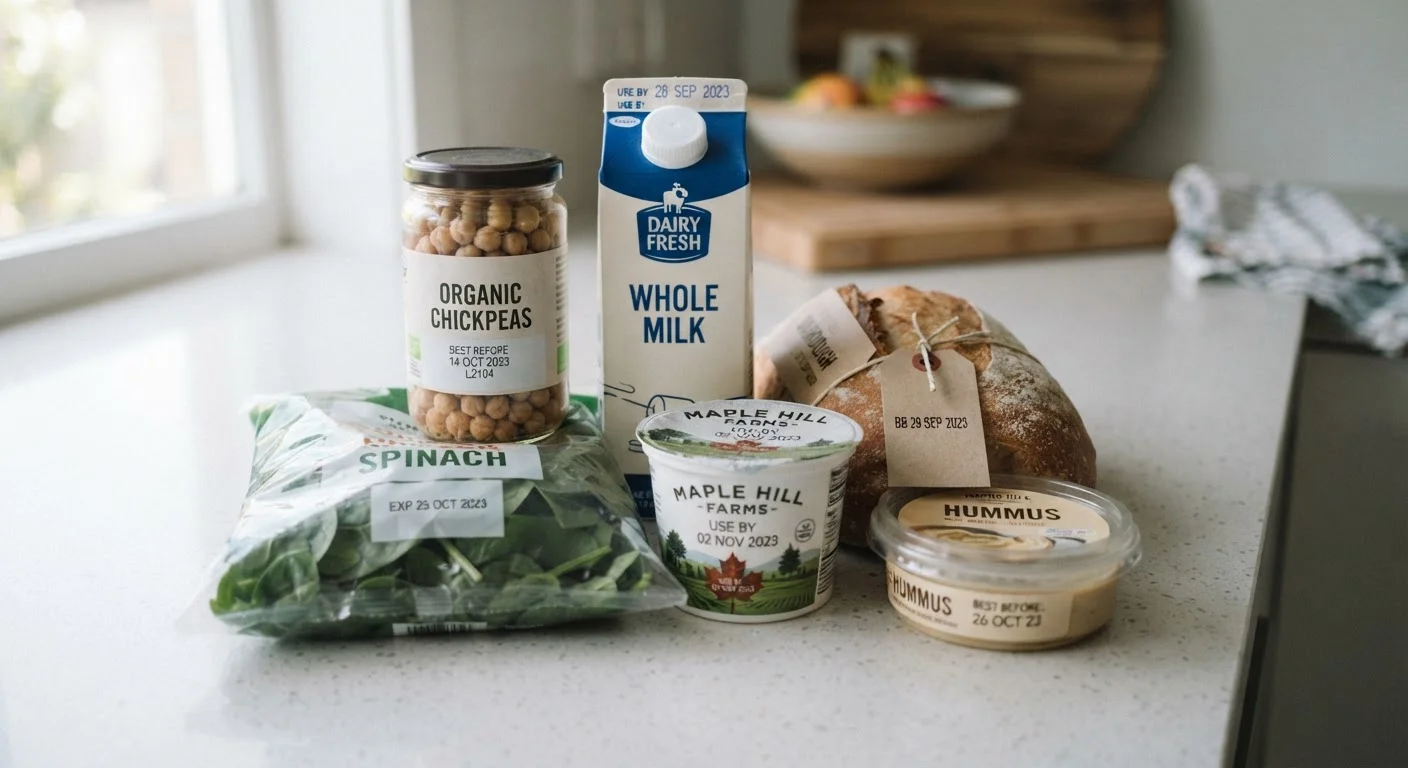
Why Date Labels Confuse Shoppers
Walk through any grocery store and you'll find food packaging stamped with a rotating cast of phrases: "Best By," "Use By," "Sell By," "Best If Used By," "Enjoy By." Despite how official these labels look, the United States has no single federal standard governing what most of them mean or how manufacturers must apply them - with one significant exception.
The result is widespread confusion. Surveys conducted by the Natural Resources Defense Council and Harvard Food Law and Policy Clinic have found that a large majority of American consumers throw out food they believe has "expired," when in many cases those dates are quality indicators, not safety cutoffs. Understanding the distinction can reduce unnecessary waste while also helping you recognize the cases where a date genuinely matters.
Food packaging can feel just as layered as reading a nutrition facts panel - but once you know how the system is structured, it becomes much easier to interpret at a glance.
What Each Label Actually Means
Best By / Best If Used By
This is a manufacturer's quality estimate. It indicates when the product is expected to be at its peak flavor, texture, or appearance - not when it becomes unsafe to eat. A box of crackers past its "Best By" date may be slightly stale, but it is not necessarily harmful. The USDA explicitly notes that "Best By" dates are not safety dates.
Sell By
This label is primarily directed at retailers, not consumers. It tells a store how long to display the product for sale, leaving a reasonable buffer for home storage afterward. Milk labeled "Sell By" a week from now, for instance, is typically still safe to consume for several days past that date if stored correctly. Throwing food away on the sell-by date is almost always premature.
Use By
This is the one label that functions as an actual safety signal - at least for certain products. The FDA requires "Use By" dates on infant formula, treating them as safety cutoffs rather than quality estimates. For most other foods, manufacturers apply "Use By" voluntarily, and its interpretation varies. When you see it on ready-to-eat deli products or refrigerated items, treat it with more caution than a "Best By" label. When in doubt, apply the smell, texture, and appearance test alongside the date.
Best By
A manufacturer's estimate of when a product will be at its best quality in terms of flavor or texture. It is not a safety date, and food past this date is not automatically unsafe to eat.
Sell By
A date printed for retailer use, indicating how long a product should remain on store shelves. Consumers typically have additional storage time after this date.
Use By
The date by which a manufacturer recommends consuming a product. For infant formula, this is a federally mandated safety date; for other products, it is applied voluntarily and interpretation varies.
Freeze By
An advisory date indicating when a product should be moved to the freezer to preserve its quality. It is not an indication that the product has already spoiled.
Shelf-stable
A category of food that can be safely stored at room temperature without refrigeration until opened, typically including canned goods, dried pasta, and certain packaged snacks.
Freeze By
Less common but increasingly used, "Freeze By" tells consumers the date by which a product should be frozen to maintain quality. It is a proactive label, not a warning that the product has already deteriorated.
When to Trust the Date - and When Not To
Date labels are calibrated under ideal storage conditions. A gallon of milk "Best By" next Tuesday may spoil sooner if your refrigerator runs warm or the container was left open. Conversely, many shelf-stable products - dried pasta, canned goods, honey - remain safe well beyond any printed date when stored properly.
The USDA maintains specific food safety guidance for individual categories. Their general rule: when a product shows signs of spoilage - off odors, visible mold, unusual texture - discard it regardless of what the label says. Conversely, a product within date but showing those signs should also be discarded.
Understanding what's actually in a food product helps too. Regulated label terms like "organic" carry legal definitions, but date labels largely do not - which is why your own sensory assessment remains a critical tool. For a broader look at how ingredient composition affects shelf life and overall food quality, see our guide on whole foods vs. ultra-processed foods.
The content on this site is provided for informational purposes only and should not be considered a substitute for professional advice. While we strive to provide accurate and up-to-date information, we make no guarantees regarding its completeness or accuracy. Always consult a qualified professional for advice specific to your circumstances before making any decisions.