

Start here
Start With the Right Grip
Next
The Guiding Hand: Your Other Job at the Board
Build on it
The Core Cuts Every Cook Uses
Refine your technique
Blade Angle and Motion: Making Cuts Work
Put it all together
Setting Up for Success Before You Cut
Start With the Right Grip
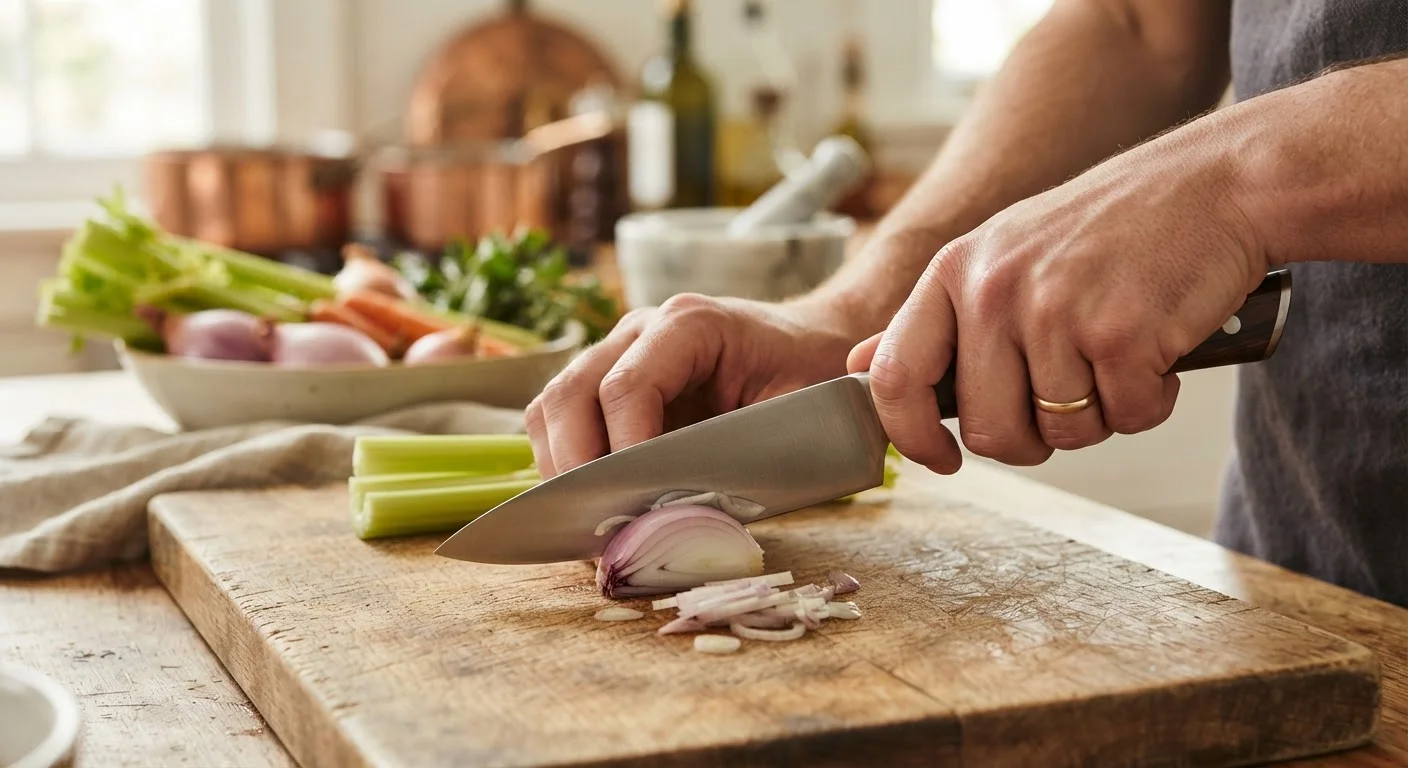
Most knife injuries and most inconsistent cuts share a common root: an insecure grip. Before anything else, learn the pinch grip - the standard hold used in professional kitchens because it works.
Pinch the blade itself between the pad of your thumb and the side of your bent index finger, just ahead of where the blade meets the handle (the bolster). Your middle, ring, and pinky fingers wrap naturally around the handle. This may feel counterintuitive - you're touching the blade - but a sharp knife gripped this way is far safer than a poorly controlled one held by the handle alone.
The pinch grip lowers your hand's center of control closer to the cutting edge, reduces lateral wobble, and allows wrist rotation to guide the blade precisely. For more on what a chef's knife is actually designed to do, see what a chef's knife actually does.
Pinch grip
A way of holding a knife where you pinch the blade itself between thumb and index finger, just forward of the handle, giving you better control and less wobble.
Claw grip
A hand position for the non-knife hand where fingertips curl under so knuckles face the blade, protecting fingers while guiding each cut.
Bolster
The thick band of metal between the blade and the handle on a chef's knife, which adds balance and provides a natural stopping point for the pinch grip.
Dice
A knife cut that produces small, uniform cubes from an ingredient - important because uniformly sized pieces cook at the same rate.
Chiffonade
A cutting technique where herbs or leafy greens are stacked, rolled, and sliced into thin ribbons.
Honing
The process of realigning a knife's edge using a honing rod - not the same as sharpening, which removes metal to create a new edge.
The Guiding Hand: Your Other Job at the Board
While your knife hand cuts, your guiding hand does two things simultaneously: it holds the ingredient steady and tells the knife where to go next. The technique is the claw grip.
Curl your fingertips under so that only your knuckles face outward toward the blade. The flat side of the blade then rests lightly against your knuckles as you work through the ingredient, and you advance the claw backward with each cut to control slice thickness. This eliminates the risk of the blade reaching your fingertips.
Practice this on a carrot or a potato where resistance gives you time to think. Once the claw becomes automatic, your cutting speed will naturally increase because hesitation - the real source of many cuts - disappears.
Practice the Claw on Low-Stakes Ingredients First
Build the claw grip habit using dense, forgiving vegetables like carrots, potatoes, or zucchini before moving to delicate or awkward-shaped produce. The resistance of a firm vegetable slows your motion naturally, giving you time to check your finger position with each cut. Once the claw is automatic, speed takes care of itself.
The Core Cuts Every Cook Uses
You don't need to master French brigade knife work to cook well at home. These three cuts cover the vast majority of everyday prep:
- Slice: A single, clean cut through an ingredient, producing rounds, half-moons, or planks. Used for onions, cucumbers, citrus, and more. Thickness consistency is the goal.
- Dice: A series of organized cuts that produce uniform cubes - large (3/4 inch), medium (1/2 inch), or small (1/4 inch). Start by squaring the ingredient, cut planks, then sticks, then cross-cut into cubes. Uniformity matters because irregular pieces cook at different rates.
- Chiffonade: Stack leafy herbs or greens, roll them tightly, and slice across the roll into thin ribbons. Used for basil, mint, and leafy greens. Delivers even distribution and an attractive presentation.
A useful fourth skill: mince. After a rough chop, rock the blade over the pile with the tip anchored to the board until you reach the fine texture you want. Standard for garlic and fresh herbs.
Blade Angle and Motion: Making Cuts Work
The same knife can perform very differently depending on how you move it. Two techniques dominate home cooking:
- Rock chop
- The tip of the blade stays in contact with the board while the heel rises and falls in an arc. Efficient for herbs and aromatics where speed matters more than precision.
- Push cut
- The blade moves forward and slightly downward in a single motion, slicing cleanly through the ingredient. Better for proteins, dense vegetables, and any task requiring control over thickness.
Avoid the pure guillotine - straight down, no forward motion - as it compresses rather than slices and accelerates edge wear. A dull blade is both less effective and less safe, because you compensate with force. Good cutting habits and proper maintenance work together; keeping knives sharp is a natural follow-on to learning technique. If you're noticing rapid dulling, why knives dull quickly covers the common culprits.
Setting Up for Success Before You Cut
Technique applied to a poorly set-up workspace produces inconsistent results. Three things matter before the first cut:
- Stabilize the board. A board that slides is a hazard. Place a damp kitchen towel or non-slip mat underneath it. Choose a board large enough that ingredients don't crowd the edges. The right cutting board material also affects both knife preservation and hygiene.
- Create a flat surface on round ingredients. Slice a thin piece off one side of any round vegetable - onions, potatoes, beets - before cutting further. A flat face on the board eliminates rolling and makes every subsequent cut safer and more accurate.
- Organize before you begin. Know what you're cutting and in what order. This connects directly to the prep discipline covered in mise en place for home cooks: when your workspace is organized, your hands can focus on technique rather than logistics.
Good knife skills compound. Each session where you practice the pinch grip, hold the claw, and move the blade correctly makes the next session faster and more confident. Start with one cut type per session rather than trying to learn everything at once - deliberate, focused repetition builds lasting muscle memory.
Frequently Asked Questions
Use the pinch grip: hold the blade itself between your thumb and the side of your index finger, just forward of the bolster, with your remaining fingers wrapped around the handle. This lowers the center of gravity and gives you precise directional control. It feels awkward at first but becomes natural within a few practice sessions.
Form a 'claw' with your guiding hand - curl your fingertips under so your knuckles face the blade. The flat side of the blade rides against your knuckles as you cut, keeping your fingertips safely out of the path. Never lay your fingers flat on the ingredient.
A dice produces uniform cubes of a specific size (large, medium, or small) and is used when even cooking matters. A mince produces very finely chopped pieces with no strict size requirement - common for garlic, herbs, and aromatics where texture is less critical than flavor distribution.
Yes. Cutting straight down (guillotine style) crushes soft ingredients and dulls blades faster. A slight forward or rocking motion lets the blade's curve do the work, producing cleaner cuts with less effort. The right angle also reduces the force needed, which improves both safety and consistency.
End-grain wood and edge-grain wood boards are generally regarded as the most knife-friendly surfaces because the fibers compress rather than abrade the blade. Hard materials like glass, ceramic, and stone accelerate dulling and should be avoided as cutting surfaces.
Frequency depends on how often you cook and what you cut, but a general guideline is honing with a honing steel before each session and full sharpening a few times a year. A knife that slides off a tomato skin rather than gliding through it needs attention sooner.
The content on this site is provided for informational purposes only and should not be considered a substitute for professional advice. While we strive to provide accurate and up-to-date information, we make no guarantees regarding its completeness or accuracy. Always consult a qualified professional for advice specific to your circumstances before making any decisions.