

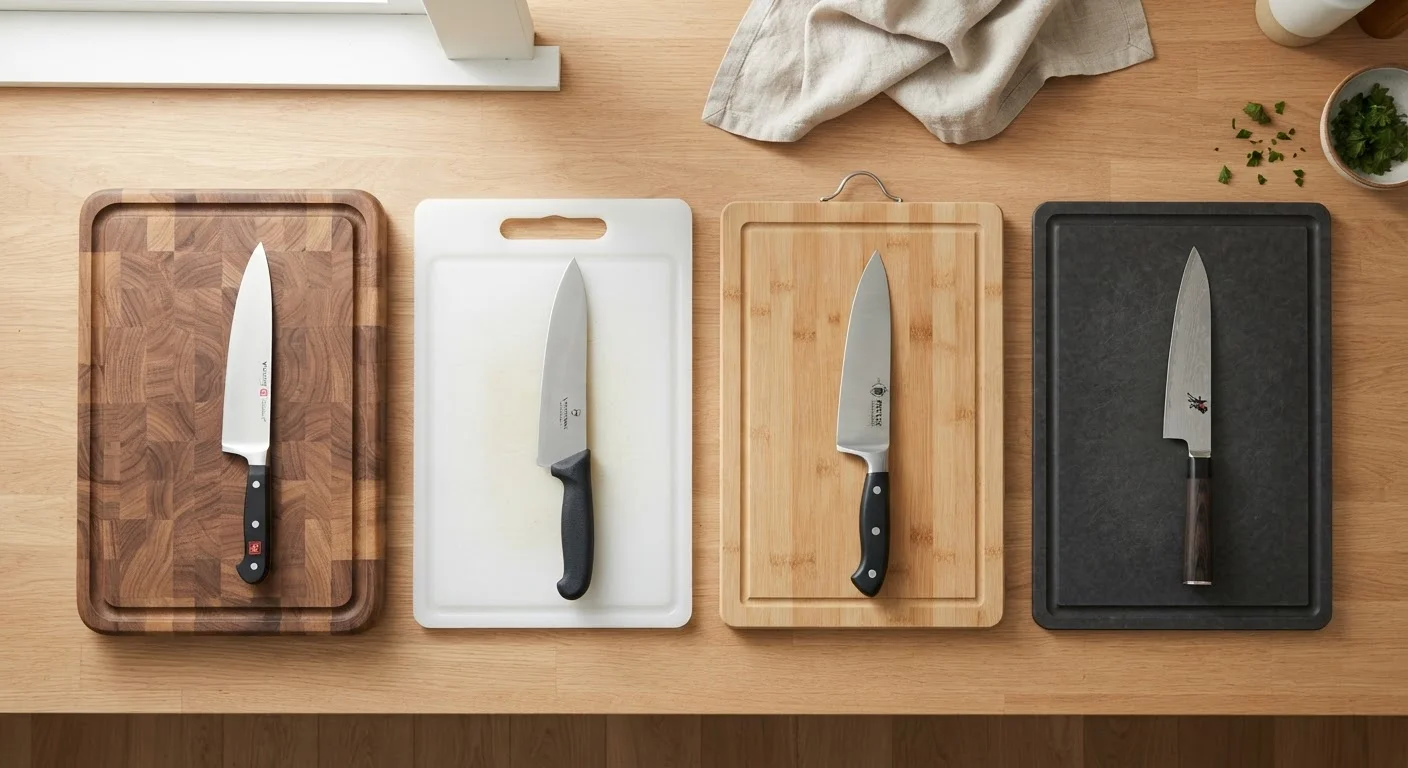
Our Verdict
Wood remains a strong all-around choice for cooks who don't mind hand-washing and want to protect their blades. Plastic suits high-volume raw-meat prep where frequent dishwasher sanitizing matters most. Bamboo works best for light duty when sustainability is a priority. Composite boards are worth considering for cooks who want dishwasher convenience without sacrificing knife longevity.
| Best for | Recommended |
|---|---|
| Everyday chopping with knife preservation as a priority | Wood |
| Raw meat prep requiring frequent machine sanitizing | Plastic |
| Light prep work with an eco-conscious preference | Bamboo |
| Cooks wanting dishwasher-safe boards that won't wreck blades | Composite |
Why Cutting Board Material Actually Matters
A cutting board isn't a passive surface - it actively affects your knives, your food safety routine, and how much maintenance your kitchen demands. The material determines how well a board absorbs impact, how easily bacteria take hold, and whether daily cleaning strips the board's integrity over time. Understanding these trade-offs before you buy prevents the frustration of choosing a board that conflicts with how you actually cook. Pair your board choice with sound knife technique and you'll get noticeably better results from both.
Wood: The Classic Choice With Real Maintenance Demands
End-grain and edge-grain hardwood boards - typically maple, walnut, or cherry - are widely regarded as among the most knife-friendly surfaces available. The wood fibers flex slightly under a blade, reducing micro-damage to the cutting edge compared to harder materials. End-grain boards, where the knife cuts into the face of the fibers rather than across them, offer the most forgiving surface of all.
The trade-off is care. Wood boards must be hand-washed and dried promptly; soaking or dishwasher cycles cause warping and cracking. They also need periodic conditioning with food-safe mineral oil to prevent the wood from drying out and splitting. Properly maintained, a quality hardwood board can last decades. Neglected, it deteriorates quickly. For anyone committed to preserving their knife edges, wood boards are difficult to beat.
Conditioning a Wood Board the Right Way
Apply food-safe mineral oil to a clean, dry wood board using a cloth, coating all surfaces including the sides and bottom. Let it absorb for several hours or overnight, then wipe away any excess. Repeat this process monthly for a new board, then quarterly once the wood is well-seasoned. Avoid vegetable or olive oils, which can turn rancid inside the wood over time.
Plastic: Convenient but Not Indefinitely Hygienic
Plastic boards - typically high-density polyethylene (HDPE) - are ubiquitous in professional kitchens because they're inexpensive, lightweight, and dishwasher-safe. The ability to machine-sanitize them makes plastic appealing for raw poultry or meat prep, where cross-contamination risk is highest.
The limitation that often goes unmentioned: plastic boards develop knife scars over time, and those grooves are difficult to clean thoroughly even in a dishwasher. Research has found that deeply scored plastic boards can harbor bacteria in ways that a relatively smooth surface doesn't. The practical solution is to replace plastic boards regularly once they show significant scarring - treating them as consumables rather than permanent tools. Thicker HDPE boards resist scarring longer and are worth the modest additional cost.
| Wood | Plastic | Bamboo | Composite | |
|---|---|---|---|---|
| Knife-friendliness | Excellent | Moderate | Poor (too hard) | Good |
| Dishwasher-safe | No | Yes | No | Yes (most) |
| Hygiene maintenance | Good with care | Degrades with scarring | Good with care | Good |
| Durability | Very high | Low-moderate | Moderate | High |
| Maintenance required | Oiling needed | Replace when scarred | Occasional oiling | Minimal |
| Relative cost | Moderate-high | Low | Low-moderate | Moderate-high |
Bamboo: Eco-Friendly With a Hardness Caveat
Bamboo is technically a grass, not a wood, but it's processed into dense boards that superficially resemble wood cutting surfaces. Its environmental profile is appealing - bamboo grows rapidly and requires fewer resources than most hardwoods. However, bamboo is considerably harder than typical cutting board woods like maple, which means it's less forgiving on knife edges. Cooks who use quality knives and care about edge retention may find bamboo accelerates the need for sharpening.
Bamboo boards also tend to be less moisture-resistant than hardwood and can split along glue lines if not dried properly after washing. They're best suited to light prep tasks - slicing bread, cutting fruit, chopping vegetables - rather than heavy daily use. Like wood, they require hand-washing and occasional oiling.
Composite: The Case for a Newer Material
Composite boards - made from compressed wood fibers or resin-impregnated paper - occupy a practical middle ground. They're harder than standard wood but gentler on blades than bamboo or plastic, and most are dishwasher-safe, which wood and bamboo are not. They resist moisture absorption better than solid wood and don't warp as readily.
The main drawback is cost: quality composite boards tend to be priced higher than plastic and comparable to or above mid-range wood boards. They're also heavier, which some cooks find inconvenient. For households that want machine-washable convenience without the blade-dulling properties of plastic or bamboo, composite is a genuinely useful option worth considering.
2-3×
Lifespan advantage of hardwood over budget plastic
Consumer and culinary testing consistently shows properly maintained hardwood boards outlast inexpensive plastic boards by a significant margin under regular use.
~1 year
Recommended replacement interval for heavily scored plastic boards
Food safety guidance generally suggests replacing plastic cutting boards once deep knife grooves make thorough cleaning unreliable, which varies by usage intensity.
Matching the Right Board to Your Kitchen Habits
No single cutting board material is universally ideal. Consider your actual cleaning habits first: if you hand-wash consistently and are willing to oil a board every few months, wood delivers the best combination of knife preservation and longevity. If your prep regularly involves raw proteins and you rely on a dishwasher for sanitation, plastic or composite is more practical. If sustainability is a guiding factor and your prep is light, bamboo earns its place - just understand its hardness limitations.
Many experienced home cooks keep more than one board type on hand, dedicating a plastic or composite board to raw meat and fish while reserving a quality hardwood board for produce and bread. This separation is a sound food safety practice regardless of which materials you choose.
The content on this site is provided for informational purposes only and should not be considered a substitute for professional advice. While we strive to provide accurate and up-to-date information, we make no guarantees regarding its completeness or accuracy. Always consult a qualified professional for advice specific to your circumstances before making any decisions.