

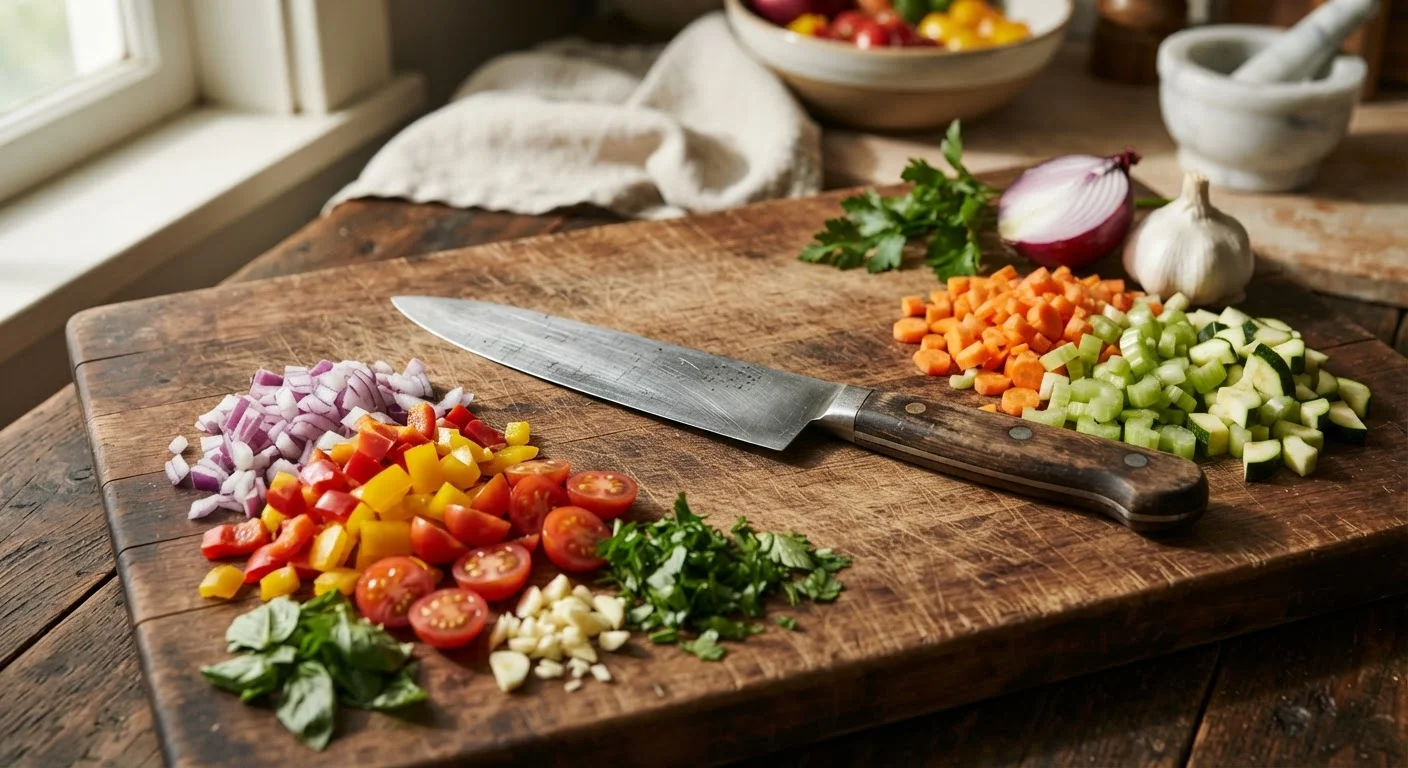
What a Chef's Knife Is Actually Built to Do
The chef's knife earns its reputation through breadth, not depth. Its curved blade and pointed tip are engineered for one primary motion: a rocking chop that keeps the tip on the board while the heel rises and falls. This lets a cook move fluidly from rough-chopping onions to finely mincing garlic to slicing a chicken breast - all without switching tools.
Specifically, a chef's knife performs reliably on:
- Vegetables and aromatics - dicing carrots, slicing cabbage, mincing shallots
- Boneless and semi-boneless proteins - slicing raw chicken, portioning fish fillets, trimming beef
- Fresh herbs - chiffonading basil, roughly chopping parsley
- Soft to medium-hard fruit - halving avocados, slicing apples, cubing melon
The blade's weight and length also make it practical for tasks like smashing garlic cloves with the flat of the blade - a move a paring knife or fillet knife simply couldn't handle safely.
8-10 in
Typical chef's knife blade length
Eight inches is the most common choice among home cooks; professional kitchens often favor ten-inch blades for higher-volume prep work.
~80%
Kitchen prep tasks a chef's knife can handle
Culinary educators commonly estimate that a single well-maintained chef's knife is adequate for the large majority of everyday home cooking prep tasks.
3 knives
Minimum set covering nearly all home cooking needs
Most culinary professionals agree a chef's knife, paring knife, and serrated bread knife together address virtually every routine home kitchen cutting task.
Where the Chef's Knife Falls Short
Understanding a chef's knife's limitations is just as useful as knowing its strengths. The blade is too large and stiff for fine detail work - peeling a kiwi, segmenting citrus, or trimming fat from a small cut of meat are all better handled by a shorter, more flexible paring knife.
Tasks that will damage the blade - or create safety risks - include:
- Cutting through frozen food: The edge is not built to withstand the impact. Even a quality blade can chip or crack on a frozen block.
- Splitting or hacking through bone: A cleaver or butcher's knife is designed for this. A chef's knife is not.
- Slicing bread or tomatoes: The straight or slightly curved edge compresses these foods rather than cutting cleanly. A serrated blade is the right tool here.
- Peeling small, round produce: Maneuvering an 8-inch knife around a shallot or potato eye is awkward and imprecise by design.
Many cooks use a chef's knife out of convenience when a more appropriate tool would deliver a better result with less effort. Knowing where that line falls is what separates functional knife skills from confident ones.
Test Your Knife's Edge Before Each Session
A quick way to check sharpness: hold a sheet of printer paper at the top edge and draw the blade through it. A sharp knife cuts cleanly with minimal resistance; a dull one tears or deflects. Running a honing rod before each use keeps the edge aligned between full sharpenings and adds up to a noticeable difference in daily performance.
Getting the Most From the Knife You Already Have
The single biggest performance factor for any chef's knife isn't price, brand, or size - it's sharpness. A well-maintained edge reduces the force required for every cut, which means less fatigue, more control, and a meaningfully lower risk of the knife slipping. For guidance on building a consistent maintenance routine, see our knife sharpening guide.
A few practical habits that extend the knife's useful range:
- Use a wooden or plastic cutting board. Glass, ceramic, and marble surfaces destroy edges quickly.
- Wash and dry by hand. Dishwashers expose blades to heat and abrasion that degrade the edge and the handle over time.
- Store properly. A knife block, magnetic strip, or blade guard protects the edge better than a crowded utensil drawer.
For cooks who want to expand what they can prepare beyond what hand tools alone allow, a small number of compact appliances can meaningfully extend kitchen capability - though a sharp, well-used chef's knife remains the foundation everything else builds on.
A home cook uses the same chef's knife to mince garlic, dice an onion, cube a butternut squash, and slice a raw chicken breast - all in one meal prep session.
A cook attempts to slice a crusty sourdough loaf with a chef's knife and ends up crushing the bread rather than cutting through it cleanly.
Someone tries to hack through a chicken carcass with a chef's knife and chips the blade on a vertebra.
A cook who switches from a dull 10-inch chef's knife to a freshly sharpened 8-inch blade finds prep work faster, easier, and noticeably safer.
Frequently Asked Questions
It can handle most everyday tasks, but it cannot fully replace a paring knife for fine detail work or a serrated knife for bread and tomatoes. For most home cooks, a chef's knife, a paring knife, and a serrated knife cover nearly every need.
An 8-inch blade is the most practical choice for the majority of home cooks. It offers enough length for large vegetables while remaining maneuverable on a standard cutting board. Cooks with smaller hands or limited counter space often find it easier to control than a 10-inch blade.
No - a chef's knife is not designed for bone work. Forcing it through joints or bones risks chipping the blade or causing the knife to slip dangerously. A cleaver or kitchen shears are the appropriate tools for breaking down bone.
Sharpening frequency depends on use, but a knife used daily typically benefits from honing before each session and full sharpening several times per year. Regular honing on a honing rod realigns the edge between sharpenings and significantly extends performance.
Not necessarily - weight preference is personal and task-dependent. Heavier German-style blades can power through dense vegetables, while lighter Japanese-style knives offer more precision and speed. Neither is objectively superior; handling a knife before buying is the most reliable way to assess fit.
The content on this site is provided for informational purposes only and should not be considered a substitute for professional advice. While we strive to provide accurate and up-to-date information, we make no guarantees regarding its completeness or accuracy. Always consult a qualified professional for advice specific to your circumstances before making any decisions.