

Summary
28 items · 30-60 minutes per seasonal review
Why a Seasonal Approach Makes Sense
Most vehicle problems don't appear without warning - they develop quietly through months of temperature swings, road grime, and accumulated mileage. The challenge is that everyday drivers rarely notice gradual wear until something actually fails. Structuring your checks around the four seasons gives you natural, recurring windows to catch issues early, before a worn wiper blade or low brake fluid becomes a roadside emergency.
This checklist is designed to complement - not replace - the service schedule in your owner's manual. If your vehicle is approaching higher mileage, certain items deserve extra attention; see our guide on keeping a high-mileage car roadworthy for what shifts after 100,000 miles. And if you're ever unsure whether a task is genuinely driver-friendly or calls for professional hands, our guide on DIY vs. mechanic boundaries draws a clear line.
Know Your DIY Limits
Visual inspections and fluid top-ups are generally driver-friendly tasks. However, brake system work, suspension inspection, and anything involving fuel or high-voltage systems in hybrid or electric vehicles should always be performed by a qualified mechanic. Attempting these without the right training or equipment can create safety hazards for you and other road users.
Tools You'll Need for a Thorough Check
You don't need a professional workshop to complete most of these inspections. A handful of inexpensive tools and a good light source will cover the majority of visual and basic functional checks. More involved work - brake pad measurement, fluid flushes, or anything involving electrical or fuel systems - should be handled by a qualified mechanic.
Tyre pressure gauge
Accurately measure tyre inflation across all four tyres and the spare.
Tread depth gauge
Measure remaining tyre tread to determine whether replacement is needed.
Torch or work light
Illuminate wheel wells, the undercarriage, and the engine bay for visual inspections.
Antifreeze test strips
Check coolant concentration to confirm freeze protection matches your climate.
Battery load tester
Assess whether the battery's cold-cranking capacity is sufficient for winter starting.
Microfibre cloths
Clean dipsticks and fluid reservoirs for accurate level and condition readings.
The Season-by-Season Checklist
Work through each group at the start of the relevant season. Many items take under a minute to eyeball; others require the vehicle to be cool and parked on a level surface. Where a check reveals a problem, note it immediately - a vehicle maintenance log is one of the simplest habits that pays long-term dividends.
For a deeper explanation of what each fluid reservoir does and what warning signs to look for, our fluid system guide covers every reservoir under the hood. And don't overlook the less obvious jobs - commonly skipped maintenance tasks like cabin air filters and serpentine belts rarely get attention until they cause a breakdown.
Spring (Post-Winter Recovery)
Summer (Heat and Long-Distance Readiness)
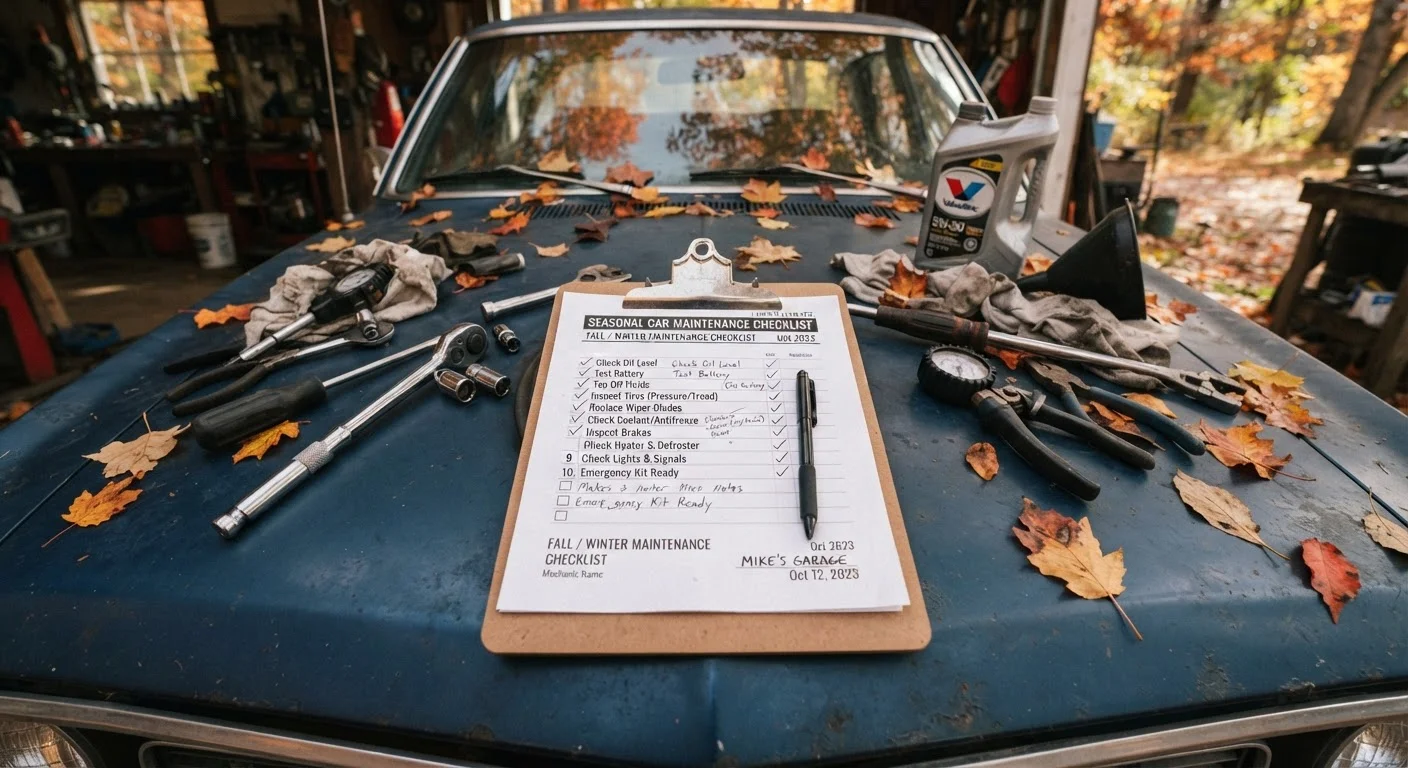
Autumn (Pre-Winter Preparation)
Winter (Ongoing Monitoring)
Year-Round Checks (Every 1-3 Months)
Brakes Are Never a 'Wait and See' Item
If you notice grinding, pulling to one side, a soft brake pedal, or a brake warning light, stop driving and have the system inspected by a professional immediately. Brake issues deteriorate rapidly and the consequences of failure are severe. Do not defer this inspection to your next scheduled service if symptoms appear before then.
Making This Checklist Part of Your Routine
Completing a checklist once is useful; completing it consistently is where the real value lies. Consider pairing each seasonal check with an existing habit - a daylight saving time change, a school-year start, or the first cold morning of autumn. These contextual cues make it far easier to remember without relying on calendar reminders alone.
Record every completed check, every fluid top-up, and every part replaced. Beyond peace of mind, a well-kept service history supports warranty claims, simplifies mechanic visits, and typically strengthens resale value. For a fuller picture of how maintenance schedules, costs, and trade-offs all fit together, our comprehensive car maintenance overview is worth bookmarking alongside this checklist.
The content on this site is provided for informational purposes only and should not be considered a substitute for professional advice. While we strive to provide accurate and up-to-date information, we make no guarantees regarding its completeness or accuracy. Always consult a qualified professional for advice specific to your circumstances before making any decisions.