

The Maintenance Tasks That Hide in Plain Sight
Oil changes and tire rotations get most of the attention - and most drivers at least have a rough sense of when those are due. But several other maintenance items sit quietly in the background, accumulating wear with no warning light, no obvious symptom, and no polite reminder from your car. Then, one day, something fails.
The tasks below aren't obscure. Most are listed right in your owner's manual. They simply don't demand attention the way a dead battery or a flat tire does - until, suddenly, they do. If you want to avoid that moment, it helps to know what to look for and roughly when to address it. For anything that crosses into more complex territory, knowing where the DIY line is before you start is just as important as the task itself.
Cabin Air Filter
The cabin air filter cleans the air coming through your heating and air conditioning system before it reaches the passenger compartment. A clogged filter doesn't typically trigger a warning light - it just quietly reduces airflow, strains the blower motor, and degrades the air quality inside the car.
Most manufacturers suggest replacing it somewhere between 15,000 and 25,000 miles, though this varies depending on your driving environment. If you spend a lot of time on dusty roads or in heavy stop-and-go traffic, you may need to replace it more frequently. Checking the filter visually at each oil change takes only a moment and can tell you a lot.
A clogged cabin air filter strains your blower motor long before you notice reduced airflow.
Coolant Flush
Engine coolant (sometimes called antifreeze) does more than prevent freezing. It also prevents overheating and contains additives that protect metal components from corrosion. Over time, those additives break down, and the coolant becomes more acidic - potentially damaging the radiator, water pump, and hoses it's supposed to protect.
Coolant flush intervals vary significantly by vehicle and coolant type, ranging from roughly every two years to over 100,000 miles for some long-life formulations. Check your owner's manual for the specific interval. Coolant flushes are one of those services that are easy to defer because the car seems fine - right up until the cooling system begins to fail.
Degraded coolant becomes acidic, corroding the very components it's meant to protect.
Serpentine Belt
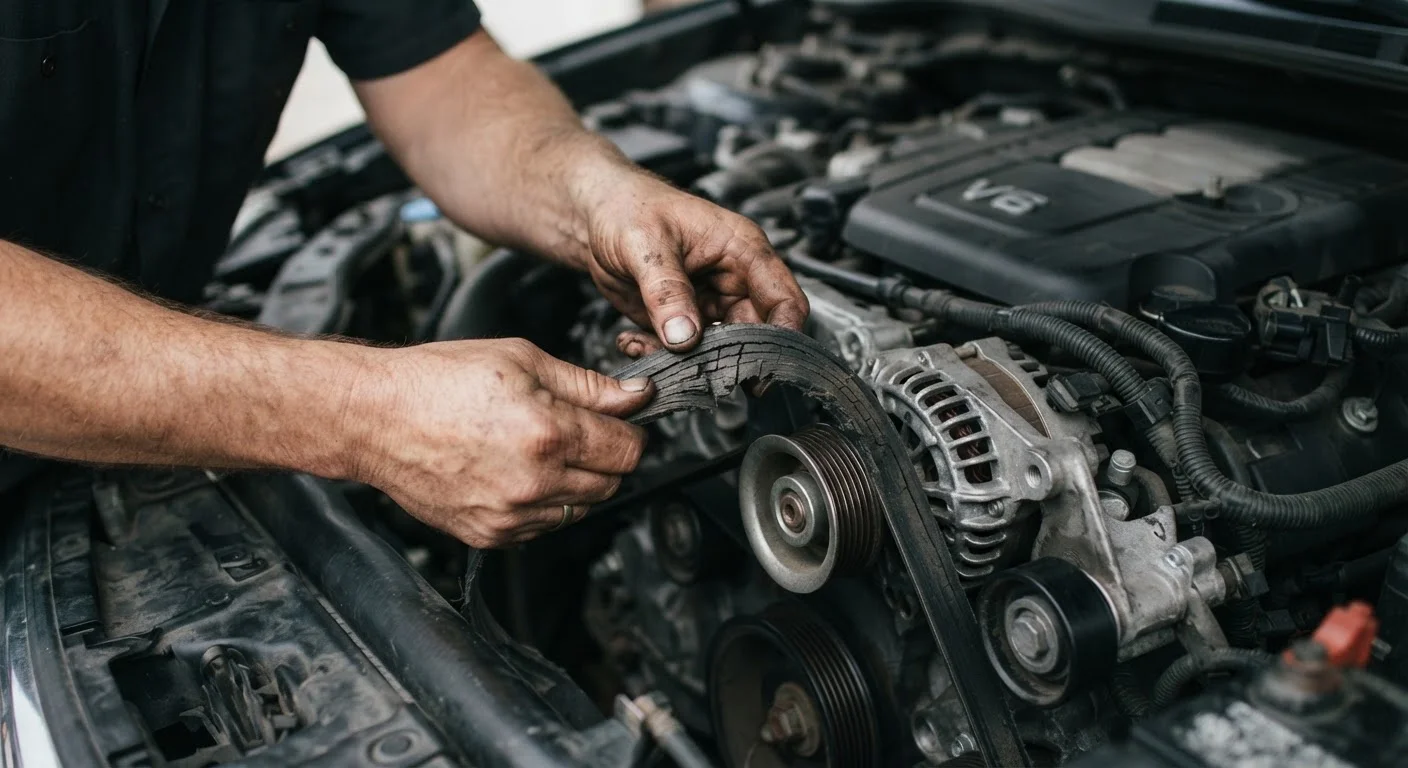
The serpentine belt drives critical accessories - the alternator, power steering pump, and air conditioning compressor - off the engine's rotation. Modern belts are made from materials that last a long time, which is actually part of the problem: they don't deteriorate in an obvious way until they're close to failure.
A snapped serpentine belt can leave you stranded immediately and may cause secondary damage depending on when and how it lets go. Many manufacturers recommend inspection or replacement somewhere between 60,000 and 100,000 miles, but consult your manual for your specific vehicle. Because this job involves working around engine components under tension, it's generally best left to a qualified mechanic.
Serpentine belts can fail without much visible warning - and the breakdown is immediate when they do.
Brake Fluid
Brake fluid is hygroscopic, meaning it absorbs moisture from the air over time. As water content rises, the fluid's boiling point drops - which can lead to reduced braking performance under hard or sustained braking, a condition sometimes called brake fade. Most drivers never notice this happening gradually.
Many manufacturers recommend testing or replacing brake fluid every two years regardless of mileage. A mechanic can test moisture content with an inexpensive tool. Because braking performance is directly tied to safety, this is one item where deferring service carries real risk. It's not a task to skip indefinitely.
Brake fluid absorbs moisture over time, quietly lowering its effectiveness under hard braking conditions.
Transmission Fluid
Transmission fluid lubricates the complex internal components of the transmission and, in many vehicles, also handles cooling. Degraded fluid leads to rough shifting, increased wear, and - if neglected long enough - transmission damage that can be extremely costly to repair.
Service intervals vary widely: some manufacturers call for changes every 30,000 to 60,000 miles under normal conditions, while others list certain transmissions as having fluid that lasts the vehicle's lifetime under ideal conditions. That "lifetime" designation is often debated among technicians, particularly for vehicles driven in severe conditions (towing, stop-and-go traffic, extreme heat). Check your manual and discuss your driving conditions with a trusted mechanic.
Transmission fluid degradation is invisible to most drivers until shifting problems or damage appear.
Tire Pressure (at Temperature Changes)
Most drivers check tire pressure occasionally, but fewer do so consistently when the seasons change. Tire pressure drops roughly one PSI for every 10°F drop in ambient temperature - meaning a tire that was properly inflated in summer may be noticeably underinflated by the time winter arrives.
Underinflated tires wear unevenly, reduce fuel efficiency, and affect handling. Overinflation creates its own problems with ride quality and grip. Neither condition triggers an immediate warning on all vehicles, and the TPMS (Tire Pressure Monitoring System) light doesn't always illuminate until pressure is significantly off. Checking manually with a gauge remains the most reliable approach. For a full seasonal perspective, a seasonal maintenance checklist can help structure these checks throughout the year.
Tire pressure shifts with the seasons - a properly inflated summer tire may be significantly low by winter.
Building a Habit Around the Overlooked Stuff
The reason these tasks get skipped isn't laziness - it's that nothing obviously breaks when you forget them, at least not right away. That delay creates a false sense that everything is fine. By the time a symptom shows up, you're often already dealing with a more serious (and more expensive) problem. Small problems rarely stay small when they go unaddressed for long enough.
The most practical habit you can build is a simple maintenance log - a written or digital record of what was done and when. It removes any guesswork about intervals and makes it far easier to spot what's coming due. See the case for keeping a vehicle maintenance log for a straightforward way to get started. And if your vehicle is past the 100,000-mile mark, it's worth knowing that maintenance priorities shift meaningfully at higher mileage.
Use Your Owner's Manual, Not Just Warning Lights
Dashboard warning lights are a last resort, not a maintenance schedule. Many of the items on this list will never trigger a light before they cause a problem. Your owner's manual lists recommended service intervals based on mileage and time - cross-referencing it with a simple log of completed services is the most reliable way to stay ahead of deferred maintenance.
The content on this site is provided for informational purposes only and should not be considered a substitute for professional advice. While we strive to provide accurate and up-to-date information, we make no guarantees regarding its completeness or accuracy. Always consult a qualified professional for advice specific to your circumstances before making any decisions.