

Why Mental Stimulation Matters for Indoor Cats
Indoor cats live longer, safer lives on average - but the trade-off is a dramatically reduced opportunity to express natural behaviours. Cats are obligate hunters, wired by evolution to stalk, chase, pounce, and explore shifting environments. Without outlets for these drives, understimulation can manifest as destructive scratching, excessive vocalisation, overgrooming, or withdrawal.
Feline behaviour researchers use the term environmental enrichment to describe deliberate modifications to a cat's living space and daily routine that promote species-appropriate behaviour. Think of it less as entertainment and more as meeting a biological need. A bored cat isn't simply idle - it may be experiencing chronic low-level stress that affects both behaviour and long-term health.
If you're also thinking about how your cat's diet supports overall wellbeing, see our guide to wet versus dry food nutrition for context on how feeding choices intersect with activity levels.
Introduce puzzle feeders and food-dispensing toys to replace or supplement the standard bowl.
Feeding from a stationary bowl eliminates any hunting challenge, leaving a cat's predatory drive entirely unmet. Puzzle feeders engage problem-solving circuits and slow consumption, which can also reduce rapid eating. Research in applied animal behaviour consistently shows that contrafreeloading - choosing to work for food when free food is available - is a genuine preference in many species, including cats.
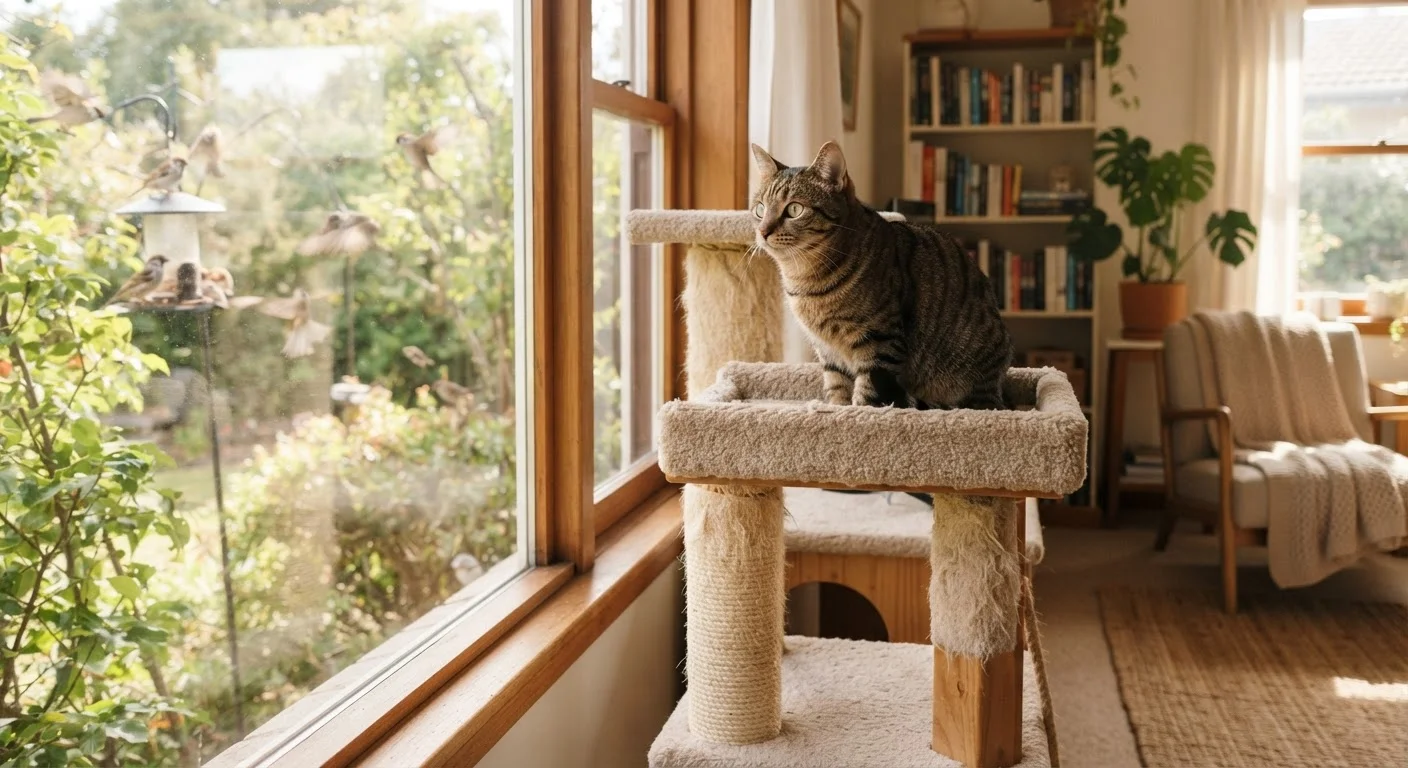
Create vertical space with cat trees, shelves, or window perches.
Height is a core resource for cats - it confers a sense of safety, allows territory surveying, and satisfies climbing instincts. Vertical enrichment effectively expands a cat's perceived territory without requiring additional floor space. Cats denied elevated positions may become more anxious and territorial at ground level.
Rotate toys regularly rather than leaving the same items out indefinitely.
Cats habituate quickly to familiar objects - what is novel today becomes invisible within days. Rotating a toy library, keeping most items stored and cycling a few into play at a time, sustains novelty without the cost of constantly buying new items. Novelty activates exploratory behaviour linked to positive emotional states.
Schedule daily interactive play sessions using wand or teaser toys.
Solitary toys do not replicate the unpredictability of prey movement. Owner-directed play with a moving wand toy - mimicking the erratic motion of small animals - engages the complete predatory sequence: stalk, chase, pounce, and catch. Even 10-15 minutes twice daily measurably reduces stress behaviours in confined cats.
Provide scratching surfaces in locations your cat already uses or prefers.
Scratching is not destructive misbehaviour - it is a necessary physical and communicative behaviour used to maintain claw health and deposit scent markers. Placing scratching posts near sleeping areas, doorways, and social spaces where cats naturally stretch addresses the behaviour proactively and protects furniture.
Use window access and bird feeders outside to provide passive visual stimulation.
Even when a cat cannot hunt, watching live movement - birds, squirrels, insects - activates predatory attention and provides hours of low-effort stimulation. Studies of shelter cat wellbeing have found that window access significantly reduces stress indicators. This strategy costs virtually nothing once established.
Core Enrichment Practices for Indoor Cats
The most effective enrichment programs combine multiple dimensions: sensory, cognitive, social, and physical. No single strategy covers all of a cat's needs, so variety is essential. Below are the evidence-informed approaches that consistently support feline mental health.
Tailoring Enrichment to Your Cat's Life Stage
A universal enrichment plan rarely fits every cat. Kittens have intense, short bursts of energy and benefit from interactive play sessions several times daily. Adult cats often engage well with puzzle feeders and independent exploration during hours their owners are away. Matching enrichment to life stage is part of broader decision-making when welcoming any cat into your home.
Older cats present their own considerations. Arthritis or reduced vision may make high climbing structures unsafe, but cognitive engagement remains just as important. Low-to-ground puzzle feeders, gentle interactive play, and predictable social time are especially valuable. Our senior cat care overview covers how a cat's physical and mental needs shift after age ten.
It's also worth noting that enrichment principles translate across species. Our bird enrichment guide explores similar strategies for caged birds, underscoring how broadly the science of captive animal wellbeing applies.
This article is for general informational purposes. For concerns about your cat's behaviour or health, consult a qualified veterinarian or a certified feline behaviour consultant.
The content on this site is provided for informational purposes only and should not be considered a substitute for professional advice. While we strive to provide accurate and up-to-date information, we make no guarantees regarding its completeness or accuracy. Always consult a qualified professional for advice specific to your circumstances before making any decisions.