

Our Verdict
Countertop dishwashers are a genuinely practical choice for one- or two-person households, renters, or anyone without room for a built-in unit - but they involve real operational trade-offs around capacity and connectivity. Full-size dishwashers remain the better fit for households running multiple loads a week or washing larger cookware regularly. Neither format is universally superior; the right choice depends on how your kitchen is set up and how you actually cook.
| Best for | Recommended |
|---|---|
| Renters or those without under-counter plumbing access | Countertop Dishwasher |
| Small households washing a limited number of dishes daily | Countertop Dishwasher |
| Families or households cooking frequently with large cookware | Full-Size Dishwasher |
| Homeowners planning a long-term kitchen setup | Full-Size Dishwasher |
How Each Type Actually Works
The most fundamental difference between countertop and full-size dishwashers isn't capacity - it's how they connect to your home's water supply.
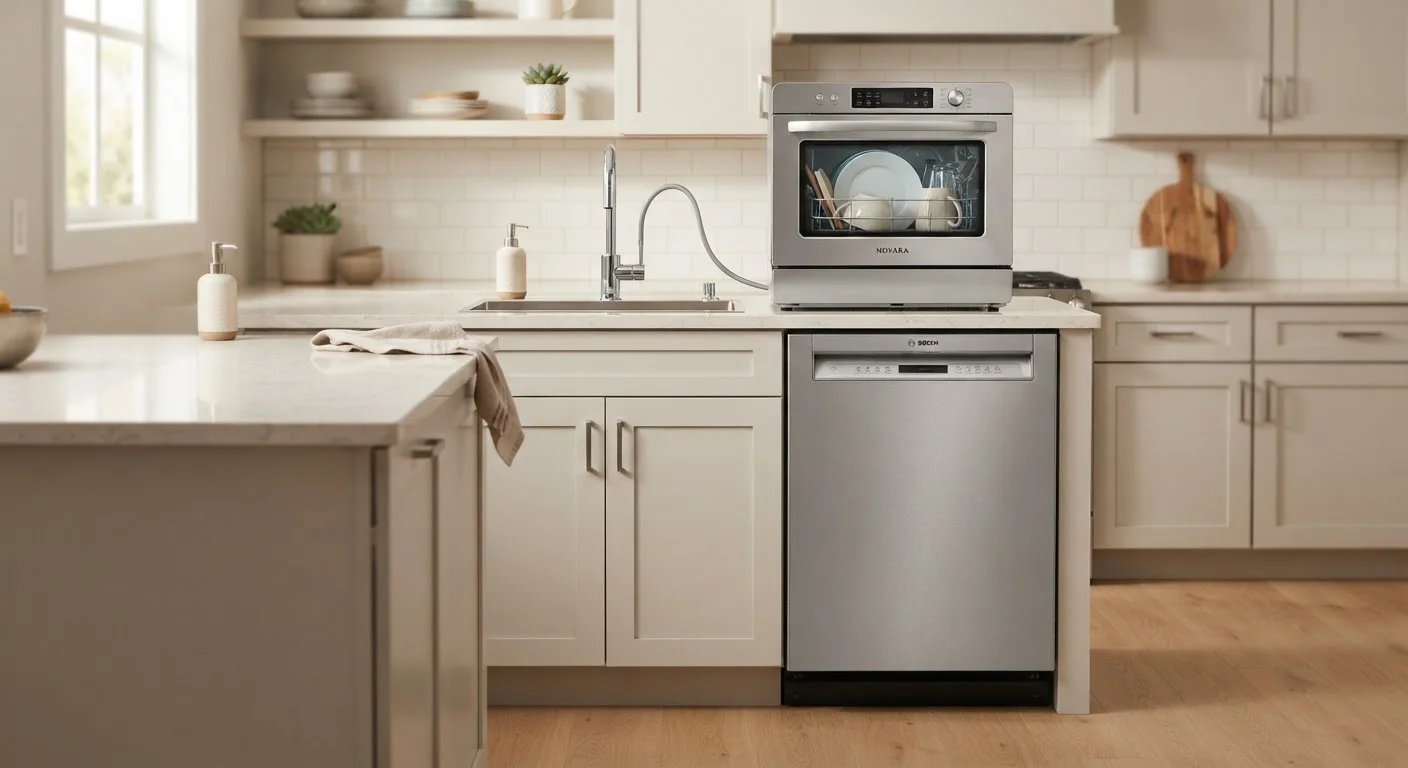
A countertop dishwasher attaches to your kitchen faucet via an adapter, draws water from the tap, and drains back into the sink. This means no dedicated water line, no drain hookup under the floor, and no permanent installation. You set it up when you need it, and in theory, you can move it. The trade-off: you need your faucet available during a cycle, and not every faucet thread is compatible without an adapter kit.
A full-size dishwasher, whether built-in or freestanding, connects to your home's hot water supply line and drains through a dedicated drain hose, typically into a garbage disposal port or sink drain. This requires a plumbing rough-in - something already present in most US kitchens but not always in studio apartments, older homes with galley layouts, or converted spaces. If your kitchen doesn't have that infrastructure, adding it means licensed plumbing work. See what built-in appliances really commit you to before assuming installation is simple.
Capacity and Load Reality
Manufacturers rate dishwasher capacity in place settings - a standardized measure representing the dishes, glassware, and cutlery for one person at one meal. Most full-size dishwashers accommodate 12 to 16 place settings per cycle. Most countertop models hold 4 to 6.
That gap matters more than it might sound. A countertop unit can typically handle the plates, glasses, and utensils from one day's meals for one or two people - but add a cutting board, a sheet pan, or a mixing bowl, and you've hit the limit. Full-size dishwashers have adjustable tines, fold-down prongs, and a second rack designed to accommodate larger items.
| Countertop Dishwasher | Full-Size Dishwasher | |
|---|---|---|
| Typical Capacity | 4-6 place settings | 12-16 place settings |
| Installation | Faucet adapter, no plumbing | Dedicated water line and drain required |
| Water Use Per Cycle | ~2-4 gallons | ~3-6 gallons |
| Cycle Options | Limited (2-4 programs) | Broader (5-8+ programs) |
| Drying Method | Often air-dry only | Heated dry available |
| Portability | Moveable, renter-friendly | Permanent or semi-permanent |
| Counter/Space Impact | Uses counter space | Uses under-counter space |
| Large Cookware | Limited accommodation | Adjustable racks, larger footprint |
If you regularly cook with pots, cast-iron skillets, or sheet pans, a countertop unit will handle your flatware while leaving your cookware to hand-wash. That's a reasonable division for some households - but not for others.
Water and Energy Use: Nuances Matter
Countertop dishwashers are often marketed as water-efficient, and they do use less water per cycle - typically 2 to 4 gallons versus 3 to 6 gallons for a full-size unit. But efficiency comparisons depend heavily on how often you run each type.
A small household running two countertop cycles a day to manage dishes may use comparable water to a larger household running one full-size cycle. Energy use follows a similar pattern: the per-cycle draw is lower for a countertop unit, but the total depends on usage habits.
Match Cycle Frequency to Household Size
To get an accurate picture of efficiency, estimate how many cycles per week each format would require for your actual dish load. A countertop unit running twice daily isn't necessarily more efficient than a full-size unit running once. Factor in your real usage patterns, not just per-cycle specs.
For a household of one or two, a countertop dishwasher used once daily may genuinely reduce water consumption compared to hand-washing, which typically uses 15 to 27 gallons per session according to general plumbing estimates. Running a full-size dishwasher half-full daily, however, isn't efficient for either format. If you're rethinking your entire kitchen appliance footprint, the kitchen equipment audit approach can help you evaluate what's actually earning its place.
Wash Performance and Cycle Options
Both formats use spray arms, detergent, and heated water to clean dishes. The performance gap between a well-functioning countertop model and a mid-range full-size dishwasher is smaller than many people expect for everyday dishware - but it widens with more demanding loads.
Full-size dishwashers typically offer more cycle options: heavy, normal, light, sanitize, quick wash, and delay start are common. Many include a heated drying mode. Countertop models generally offer fewer programs, and some rely on air-drying rather than heated drying, which can leave plastics slightly damp.
Noise levels vary by model more than by format, but full-size dishwashers - especially those designed for built-in installation - tend to include better insulation. Countertop units sit on your counter and may be more audible during a cycle.
If you're weighing a countertop appliance as part of a broader compact-kitchen strategy, which small appliances actually earn counter space is worth reading alongside this comparison.
Who Each Format Actually Suits
Countertop dishwashers are a practical match for:
- Renters who can't install permanent appliances or don't want to invest in a unit they'll leave behind
- One- or two-person households generating modest dish loads daily
- Kitchens without under-counter space or existing plumbing rough-ins
- Supplemental use - for example, a household with a full-size unit that also wants a faster option for small loads
Full-size dishwashers suit households that:
- Cook frequently and use large pots, pans, and baking sheets regularly
- Have three or more people generating dishes across multiple meals
- Want a wider range of wash programs and drying options
- Own their home and plan to be in the space long-term
Counter space is also a real consideration. A countertop dishwasher occupies roughly 17-22 inches of your work surface - a meaningful footprint in a small kitchen. For guidance on managing that trade-off, small kitchen organization principles covers how to think through appliance placement without losing functional workspace.
The content on this site is provided for informational purposes only and should not be considered a substitute for professional advice. While we strive to provide accurate and up-to-date information, we make no guarantees regarding its completeness or accuracy. Always consult a qualified professional for advice specific to your circumstances before making any decisions.