

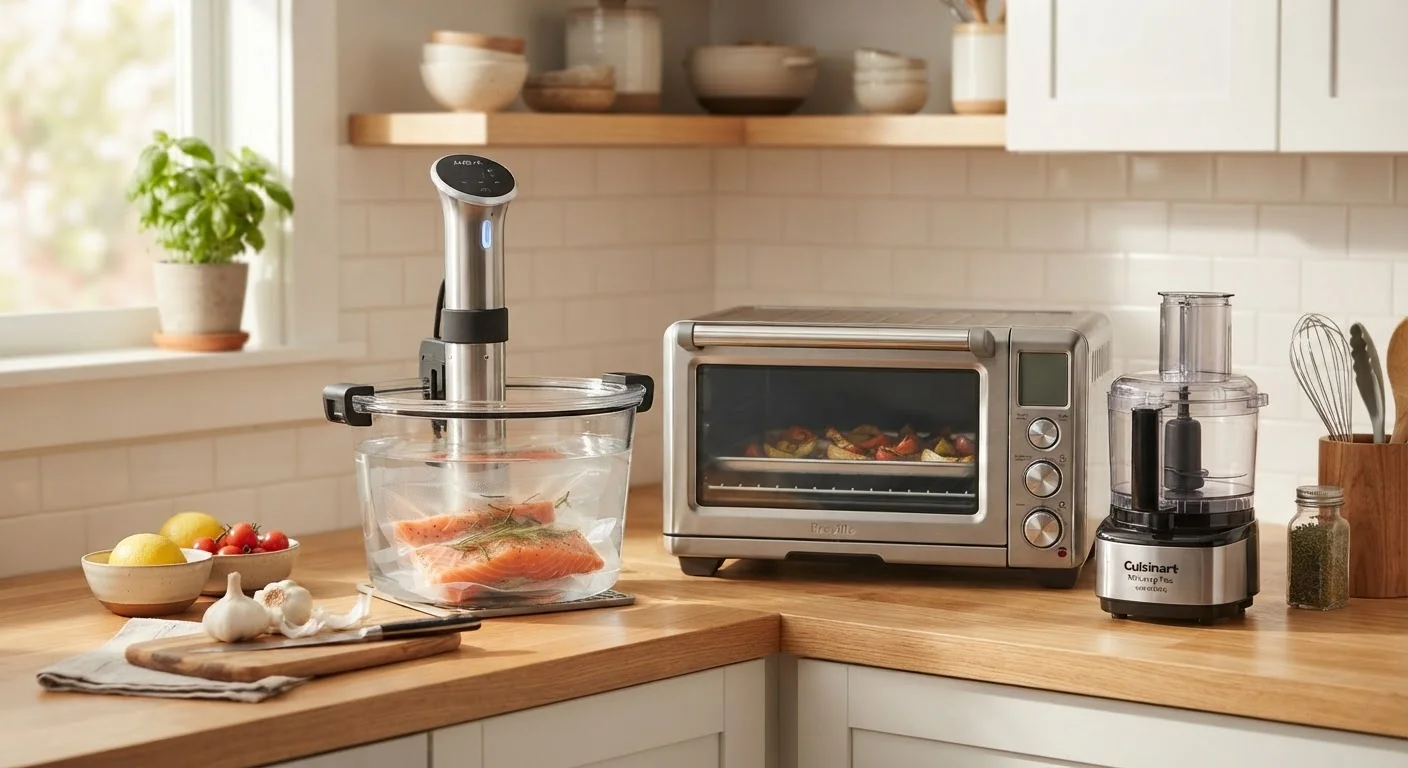
Beyond the Basics: Why Some Appliances Are Worth the Counter Space
Most kitchens are already equipped for standard cooking - a stove, an oven, a microwave. But certain techniques remain stubbornly out of reach without the right equipment. Fermentation, precision low-temperature cooking, high-heat crisping without a full oven: these aren't exotic restaurant tricks. They're approaches that home cooks can realistically use once they have a tool that makes them accessible.
The appliances below aren't novelties. Each one genuinely opens up a method or category of cooking that would otherwise require either professional equipment or a lot of improvisation. If you're building out your kitchen from scratch, it's worth knowing what each of these actually does before deciding whether it belongs on your counter. And if you're doing a kitchen equipment audit, these are the appliances most worth evaluating honestly.
Immersion Circulator (Sous Vide)
An immersion circulator holds water at a precise temperature - typically within a fraction of a degree - allowing food sealed in a bag to cook slowly and evenly to an exact doneness. The technique, called sous vide, produces results that are genuinely difficult to replicate on a stovetop or in a conventional oven: chicken breast that's uniformly tender throughout, steak with edge-to-edge even color, eggs with a custard-like yolk at exactly the texture you want.
The learning curve is real. Sous vide requires planning ahead - most proteins cook for one to four hours, some cuts much longer - and a quick sear afterward is typically needed for texture and color. But once you understand the method, it's highly repeatable. For a fuller look at what it does and doesn't do well, see the practical trade-offs of home sous vide.
Best suited for: Cooks who want precise, consistent results with proteins and are willing to plan meals ahead.
Sous vide produces edge-to-edge even doneness that stovetop cooking simply can't reliably replicate.
Countertop Convection Oven
A countertop convection oven is meaningfully different from a standard toaster oven. The fan-forced air circulation cuts cooking times, browns food more evenly, and - in models with a broil or high-heat setting - can crisp food in ways a microwave cannot approach. For smaller households, it can replace a full oven for most weeknight cooking and saves significant preheating time.
In small apartments or kitchens with an underperforming main oven, a quality countertop convection oven functions as a genuine supplement or replacement rather than a convenience item. It also handles roasting vegetables, reheating pizza, and baking small batches well, making it broadly useful across meal types.
Best suited for: Small households, apartment dwellers, or anyone whose main oven runs poorly or is frequently occupied.
Fan-forced convection cooks faster and browns more evenly than a standard oven - in a fraction of the footprint.
Immersion Blender
An immersion blender (also called a stick blender or hand blender) lets you blend directly in the pot, eliminating the dangerous step of transferring hot liquid to a countertop blender. For soups, sauces, and purees, this is a practical safety improvement as much as a convenience one. It also handles smaller quantities far better than a full blender, which often struggles with anything under a cup of liquid.
The limitations are real: it won't produce the silky-smooth texture of a high-powered countertop blender for certain applications, and it struggles with ice or very thick mixtures. But for everyday sauce and soup work, it's fast, easy to clean, and requires almost no storage space.
Best suited for: Any cook who regularly makes soups, sauces, or purees and wants a faster, safer approach than a countertop blender.
Blending hot soup directly in the pot removes a genuinely hazardous transfer step from everyday cooking.
Electric Spice or Coffee Grinder
Freshly ground spices release significantly more volatile aromatic compounds than pre-ground ones - a difference that's noticeable in dishes where spice is a primary flavor. A small blade grinder dedicated to spices (kept separate from any coffee grinder) lets you grind whole cumin, coriander, cardamom, or custom spice blends in seconds. It also handles dried chiles, peppercorns, and dried herbs.
This is one of the lowest-cost, smallest-footprint appliances that produces a noticeable improvement in cooking quality. The main discipline required is keeping it clean between uses - residual oils from one spice will carry over to the next.
Best suited for: Cooks who cook with spices frequently and want noticeably better flavor without significant expense or space investment.
Whole spices ground fresh release far more aroma than pre-ground - and the difference is immediately noticeable.
Yogurt Maker or Fermentation Vessel
Yogurt making requires maintaining milk at a consistent temperature - typically around 110°F (43°C) - for several hours while bacterial cultures work. A dedicated yogurt maker does this automatically and reliably. Without one, maintaining that temperature through improvised methods (a warm oven, a towel-wrapped pot) is possible but inconsistent.
Beyond yogurt, purpose-built fermentation vessels with temperature control open up a wider range of fermented foods - certain cultured dairy products, some grain ferments - that depend on consistent warmth. These are niche tools, but for cooks interested in fermentation, they address a genuine technical barrier.
Best suited for: Cooks who make yogurt or fermented foods regularly and find improvised temperature-keeping unreliable.
Consistent temperature is the single biggest obstacle to reliable home fermentation - a yogurt maker solves it.
Food Processor
A food processor handles tasks that are technically possible by hand but realistically time-consuming to the point where most cooks skip them: shredding large volumes of vegetables, making pastry dough, grinding nuts to a paste, emulsifying dressings, or processing cauliflower to a rice-like texture. The value is less about enabling entirely new techniques and more about removing friction from tasks that produce better results when done more thoroughly.
It's worth distinguishing a food processor from a blender - the two overlap but are not interchangeable. A food processor excels at chopping, slicing, shredding, and mixing drier ingredients. If you find yourself skipping prep steps because of the time they take, a food processor directly addresses that. A stand mixer covers related but different territory for baking-focused cooks.
Best suited for: Cooks who do significant meal prep, bake regularly, or frequently work with large quantities of vegetables.
A food processor doesn't replace knife skills - it makes volume prep realistic when doing it by hand simply isn't.
Making the Right Call for Your Kitchen
The honest measure of any appliance is how often it changes what you actually cook - not how many functions it lists on the box. An immersion circulator sitting unused in a drawer costs you nothing after purchase but delivered nothing either. A countertop convection oven used five nights a week is earning its footprint.
Test Frequency Before You Commit Counter Space
Before purchasing any appliance, try borrowing one from a friend or using a similar tool at a cooking class. A week of actual use reveals whether a technique genuinely fits how you cook or just appealed in theory. Appliances that earn counter space are the ones you reach for without thinking - not the ones you pull out for a specific occasion twice a year.
Space is a real constraint. If you're working with limited counter or cabinet room, smart storage principles matter as much as what you own. The appliances that justify permanent counter space are the ones you reach for multiple times a week - everything else should have a designated cabinet home or be reconsidered.
Each appliance here represents a genuine expansion of what's possible in a home kitchen. Whether that expansion is relevant to your kitchen depends on how you actually cook, how often you'd use it, and whether you have somewhere to put it. Those three questions, answered honestly, will tell you more than any feature list.
The content on this site is provided for informational purposes only and should not be considered a substitute for professional advice. While we strive to provide accurate and up-to-date information, we make no guarantees regarding its completeness or accuracy. Always consult a qualified professional for advice specific to your circumstances before making any decisions.