

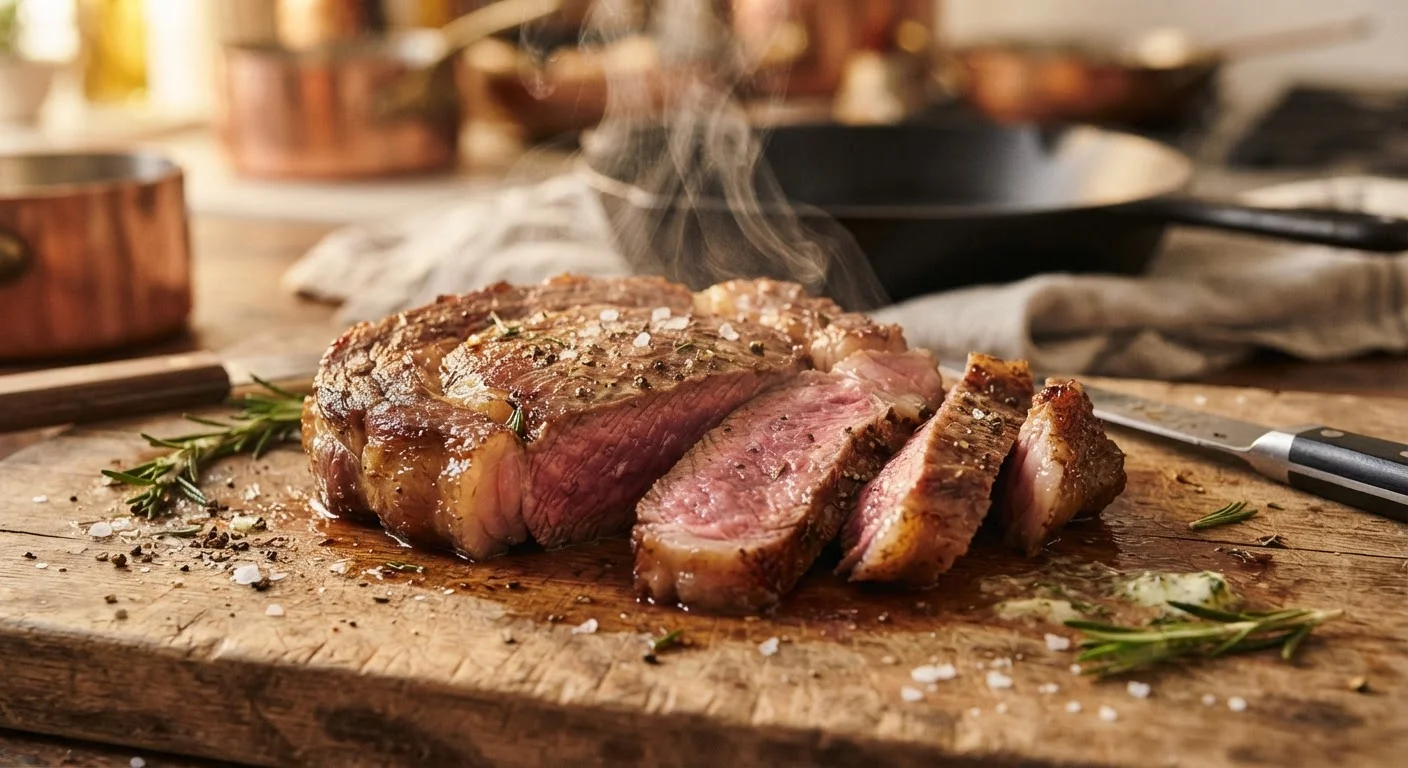
What Actually Happens Inside the Meat
When meat hits high heat - whether on a grill, in a cast-iron pan, or inside a roasting oven - the muscle fibers contract sharply. That contraction squeezes moisture toward the cooler center of the cut. If you slice the moment it comes off the heat, all that concentrated liquid rushes out immediately, pooling on the board instead of staying in the meat.
Resting gives those contracted proteins a chance to partially relax. As the temperature gradient between the outer crust and the center evens out, moisture redistributes more evenly through the muscle. The difference in juiciness between a steak sliced immediately and one rested five to ten minutes is not subtle - it's visible and tasted in every bite.
This is also why searing doesn't actually seal in juices the way the old kitchen myth suggests. Moisture retention is governed by temperature management throughout the cook - and resting is a critical final step in that management.
“The single most common mistake home cooks make after getting the heat right is not giving the meat any time to rest. Patience at the end of the cook is just as important as technique during it.”
— Harold McGee, Food science author, On Food and Cooking
Carryover Cooking: Why You Should Pull Early
Resting is inseparable from the concept of carryover cooking. When you remove meat from heat, the surface is significantly hotter than the interior. That residual surface heat continues conducting inward, raising the internal temperature even as the meat sits undisturbed.
For a steak, carryover might add 3 to 5°F. For a large prime rib or whole turkey, it can add as much as 10 to 15°F. Pull too late and you've overshot your target doneness before you've even plated the dish.
The practical implication: always pull meat a few degrees below your intended finished temperature and let rest do the remaining work. This is where a reliable thermometer becomes non-negotiable. Understanding what your kitchen thermometer is actually telling you helps you read pull points with confidence rather than guesswork.
Pull a Few Degrees Early, Every Time
Build the habit of pulling any cut of meat 5°F below your target internal temperature. Set a second thermometer alert if yours supports it. By the time you've moved the pan, rested the meat, and tented it loosely, carryover cooking will have done the rest of the work reliably.
Resting Times by Cut
There's no single resting time that covers all proteins - the right window scales with the size and density of the cut.
- Thin steaks (under 1 inch): 3 to 5 minutes
- Standard steaks (1 to 2 inches): 5 to 10 minutes
- Thick steaks and bone-in cuts: 10 to 15 minutes
- Pork chops and chicken breasts: 5 minutes
- Whole roast chicken: 10 to 15 minutes
- Large beef roasts and whole turkey: 20 to 30 minutes
During rest, tent the cut loosely with aluminum foil to retain warmth without trapping steam against the crust. A hard wrap traps condensation and softens any bark or sear you developed - the same crust that results from choosing the right heat application for the job, as discussed in our article on dry heat vs. moist heat cooking methods.
~15%
Moisture loss from cutting steak immediately vs. resting
Research on meat cookery consistently shows that allowing muscle fibers to relax before slicing meaningfully reduces juice loss onto the cutting board.
5-15°F
Typical carryover temperature rise during rest
The range depends on cut size and cooking temperature; large, high-heat roasts experience the greatest carryover effect.
5 min
Minimum effective rest for a standard steak
Even a brief 5-minute rest makes a measurable difference in moisture retention compared to immediate slicing.
How to Slice After Resting
Resting does the internal work - slicing technique determines how well you preserve it at the table. Always cut against the grain, meaning perpendicular to the direction the muscle fibers run. Cutting with the grain leaves long, chewy fiber strands intact; cutting against it shortens them into tender, manageable bites.
On tougher cuts like flank or skirt steak, identifying grain direction before cooking - not after - makes it easier to spot when the surface is seared. A sharp knife matters here too; dragging a dull blade through rested meat compresses fibers and squeezes out moisture you just spent time preserving. If your knife skills need sharpening (literally and figuratively), our knife skills guide for home cooks is a useful starting point.
Frequently Asked Questions
For most steaks - ribeye, strip, or sirloin - a 5 to 10 minute rest is generally sufficient. Thicker cuts like a tomahawk or bone-in rib steak benefit from closer to 10 to 15 minutes. The goal is for the internal temperature to stabilize and the muscle fibers to relax.
Yes, measurably so. Studies on muscle fiber behavior in cooked meat show that proteins contract under heat and expel moisture. Allowing the cut to rest lets those fibers partially relax and reabsorb liquid. Slicing immediately results in noticeably more juice loss onto the cutting board.
Surface temperature does drop, but the interior stays warm for longer than most people expect. Loosely tenting with foil slows heat loss without trapping steam against the crust. For large roasts, a 20 to 30 minute rest still yields a warm, serving-ready result.
Yes, though the times vary. Chicken breasts and pork chops benefit from a 5-minute rest. A whole roast chicken or pork loin needs closer to 15 minutes. The same physical principle applies across all proteins - heat-contracted fibers need time to relax.
As a general guideline, pull the cut roughly 5°F below your target finished temperature for smaller cuts, and up to 10°F below for large roasts. Carryover cooking continues raising the internal temperature even off the heat. A good thermometer is essential - see our guide on <a href="/food-drink/cooking-techniques/what-your-kitchen-thermometer-is-actually-telling-you">what your kitchen thermometer is actually telling you</a>.
Loosely tenting with aluminum foil is a good practice for larger cuts to slow heat loss. Avoid wrapping tightly, which traps steam and softens a crust you worked hard to develop. For steaks, a simple tent or even just a warm plate placed over the top works well.
The content on this site is provided for informational purposes only and should not be considered a substitute for professional advice. While we strive to provide accurate and up-to-date information, we make no guarantees regarding its completeness or accuracy. Always consult a qualified professional for advice specific to your circumstances before making any decisions.