

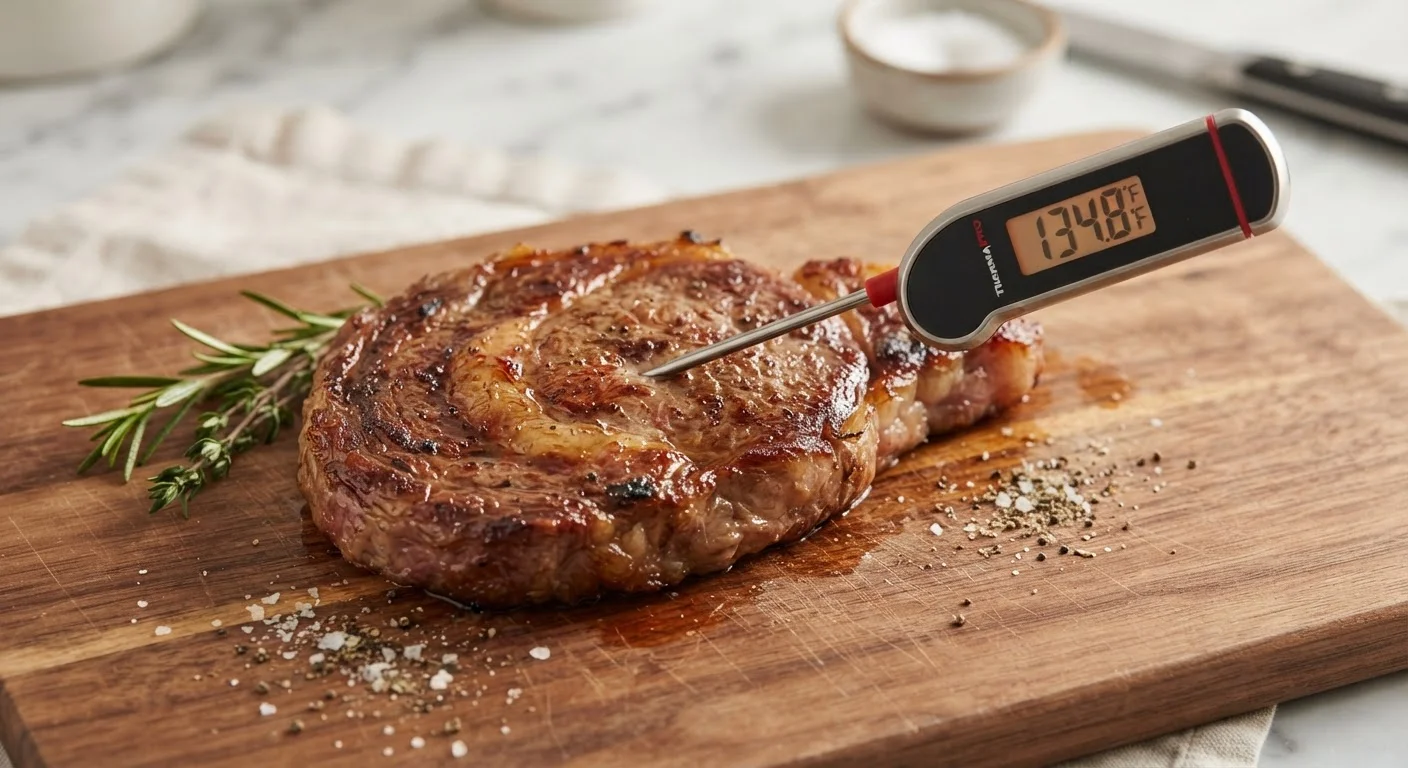
Reading the Numbers Right
A kitchen thermometer doesn't lie - but it does require some interpretation. The temperature reading you see reflects conditions at the probe tip at that exact moment in time. Where you insert the probe, how deep it goes, and whether the meat is still on a hot pan all influence what you're measuring. To get a reliable reading, insert the probe into the thickest part of the cut, away from bone (which conducts heat differently) and away from fat pockets. For thinner cuts like chicken breasts or fish fillets, go in from the side to hit the center.
It's also worth understanding the difference between pull temperature and final serving temperature. Because of carryover cooking - the way residual heat continues to raise internal temperature after a protein leaves the heat source - you typically want to pull food a few degrees before your target. For a thick roast, this can mean pulling 5-10°F early. For a thin fillet, carryover is minimal. Understanding how resting works is the essential companion to reading temperatures correctly.
| Beef / Lamb / Veal / Pork (whole cuts) | 145°F (63°C) + 3-min rest (USDA Food Safety and Inspection Service) |
| Ground beef / Ground pork | 160°F (71°C) (USDA Food Safety and Inspection Service) |
| All poultry | 165°F (74°C) (USDA Food Safety and Inspection Service) |
| Fish | 145°F (63°C) (USDA Food Safety and Inspection Service) |
| Egg dishes / casseroles | 160°F (71°C) (USDA Food Safety and Inspection Service) |
| Typical carryover range (large roasts) | 5-10°F rise after removal (General culinary reference) |
USDA Minimum Safe Temperatures - and What Doneness Actually Means
The USDA publishes minimum safe internal temperatures designed to eliminate harmful pathogens at statistically safe levels. These are not aesthetic targets - they're food safety thresholds. Knowing both the safety floor and the typical doneness range gives you the full picture.
Carryover cooking
The continued rise in internal temperature that occurs after food is removed from a heat source. Residual heat stored in the outer layers continues to move toward the center. For thick cuts, carryover can add 5-10°F to the final temperature.
Pull temperature
The internal temperature at which you remove food from heat, intentionally set a few degrees below the final target to account for carryover cooking.
Doneness vs. safety
Doneness describes the texture, color, and moisture level of cooked protein - a matter of preference. Safety temperature is the minimum internal heat required to eliminate pathogens. The two targets are related but not identical.
Instant-read thermometer
A probe thermometer that displays a temperature reading within 2-5 seconds of insertion. Preferred over dial-style thermometers for accuracy and speed during active cooking.
- Whole cuts of beef, lamb, veal, and pork: 145°F (63°C), with a 3-minute rest. Medium-rare beef sits around 130-135°F; the USDA minimum applies as a safety baseline, not a doneness directive for whole-muscle cuts.
- Ground beef and ground pork: 160°F (71°C). Ground meat is held to a stricter standard because surface bacteria get distributed throughout during grinding.
- All poultry (whole birds, ground, pieces): 165°F (74°C). There is no safe undercooked chicken - this target is firm across the board.
- Fish and shellfish: 145°F (63°C) for fish; shellfish such as shrimp and scallops should be opaque and firm. Some preparations (sushi-grade, certain raw bar items) carry separate food-safety considerations outside the scope of standard home cooking guidance.
- Eggs and egg dishes: 160°F (71°C) for egg-based casseroles; cook eggs until yolk and white are firm unless using pasteurized eggs in dishes that will remain runny.
If you're cooking with an unfamiliar piece of equipment, consult common temperature conversions to avoid confusion between Fahrenheit and Celsius readings.
Common Mistakes That Throw Off Your Reading
Even experienced cooks can get inaccurate readings without realizing it. The most frequent culprits:
- Probe placement near bone: Bone heats faster and skews readings high. Always target the densest muscle mass.
- Measuring from above fat cap: Fat has different thermal properties than lean meat and can give a falsely elevated reading before the center is safe.
- Not accounting for carry-over: Pulling a large roast at exactly 145°F, then watching it climb to 155°F while resting, is a sign the thermometer is doing its job - if you understand what the numbers mean. See common cooking myths unpacked for related technique misconceptions.
- Using a slow-read thermometer: Dial-style thermometers can take 20-30 seconds to stabilize. Instant-read thermometers respond in 2-5 seconds and are far less likely to give a misleading snapshot during a brief check.
- Not calibrating regularly: Test your thermometer in an ice-water slurry (should read 32°F/0°C) or in boiling water (should read 212°F/100°C at sea level) periodically. Altitude affects boiling point, so adjust expectations accordingly.
Altitude Affects Boiling Point Calibration
Water boils at 212°F (100°C) at sea level, but at higher elevations it boils at lower temperatures - roughly 202°F (94°C) at 5,000 feet. If you calibrate your thermometer using boiling water, factor in your elevation. Ice-water calibration (32°F/0°C) is unaffected by altitude and is generally the more reliable method.
The content on this site is provided for informational purposes only and should not be considered a substitute for professional advice. While we strive to provide accurate and up-to-date information, we make no guarantees regarding its completeness or accuracy. Always consult a qualified professional for advice specific to your circumstances before making any decisions.