

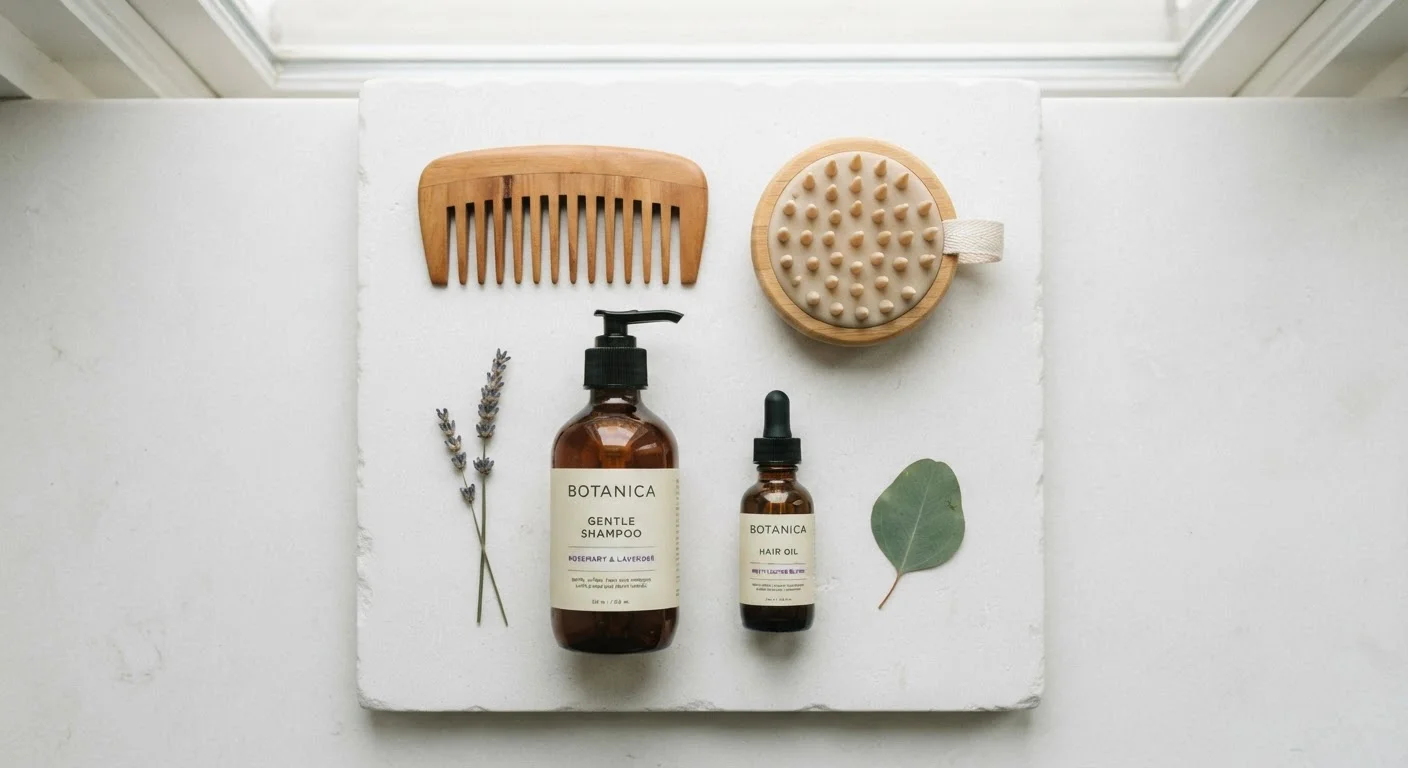
Option A
Scalp Care
The foundation-first approach to hair health.
Best for: Anyone dealing with dryness, flaking, excess oil, irritation, or sluggish hair growth who wants to address root causes rather than surface symptoms.
Option B
Hair Care
The strand-focused practice most routines are built around.
Best for: Those managing texture, moisture balance, damage repair, or styling concerns along the length and ends of the hair shaft.
Two Distinct Systems Working Together
Most people treat hair care as a single practice - shampoo in, conditioner out, done. But the scalp and the hair strand are biologically and functionally distinct systems. Conflating them leads to routines that address one while ignoring the other, which often explains why persistent issues like flaking, oiliness, or breakage don't resolve despite regular washing.
The scalp is living skin. It contains sebaceous glands, hair follicles, sweat glands, and a microbiome - the community of microorganisms that help maintain barrier function. Like the skin on your face, it sheds dead cells, produces oil, and responds to inflammation. By contrast, the hair shaft - what most people call "hair" - is composed of dead keratin cells. Once it grows past the follicle, it cannot repair itself from within. It can only be managed and protected externally.
This distinction matters practically. Ingredients and techniques that benefit the scalp environment are often different from, or even counterproductive for, the hair strand. A rich conditioning mask applied to the scalp, for example, can clog follicles and disrupt sebum balance. Conversely, a clarifying scrub suitable for the scalp can strip and damage fragile strands if applied the full length of the hair. Just as a skincare routine addresses different layers and functions of skin with distinct steps, a hair routine functions best when it acknowledges these two zones separately.
| Criterion | Scalp Care | Hair Care |
|---|---|---|
| Primary focus | Living skin and follicle environment | Dead keratin strands along the hair shaft |
| Core steps | Cleansing, exfoliation, hydration | Conditioning, moisture, protein balance |
| Key concern | Sebum balance, inflammation, barrier health | Cuticle integrity, moisture retention, damage |
| Product application zone | Directly on the scalp skin | Mid-lengths to ends of strands |
| Exfoliation | Beneficial; done weekly for most people | Not applicable; can damage strands |
| Oil management | Regulates sebum at follicle level | Adds or seals moisture into strands |
| Growth impact | Directly affects follicle conditions | No impact on growth rate |
What Scalp Care Actually Involves
Scalp care centers on maintaining a balanced, healthy environment for the follicle. The key functions - cleansing, exfoliation, and hydration - parallel basic skin care principles but are applied to a different anatomy.
Cleansing removes sebum buildup, dead skin cells, product residue, and environmental pollutants. Most standard shampoos accomplish some of this, but the emphasis is often on lathering the hair rather than actually massaging the scalp. Effective scalp cleansing involves applying product directly to the scalp and working it in with fingertips or a soft scalp brush - not simply letting shampoo rinse down from above.
Exfoliation helps remove the accumulation of dead skin cells that can block follicle openings. This can be done physically - with a silicone brush or exfoliating tool - or chemically, using ingredients like salicylic acid or certain AHAs formulated for scalp use. Exfoliation frequency depends on how quickly the scalp sheds and how much product a person typically uses. Over-exfoliating can strip the barrier, so this step is generally recommended no more than once a week for most people.
Scalp hydration is the most overlooked element. The scalp can become dry - particularly in dry climates, with frequent heat styling, or after harsh cleansing. Lightweight scalp serums or oils (applied sparingly directly to the skin, not the hair) can help maintain moisture without weighing down the hair at the roots.
When Scalp Symptoms Warrant Professional Evaluation
Persistent or severe scalp issues - including significant hair shedding, inflamed patches, scaling, or pain - may indicate dermatological conditions such as seborrheic dermatitis, psoriasis, or alopecia. These conditions require evaluation by a dermatologist and should not be self-treated based on general grooming advice. A licensed professional can distinguish between cosmetic scalp concerns and conditions that need medical attention.
What Hair Care Addresses - and Its Limits
Hair care focuses on managing the physical and chemical state of the hair shaft: its moisture content, protein structure, surface integrity, and appearance. Because strands are not living tissue, the goal is preservation rather than healing - slowing degradation and compensating for what the strand cannot do for itself.
Conditioning is the core of hair care. Conditioners coat the cuticle (the outer protective layer of the hair shaft) to smooth roughness, reduce friction, and seal in moisture. Conditioners, deep conditioners, and hair masks each work differently and serve distinct purposes depending on how damaged or porous the hair is.
Understanding hair porosity - how readily the hair shaft absorbs and retains moisture - is essential to choosing effective hair care. High-porosity hair absorbs moisture quickly but loses it just as fast; low-porosity hair resists both absorption and loss. The same product can behave very differently depending on porosity, which is why generic advice doesn't always translate.
Hair care also includes protective decisions: heat protection before styling, trimming damaged ends to prevent further splitting, and choosing the right cleansing system. For example, switching to a sulfate-free shampoo may better preserve moisture for some hair types. When breakage or split ends are present, understanding whether to trim or treat helps avoid wasting time on the wrong intervention.
This article is for general informational purposes only and is not a substitute for advice from a qualified dermatologist or licensed cosmetologist.
The content on this site is provided for informational purposes only and should not be considered a substitute for professional advice. While we strive to provide accurate and up-to-date information, we make no guarantees regarding its completeness or accuracy. Always consult a qualified professional for advice specific to your circumstances before making any decisions.