

Our Verdict
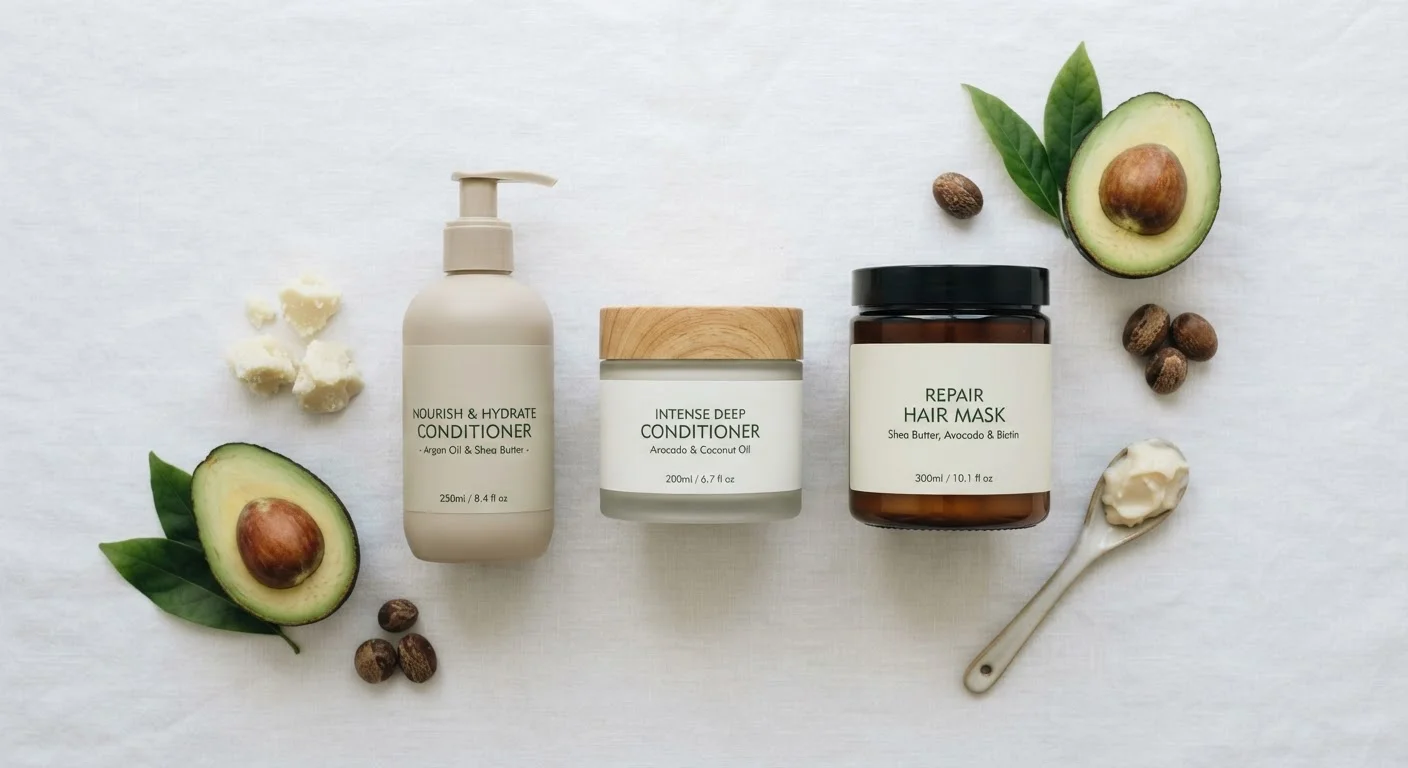
Regular conditioner handles everyday maintenance and detangling, deep conditioner restores moisture balance on a weekly or biweekly basis, and hair masks address more acute concerns like breakage, dryness, or chemical damage. None of the three fully replaces the others - each occupies a specific role in a well-rounded hair care routine.
| Best for | Recommended |
|---|---|
| Those washing hair frequently and needing lightweight daily moisture | Regular Conditioner |
| Those with dry, coarse, or color-treated hair needing regular replenishment | Deep Conditioner |
| Those dealing with significant breakage, heat damage, or extreme dryness | Hair Mask |
| Those with tightly coiled or high-porosity hair needing layered moisture support | All Three in Rotation |
Why These Three Products Get Confused
Walk down any hair care aisle and you'll find shelves stacked with conditioners, deep conditioners, and masks - many of them in nearly identical packaging. Marketing language often blurs the lines further, with terms like "intensive conditioning mask" or "deep treatment conditioner" appearing on what are essentially different product types. The confusion is understandable, but using these products without understanding their distinct functions means you're likely leaving results on the table.
The core difference lies in penetration depth, concentration of active ingredients, and intended frequency of use. For a deeper look at how ingredient formulation affects product performance, understanding what's actually on a hair product label is a useful starting point.
Regular Conditioner: Your Everyday Moisture Seal
Standard rinse-out conditioner is designed to be used after every wash. Its primary job is to smooth the hair cuticle - the outermost layer of each strand - which opens slightly during shampooing. By sealing the cuticle back down, conditioner reduces friction, adds softness, and makes detangling easier.
Formulations typically rely on cationic (positively charged) surfactants, silicones, and lightweight humectants. These coat the surface of the hair rather than penetrating the cortex deeply. That's intentional: regular conditioner is built for speed and convenience, not intensive treatment. Most formulas are rinsed out within a few minutes.
This is the right tool for managing manageability between wash days and maintaining everyday softness. It is not designed to reverse damage or significantly restore moisture to hair that's severely dry or compromised.
| Regular Conditioner | Deep Conditioner | Hair Mask | |
|---|---|---|---|
| Primary purpose | Seal cuticle, add slip | Restore moisture balance | Repair damage or extreme dryness |
| Penetration depth | Surface (cuticle layer) | Cuticle + some cortex | Cortex-focused, structural |
| Typical leave-on time | 1-3 minutes | 5-30 minutes | 20-60+ minutes |
| Recommended frequency | Every wash | Weekly or biweekly | Monthly or as needed |
| Best suited for | All hair types, daily use | Dry, color-treated, coarse hair | Damaged, heat-stressed, or very dry hair |
| Key ingredient focus | Cationic surfactants, silicones | Humectants, fatty alcohols, proteins | Proteins, bond builders, heavy emollients |
Deep Conditioner: Penetrating Moisture Replenishment
Deep conditioners are formulated with a higher concentration of moisturizing agents - often including proteins, ceramides, fatty alcohols, and emollients - and are meant to sit on the hair for an extended period, typically between 5 and 30 minutes. This dwell time allows some of the active ingredients to move past the cuticle and interact with the hair's cortex, the structural core of each strand.
They're generally recommended once a week or every two weeks, depending on hair type and condition. People with dry, high-porosity, color-treated, or chemically processed hair tend to benefit from more frequent use. For those with fine or low-porosity hair, applying heat during the treatment (via a hooded dryer or steam cap) can help open the cuticle and improve absorption.
Type 4 hair textures - which tend toward lower natural moisture retention due to the coiled structure - often rely heavily on deep conditioning as a foundational step in their routine.
Hair Mask: Targeted Repair for Stressed Strands
Hair masks sit at the most intensive end of the spectrum. They're formulated with higher concentrations of reparative ingredients - such as hydrolyzed proteins, bond-building compounds, or heavy oils - and are typically designed to address a specific concern: breakage, extreme dryness, heat damage, or post-chemical processing recovery.
Most masks are applied for 20 minutes to an hour, sometimes longer. Some are formulated to work with heat. Unlike deep conditioners, which focus broadly on hydration, masks often target structural repair or have a more targeted ingredient payload. If you're weighing whether a treatment is the right response - or whether trimming damaged ends makes more sense - understanding the difference between split ends and breakage can help clarify the decision.
Masks are generally used less frequently than deep conditioners - perhaps once a month or during periods of increased stress on the hair.
Maximize Mask Effectiveness With Heat
Applying gentle heat - using a hooded dryer, steam cap, or even a warm towel wrap - while your hair mask processes can improve ingredient absorption, especially for low-porosity hair. The warmth helps lift the cuticle slightly, allowing active ingredients to penetrate more effectively. Keep heat moderate to avoid additional stress on already-compromised strands.
How to Build a Routine Using All Three
A practical approach is to layer these products by need rather than treating them as interchangeable. Use a regular conditioner after every wash as a baseline. Incorporate a deep conditioner weekly or biweekly depending on your hair's moisture needs. Reserve the hair mask for periods when damage, dryness, or breakage is more pronounced.
Scalp health also matters here - conditioners and masks should generally be applied mid-shaft to ends, not directly on the scalp. For a fuller picture of why scalp care and hair care are distinct practices, separating scalp care from hair care is worth reviewing.
Hair porosity - how readily your strands absorb and retain moisture - plays a significant role in how each product performs. Low-porosity hair may find thick masks sit on top rather than absorbing; high-porosity hair often benefits from protein-rich treatments to help retain moisture longer. If you're uncertain about your hair's porosity, a stylist can help you assess it.
This article is for general informational purposes only. For personalized hair care advice, particularly if you are experiencing scalp conditions or significant hair loss, consult a qualified dermatologist or trichologist.
The content on this site is provided for informational purposes only and should not be considered a substitute for professional advice. While we strive to provide accurate and up-to-date information, we make no guarantees regarding its completeness or accuracy. Always consult a qualified professional for advice specific to your circumstances before making any decisions.