

Our Verdict
USB chargers are the practical default for most drivers - affordable, plug-and-play, and more than adequate for everyday devices. Power inverters earn their place when you regularly need to run AC-powered equipment like laptops or small appliances on the road. Neither approach is risk-free; both require attention to wattage limits and battery load.
Drivers who primarily charge phones and earbuds will find a quality USB charger sufficient, while road warriors, tradespeople, or frequent travelers powering larger electronics will benefit most from a low-to-mid wattage power inverter.
How Each Option Works
Both USB chargers and power inverters draw power from your vehicle's 12V electrical system - typically accessed through the 12V outlet (often still called the cigarette lighter port) or, in some modern vehicles, directly hardwired under the dash.
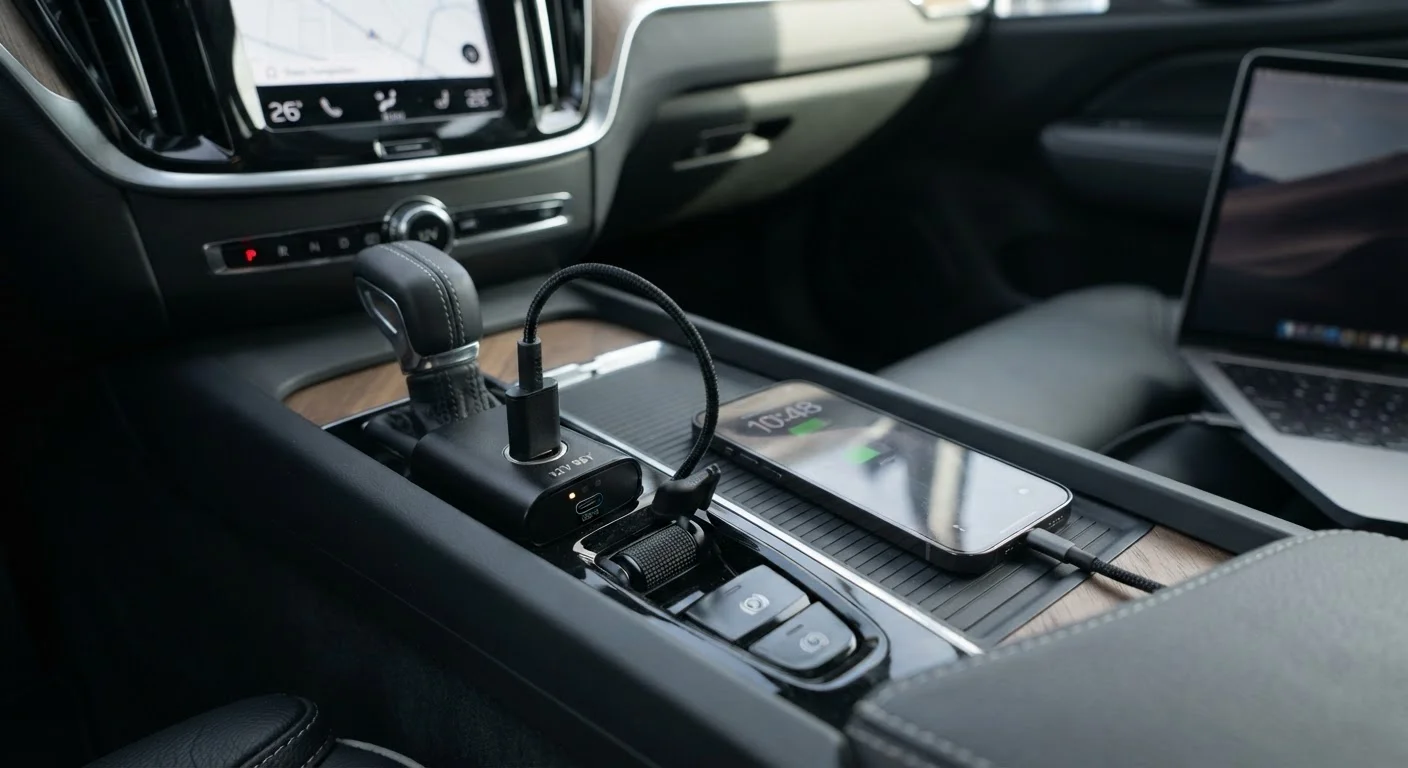
A USB car charger is a small adapter that steps the 12V DC supply down to the 5V or 9V DC output that USB standards require. Most current models feature multiple ports, including USB-A and the faster USB-C, with some supporting Power Delivery (PD) protocols for quicker charging of compatible devices.
A power inverter converts the vehicle's 12V DC power into 120V AC - the same type of power that comes from a household wall outlet. That means it can run anything with a standard AC plug: laptop chargers, small fans, CPAP machines, or power tools. Inverters are rated by wattage; consumer models typically range from 150W to 2,000W, though units above 400W generally require a direct connection to the vehicle battery rather than the 12V outlet.
A Note on Modified vs. Pure Sine Wave
Most affordable inverters produce a modified sine wave, which works well for phone chargers, LED lights, and simple appliances. However, sensitive electronics - including some medical devices and audio equipment - may require a pure sine wave inverter for reliable, safe operation. Check the device manufacturer's guidance before connecting it to a modified sine wave unit.
For more context on how your vehicle's electrical ecosystem supports accessories, see our complete guide to car accessories.
Pros and Cons of USB Car Chargers
USB chargers are the most common in-car charging solution for good reason. They're simple, affordable, and well-matched to the devices most drivers carry daily.
Compact and easy to install in seconds
USB chargers plug directly into the 12V outlet with no tools or wiring required, making them accessible for any driver regardless of technical skill.
Low cost with wide device compatibility
Multi-port USB chargers are widely available at modest price points and cover the majority of consumer electronics through standard USB-A and USB-C connections.
USB-C Power Delivery supports fast charging
Modern USB-C PD chargers can deliver enough wattage to meaningfully charge tablets and some laptops, not just smartphones, closing the gap with inverters for many users.
Minimal battery drain on the vehicle
Even multi-port USB chargers draw relatively little current compared to inverters, posing a low risk to the vehicle's electrical system during normal use.
That said, USB chargers do have meaningful limitations. If you carry a mix of devices - a tablet, wireless earbuds, a dashcam, and a phone - you may find yourself shuffling cables or hunting for a multi-port hub. And while USB-C with Power Delivery can push 65W or more to a laptop, some laptops still charge more efficiently via their AC adapter through an inverter.
Cannot power standard AC devices
Devices that require a 120V AC outlet - such as most laptop power bricks, CPAP machines, or small appliances - cannot be used with a USB charger alone.
Output limited by the 12V socket's amperage
Most 12V outlets are fused at 10-20 amps, which caps the total wattage available to all connected USB ports simultaneously.
Cable quality significantly affects performance
A low-quality or non-compliant USB cable can restrict charging speed even when a capable charger is used, leading to frustrating slow-charge experiences.
Charging speed is also influenced by the cable itself. A USB-C cable that doesn't support the full PD spec will bottleneck even a high-output charger. It's worth pairing your charger with a cable rated for the wattage you need.
For drivers who also use a phone mount, cable routing becomes part of the equation - see our guide on safe phone mount placement for practical setup tips.
Pros and Cons of Power Inverters
A power inverter opens up your car to virtually any AC-powered device, making it a genuinely versatile tool for long hauls, job sites, or emergency preparedness.
150-400W
Typical 12V outlet-compatible inverter range
Inverters within this wattage range can generally draw power safely from the vehicle's 12V socket without requiring a direct battery connection.
~1 hour
Estimated battery run time at 200W load
A standard 12V automotive battery can typically sustain a 200W inverter load for roughly one hour with the engine off before voltage drops to unsafe levels.
Inverters also introduce trade-offs that USB chargers don't. Larger units require direct battery connections, and running high-wattage appliances with the engine off can deplete a standard 12V battery surprisingly fast - typically within an hour or less for loads above 200W. Always run the engine or keep an eye on voltage when drawing significant power.
Modified sine wave inverters (the more common, lower-cost type) work fine for most resistive loads like phone chargers and fans, but some electronics - notably medical devices and certain audio equipment - perform better or are rated only for pure sine wave output. Pure sine wave inverters cost more but produce cleaner power.
If you're also considering other emergency power tools for your vehicle, our comparison of portable jump starters vs. jumper cables covers related electrical considerations worth knowing.
Choosing the Right Solution for Your Needs
The honest answer is that most drivers don't need to choose between one or the other - they serve different roles. A compact USB charger handles daily device charging with minimal fuss, while an inverter stays in the trunk for trips or tasks that demand more power.
When evaluating either option, consider:
- Device list: If everything you charge has a USB port, an inverter adds complexity without benefit.
- Wattage needs: Add up the peak wattage of devices you'd run simultaneously. A 150W inverter won't handle a 90W laptop charger and a small fan at the same time.
- Vehicle compatibility: Older vehicles with smaller alternators and basic 12V sockets can struggle to support high-draw accessories reliably.
- Usage pattern: Frequent long-distance drivers or those who work from their vehicles have very different requirements than urban commuters.
Drivers interested in how in-car power relates to the broader EV vs. combustion-engine discussion will find relevant context in our article on electric vehicles vs. petrol cars, which covers on-board charging infrastructure differences.
The content on this site is provided for informational purposes only and should not be considered a substitute for professional advice. While we strive to provide accurate and up-to-date information, we make no guarantees regarding its completeness or accuracy. Always consult a qualified professional for advice specific to your circumstances before making any decisions.