

Option A
Portable Jump Starter
The self-sufficient, solo-capable solution.
Best for: Drivers who frequently travel alone, park in remote areas, or want a tool that works without a second vehicle.
Option B
Jumper Cables
The time-tested, reliable standby.
Best for: Drivers who typically have access to other vehicles and want a low-maintenance, long-lasting backup option.
How Each Tool Actually Works
Despite achieving the same result - a restarted engine - portable jump starters and jumper cables operate on fundamentally different principles.
Jumper cables are passive conductors. They transfer electrical current from a donor vehicle's live battery to your dead one, allowing enough charge to build up for the engine to crank. The process relies entirely on an outside power source - typically another car parked nose-to-nose or bumper-to-bumper with yours.
Portable jump starters (sometimes called booster packs) contain their own internal lithium-ion or lead-acid battery. They clamp directly onto your dead battery and deliver a short, high-amperage burst of current - no second vehicle required. Once the engine starts, your alternator takes over and begins recharging the depleted battery as you drive.
Understanding this distinction is the foundation of every other trade-off between the two tools. One depends entirely on circumstances; the other carries its power source with it.
| Criterion | Portable Jump Starter | Jumper Cables |
|---|---|---|
| Requires a second vehicle | No | Yes |
| Ongoing maintenance | Recharge every 3-6 months | Virtually none |
| Typical upfront cost | Higher | Lower |
| Risk of being unprepared | If battery depleted | If no donor vehicle nearby |
| Additional features | USB charging, flashlight (often) | None |
| Lifespan | 3-7 years (battery-limited) | 10+ years with basic care |
| Best environment | Remote or solo driving | Urban or suburban driving |
Practical Trade-Offs: Independence, Reliability, and Cost
The most significant advantage of a portable jump starter is independence. You are not waiting for a passing driver willing to help, nor are you relying on a roadside assistance arrival window. In rural areas, on overnight trips, or when parked in an isolated lot, this autonomy can be the difference between a minor inconvenience and a multi-hour ordeal.
Jumper cables, however, have a compelling counter-argument: they cannot fail due to their own depleted charge. A jump starter that hasn't been recharged in eight months may not have enough power to start a cold engine - especially with larger displacement V6 or V8 engines that demand more cranking amps. Cables, by contrast, work as long as a charged donor battery exists.
Cold Weather and Battery Demand
In cold climates, battery-related breakdowns spike in winter - and cold temperatures also reduce a jump starter's own battery capacity. If you live in a region with harsh winters, look for a jump starter with a peak amperage rating well above the minimum required for your engine size. This buffer accounts for both the cold-reduced output of the jump starter itself and the higher cranking demands of a cold engine.
Cost is also a meaningful factor. A reliable set of jumper cables - with heavy-gauge copper clamps and sufficient cable length (at least 12 feet is generally recommended) - can be purchased for a modest sum and will last many years. Portable jump starters with adequate peak amperage for most passenger vehicles carry a noticeably higher price point, and their internal batteries have a finite lifespan, typically requiring replacement or unit retirement after several years of regular use.
For drivers who already carry a portable tyre inflator or other powered accessories, a jump starter with a built-in USB power bank adds genuine multi-purpose value to the trunk kit.
Which Belongs in Your Vehicle?
There is no universally correct answer - context matters more than any single feature.
Consider your typical driving patterns. Commuters in dense metro areas are rarely more than a flagged-down driver away from a jump. For them, quality jumper cables stored neatly in the trunk represent a practical, reliable, and economical choice. The key is ensuring the cables are long enough to reach between two vehicles parked in realistic configurations - short cables create awkward positioning problems at the worst possible moment.
Drivers who regularly cover long distances on rural highways, travel solo at night, or park in areas with low foot traffic gain real safety value from a portable jump starter. The peace of mind alone is worth factoring into the decision. It is worth noting, however, that maintenance discipline is non-negotiable: most manufacturers recommend recharging the unit every three to six months, even when unused, to ensure it holds adequate charge when needed.
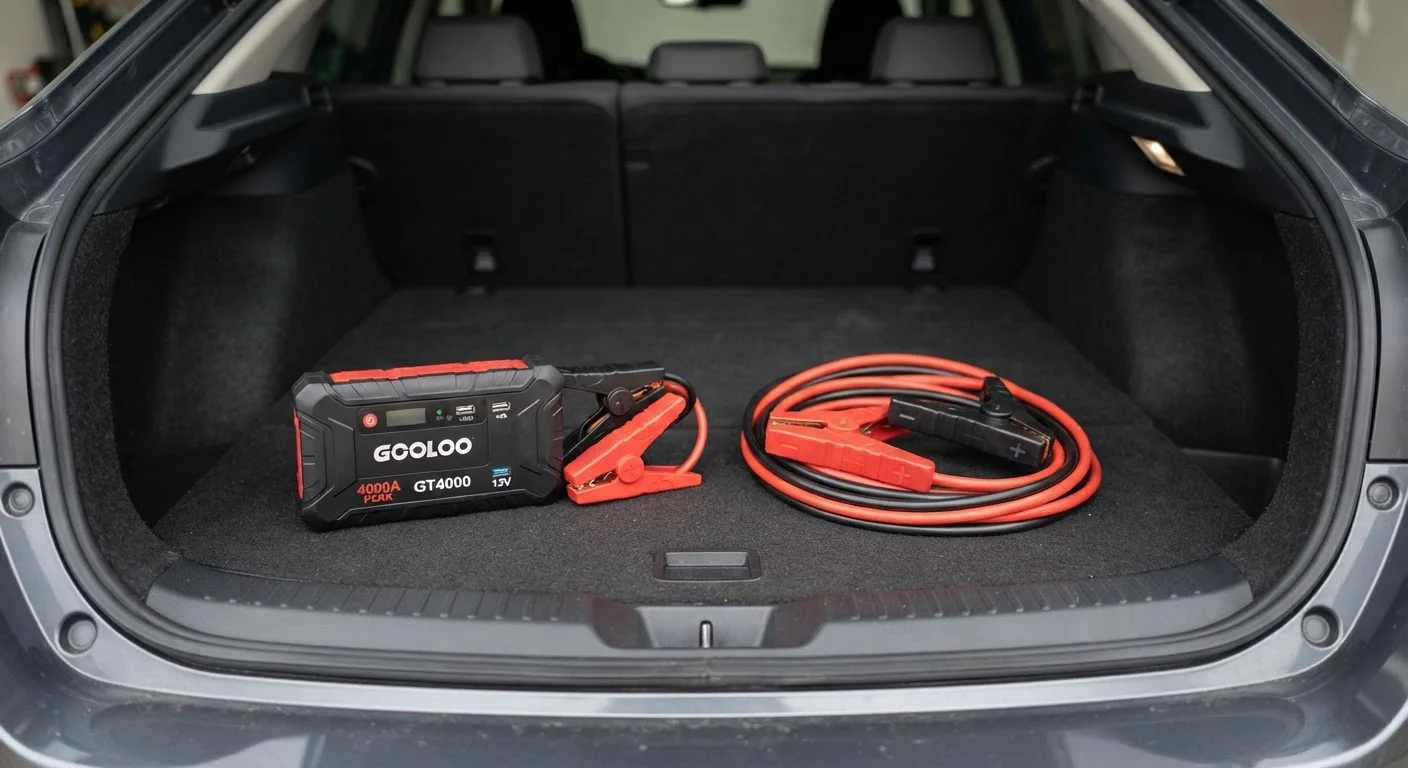
Some drivers choose to carry both - cables as a failsafe backup and a jump starter as the primary tool. Given how compact modern jump starters have become, this combination is feasible without consuming significant cargo space. Think of the pairing similarly to how you might weigh USB chargers versus power inverters - the tools serve overlapping but not identical needs, and knowing the limits of each is the smartest form of preparation.
Regardless of which tool you choose, familiarize yourself with correct connection procedure - always connect positive to positive and negative to an unpainted metal ground away from the battery - before you need it roadside under stress.
The content on this site is provided for informational purposes only and should not be considered a substitute for professional advice. While we strive to provide accurate and up-to-date information, we make no guarantees regarding its completeness or accuracy. Always consult a qualified professional for advice specific to your circumstances before making any decisions.