

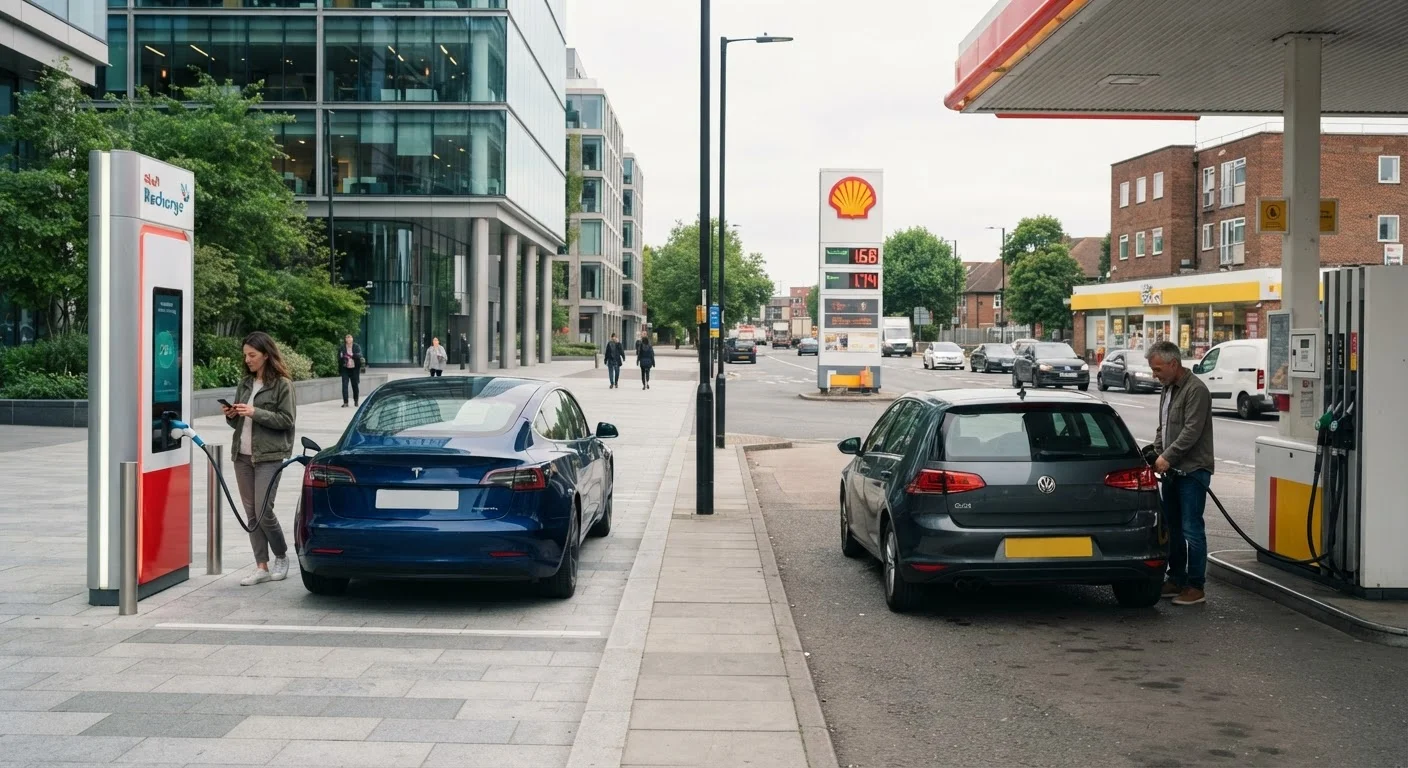
Option A
Electric Vehicles (EVs)
The forward-looking, lower-running-cost alternative.
Best for: Drivers with predictable daily routes, home charging access, and an interest in reducing fuel and maintenance costs over time.
Option B
Petrol Cars
The established, flexible, and widely supported choice.
Best for: Drivers who need maximum range flexibility, fast refuelling, and straightforward access to repair and service networks.
Running Costs: Where the Numbers Really Diverge
For many everyday buyers, day-to-day running costs are the single most important factor - and this is where EVs and petrol cars diverge most sharply. Electricity is generally cheaper per mile than petrol when charged at home on a standard residential rate. However, relying heavily on public DC fast chargers can erode that advantage, as rapid-charge pricing varies considerably by network and location.
Maintenance is another meaningful difference. EVs skip oil changes entirely and typically require less brake work, thanks to regenerative braking systems that recapture energy and reduce pad wear. Petrol vehicles carry more mechanical complexity - belts, exhausts, cooling systems, and transmission components all require periodic attention. See our guide to total cost of ownership for a fuller breakdown of how these factors compound over several years.
| Criterion | Electric Vehicles | Petrol Cars |
|---|---|---|
| Typical fuel/energy cost per mile | Lower (home charging) | Higher (pump prices) |
| Routine maintenance complexity | Lower (fewer components) | Higher (oil, belts, exhaust) |
| Upfront purchase price | Generally higher | Generally lower |
| Refuel/recharge time | 20-60+ min (fast charge) | 3-5 minutes |
| Infrastructure coverage (US) | Expanding, uneven | Comprehensive, nationwide |
| Home charging option | Yes (requires setup) | Not applicable |
| Used-market depth | Growing but limited | Deep and well-established |
| Insurance costs (general trend) | Currently higher | Generally lower |
Insurance costs tend to be higher for EVs currently, partly reflecting higher repair costs for battery-related incidents and a more limited pool of trained technicians. This gap is narrowing as the market matures, but it's worth factoring into any budget comparison.
Range, Charging, and the Infrastructure Reality
Range anxiety - the concern about running out of charge before reaching a charger - remains one of the most cited barriers to EV adoption. In practice, most current EVs offer ranges well suited to average US daily driving distances, which according to the Federal Highway Administration typically average around 37 miles per day. The challenge arises on longer trips or in areas where public charging coverage is thin.
Petrol infrastructure, by contrast, is deeply embedded across the country. Refuelling takes three to five minutes almost anywhere. EV charging, even at fast-charge speeds, still requires meaningfully longer stops - though for drivers who charge overnight at home, this largely ceases to be a daily concern.
Public Charging Reliability Varies Widely
Not all public charging stations deliver the same experience. Station availability, charge speed, and payment reliability differ across networks and regions. Before committing to an EV without home charging, it's worth researching the density and condition of public chargers along your most common routes. Apps and mapping tools maintained by charging networks can provide a realistic picture of local coverage.
For a broader look at how different fuel types compare on a practical level, the Fuel Type Decoded guide covers petrol, diesel, hybrid, and electric options side by side.
The Ownership Experience Day to Day
Beyond the numbers, ownership feel matters. EV drivers often describe the experience as simpler in daily use - no trips to a petrol station for routine commutes, smooth and quiet acceleration, and over-the-air software updates that can improve vehicle behaviour without a workshop visit. Petrol car drivers, on the other hand, benefit from a mature, well-understood ecosystem: service centres everywhere, a large pool of experienced mechanics, and no uncertainty about where to refuel on a road trip.
Depreciation is a factor worth watching. EV residual values have been volatile as newer models with greater range enter the market, which can affect both resale and lease economics. The buying vs. leasing comparison explores how these dynamics play out across ownership structures. Petrol vehicles, especially proven platforms with long track records, tend to have more predictable used-market values - though this advantage may narrow as EV adoption widens.
Practical accessory and modification considerations also differ between the two. EV owners, for example, may prioritise in-car charging for devices differently - our guide to in-car USB chargers and power inverters covers what's worth considering. And regardless of which powertrain you choose, ongoing upkeep is central - the car maintenance hub is a useful resource for keeping any vehicle running reliably.
~37 miles
Average US daily driving distance per driver
According to the Federal Highway Administration, most American drivers travel well within the range capability of mainstream EVs on a typical day.
~3-5 min
Time to refuel a petrol car
Compared to 20-60+ minutes for a DC fast-charge session for an EV, petrol refuelling remains significantly faster for long-distance travel scenarios.
The content on this site is provided for informational purposes only and should not be considered a substitute for professional advice. While we strive to provide accurate and up-to-date information, we make no guarantees regarding its completeness or accuracy. Always consult a qualified professional for advice specific to your circumstances before making any decisions.