

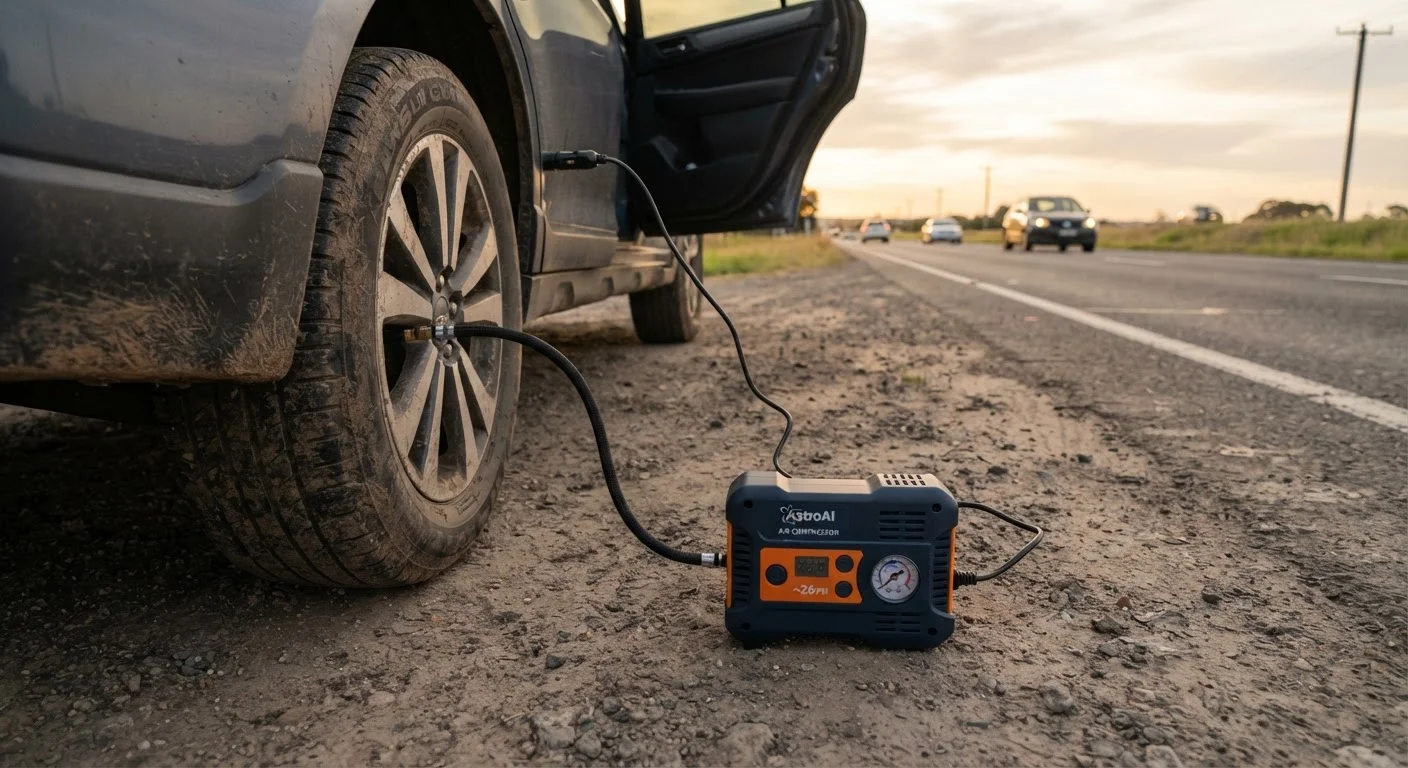
How a Portable Tyre Inflator Actually Works
At the core of every portable tyre inflator is a small electric motor driving either a piston or a diaphragm to compress ambient air and push it into a tyre. When you connect the inflator's hose to the tyre's valve stem and set a target pressure - usually via a digital display - the motor runs until the sensor detects that pressure has been reached, then shuts off automatically.
Power sources split into two main types. 12V models plug into a vehicle's 12-volt accessory outlet (formerly called a cigarette lighter socket). They draw constant power from the car's electrical system, meaning they won't run out mid-task - though they do require the engine to be running or at least the ignition on to avoid draining the battery. Cordless models use rechargeable lithium-ion battery packs, offering more freedom of movement but finite run time. Some higher-end cordless units share battery platforms with power tools, which is convenient if you already own compatible tools.
The built-in pressure gauge is critical. Cheaper units sometimes read inaccurately - which matters because both under- and over-inflation affect handling and tyre wear. For a deeper look at what correct tyre pressure means for your vehicle, see our practical guide to tyre pressure and tread depth.
Inflators Don't Diagnose the Cause of Pressure Loss
A portable inflator restores pressure but won't tell you why a tyre lost it. If a tyre repeatedly drops pressure over days or weeks, it likely has a slow puncture, a faulty valve core, or a compromised bead seal - all of which require inspection by a tyre professional. Repeatedly topping up a damaged tyre without investigation is not a safe long-term strategy.
When a Portable Inflator Is - and Isn't - the Right Tool
Portable inflators genuinely earn their place in several scenarios. Gradual pressure loss from temperature drops or a slow, minor puncture is the most common use case. Many drivers find their TPMS warning light activates on cold winter mornings when tyre pressure drops a few PSI overnight - a portable inflator resolves this in minutes without a trip to the gas station. If you're not sure what your TPMS light is signalling, this guide to reading a tyre pressure monitoring system breaks down what each alert means.
When paired with an aerosol tyre sealant, inflators can also temporarily seal minor tread punctures - enough to reach a tyre shop safely. However, sealant-treated tyres typically need professional assessment soon after, and some sealants can complicate TPMS sensor repairs.
There are situations where an inflator simply can't help. Sidewall damage, blowouts, and severe tread separation require a spare tyre or a tow. If the tyre has lost its bead seal from the rim, no portable unit will re-seat it - that requires a dedicated mounting machine. An inflator is a complement to, not a replacement for, a properly inflated spare and a roadside assistance plan. For similar thinking about other emergency tools, see portable jump starters vs. jumper cables.
Check Your Tyre's Recommended PSI First
Before using any inflator, confirm the correct target pressure for your vehicle. Look for the sticker inside the driver's door jamb or consult the owner's manual - the number moulded into the tyre sidewall is the maximum allowable pressure, not the recommended operating level. Inflating to the sidewall maximum can cause overinflation, affecting handling and comfort.
Key Features Worth Evaluating
Not all portable inflators are equivalent. A few technical specifications meaningfully affect real-world usefulness:
- Maximum pressure rating: Passenger cars typically need 32-36 PSI; light trucks may require 50-80 PSI. Confirm the unit's ceiling matches your vehicle type.
- Flow rate: Expressed in L/min or CFM, this determines inflation speed. Higher-volume tyres (SUVs, trucks) benefit from a higher flow rate.
- Gauge accuracy: A unit that reads 2-3 PSI off in either direction undermines the point of precision inflation. Look for models with verified gauge accuracy.
- Hose length: Short hoses create awkward positioning. A hose of at least 20 inches reaches all four tyre positions more comfortably.
- Heat management: Extended use generates heat. Duty cycle ratings - the percentage of time a motor can run before needing to cool - indicate how well a unit handles multiple tyres in succession.
- Auto-shutoff: Stops inflation at the preset pressure, preventing overinflation without requiring you to watch the gauge continuously.
For drivers who already rely on USB power in the car, understanding your vehicle's overall electrical capacity is also worthwhile - see our breakdown of USB chargers and power inverters for context on power draw trade-offs.
Who Benefits Most From Carrying One
Portable tyre inflators offer the most consistent value to specific driver profiles. Frequent highway commuters and road-trip drivers who cover long distances between service stations are the clearest beneficiaries - a slow leak on an unfamiliar stretch of road is far less stressful when you have a functioning inflator in the boot.
Drivers of vehicles without a full-size spare - including many modern sedans and crossovers that ship with a compact spare or run-flat tyres - have reduced margin for error, making an inflator a more practical first-response tool. Similarly, outdoor and off-road enthusiasts who intentionally drop tyre pressure for traction on dirt or sand need a reliable way to re-inflate before returning to paved roads.
For general car maintenance context beyond tyre care, the car maintenance hub covers the broader upkeep routines that keep a vehicle roadworthy.
Drivers who park primarily near service stations, carry a full-size spare, and rarely venture far from urban infrastructure will get less everyday value - though even for them, an inflator's compact size means storage cost is low relative to the occasional utility it provides.
Frequently Asked Questions
It depends on why the tyre went flat. If a slow puncture has left the tyre deflated but the tyre bead is still seated on the rim, many inflators can restore pressure. However, if the tyre has lost its bead seal or the damage is severe, an inflator alone won't be enough - you'll need professional assistance or a spare tyre.
For a standard passenger car tyre that's only partially deflated, most inflators take between 3 and 8 minutes. A completely flat tyre on an SUV or truck can take significantly longer. Flow rate (measured in L/min) is the main factor affecting speed.
Modern cordless inflators, especially those using 18V or 20V lithium-ion battery platforms, perform comparably to many 12V models for passenger vehicles. However, battery capacity limits run time, so they may struggle with multiple tyres or high-volume applications like light truck tyres.
Your vehicle's recommended tyre pressure is printed on a sticker inside the driver's door jamb or in the owner's manual - not on the tyre sidewall, which shows the maximum allowable pressure. Most passenger cars fall between 30 and 36 PSI, though trucks and SUVs can require more.
Many inflators include adapter nozzles for Presta and Schrader valve stems and needle adapters for sports balls. Road bike tyres typically require much higher pressures (80-130 PSI) than car tyres, so check that the inflator's maximum pressure rating is sufficient before relying on it.
Most reputable inflators have an auto-shutoff feature that cuts power when the target pressure is reached, reducing the risk of overinflation. Even so, it's good practice to stay nearby during inflation, as motor heat can build up during extended use, particularly with larger tyres.
The content on this site is provided for informational purposes only and should not be considered a substitute for professional advice. While we strive to provide accurate and up-to-date information, we make no guarantees regarding its completeness or accuracy. Always consult a qualified professional for advice specific to your circumstances before making any decisions.