

What the Socialisation Window Actually Means
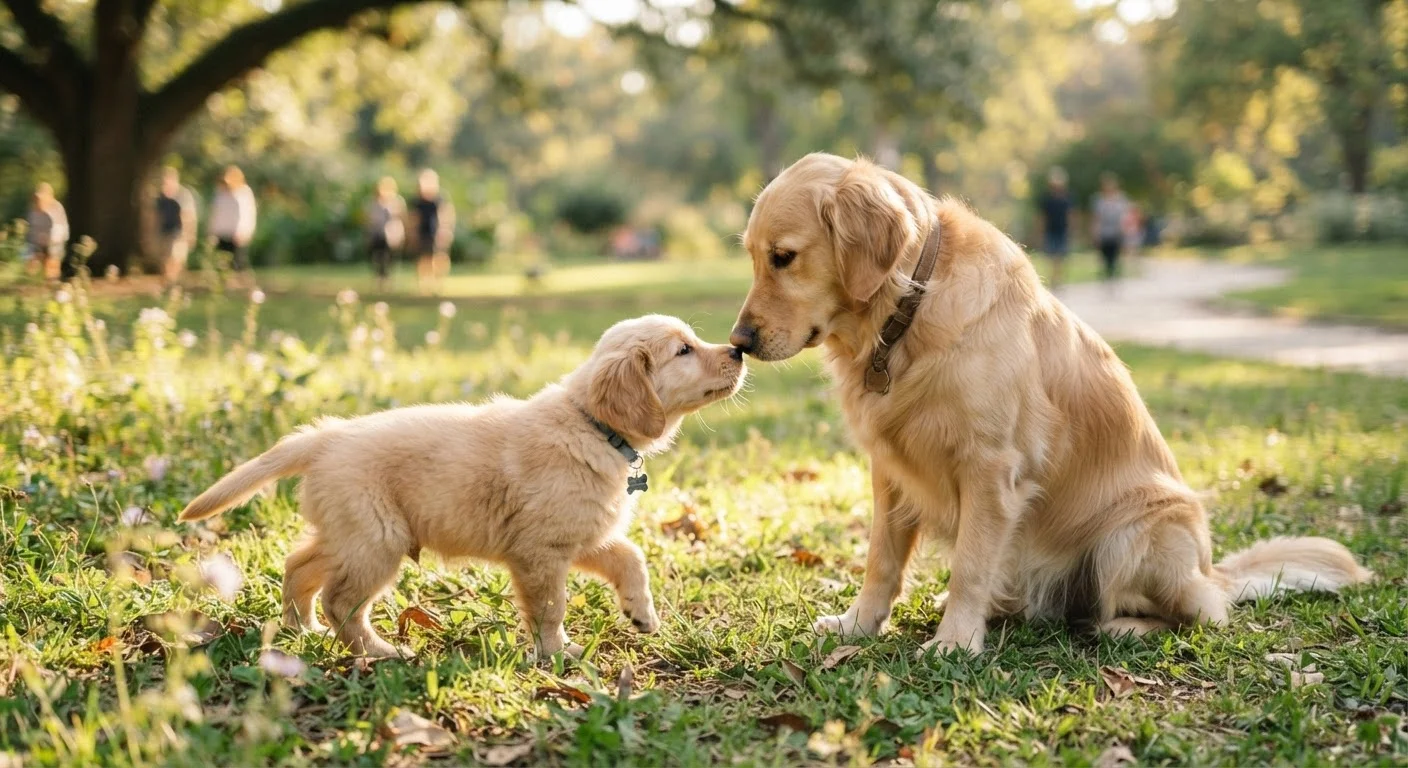
The term "socialisation window" describes a developmental phase during which a puppy's brain is especially open to forming lasting associations with the world around it. Between roughly 3 and 14 weeks of age, a puppy exposed to diverse people, animals, sounds, surfaces, and environments is more likely to interpret those stimuli as ordinary and safe throughout adult life.
This is not simply about being friendly. It is about the neural architecture of perception. During this window, fear responses are dampened relative to exploratory drive, allowing puppies to approach and investigate novelty without triggering the avoidance behaviour that would be more dominant in an older dog. Once the window closes, the brain defaults to greater caution about unfamiliar stimuli - an evolutionarily useful trait that, in a domestic context, can become a source of reactivity or anxiety.
Importantly, "socialisation" does not mean overwhelming a puppy with stimulation. The goal is controlled, positive exposure - experiences that conclude with the puppy feeling safe, not stressed. Understanding this distinction is essential, because a frightening experience during the window can be just as formative as a positive one.
The Stages Within the Critical Period
The socialisation window is not a uniform block of time. Researchers in canine development commonly divide early puppyhood into overlapping phases, each with its own significance.
- Neonatal period (0-2 weeks): Eyes and ears are closed. The puppy is almost entirely dependent on warmth and feeding. Gentle handling by humans begins to lay groundwork for human-animal bonds.
- Transitional period (2-3 weeks): Senses open rapidly. The puppy begins to engage with its immediate environment and littermates.
- Socialisation period (3-12 weeks): The core window. Exposure to humans, other animals, varied sounds, and environmental surfaces during this phase builds the "template" for what the dog will accept as normal. Around 8 weeks, many puppies experience a secondary fear period - brief but notable - during which frightening experiences can leave a strong negative imprint.
- Juvenile period (12-24 weeks and beyond): The socialisation window is effectively closed, but learning continues. Consistent, positive exposure still matters and reinforces earlier foundations.
3-14 weeks
Primary socialisation window in domestic dogs
This range is cited consistently in veterinary behavioural literature, including guidance published by the American Veterinary Society of Animal Behavior.
~8 weeks
Age most puppies enter new homes
Eight weeks falls within the core socialisation period, making the first weeks of ownership among the most behaviorally consequential a dog will experience.
Up to 70%
Behaviour problems linked to inadequate socialisation
Veterinary behaviourists frequently cite under-socialisation as among the most common contributing factors in fear-based and reactive behaviour cases, though exact prevalence figures vary by study.
Most puppies arrive in their new homes at 8 weeks - right inside the primary socialisation window. This makes the first several weeks of ownership disproportionately influential on long-term temperament.
What Good Socialisation Looks Like in Practice
Effective socialisation is systematic and positive, not accidental. It means intentionally introducing a puppy to the full range of experiences it is likely to encounter in adult life - and doing so in a way that keeps the puppy comfortable throughout.
A puppy brought to a busy coffee shop patio at 9 weeks, allowed to observe foot traffic from the safety of its owner's lap, and rewarded with treats for calm behaviour.
A 10-week-old puppy introduced to toddlers in a structured setting where children are coached to approach quietly and offer treats.
A breeder who begins handling each puppy's paws, ears, and muzzle daily from the second week onward.
An 11-week-old puppy attending a well-run puppy class, playing with other vaccinated puppies on varied surfaces with trainer supervision.
Key categories to address include: people of different ages, appearances, and movement patterns (including children, people using mobility aids, and people in hats or uniforms); other animals, both dogs and non-dog species the household will encounter; surfaces such as hardwood, tile, grass, gravel, and stairs; sounds including traffic, appliances, thunder recordings, and crowds; and handling of ears, paws, and mouth - essential for veterinary visits and grooming.
Pairing each new exposure with calm praise, play, or food rewards helps build positive associations. For a deeper look at how reward-based methods support this process, see our article on positive reinforcement in dog training.
Puppy classes run by qualified, force-free trainers are one structured way to provide social exposure in a controlled environment. Your veterinarian can advise on timing relative to your puppy's vaccination schedule.
When the Window Has Closed: What Owners Can Still Do
A dog that missed adequate early socialisation is not beyond help - but the approach changes. Rather than building a baseline of acceptance, the work becomes modifying an existing fear or wariness response. This typically involves gradual desensitisation (controlled, low-level exposure) combined with counter-conditioning (pairing the feared stimulus with something the dog values highly, such as food).
Progress is possible, and many dogs make meaningful improvements. However, outcomes vary based on the degree of under-socialisation, the individual dog's temperament, and the consistency of the training effort. Working with a certified professional - such as a Certified Applied Animal Behaviourist (CAAB) or a veterinary behaviourist - is advisable when fearfulness is significant or when the dog has shown reactive or aggressive behaviour.
Understanding your dog's body language is a valuable complement to any behaviour work. Our guide on how dogs communicate stress, fear, and contentment provides practical grounding in reading canine signals accurately.
Home environment also plays a supporting role. A dog managing anxiety benefits from a predictable routine and safe retreat spaces - considerations explored in our overview of crate training versus free roaming.
Prioritise Quality Over Quantity
A common mistake during the socialisation window is exposing puppies to too much, too fast. A single calm, positive introduction to a new stimulus is more valuable than five rushed or overwhelming ones. If a puppy shows signs of stress - crouching, hiding, refusing food, or trembling - end the session and try again at a lower intensity. Learning to read your puppy's comfort level is as important as the socialisation itself.
Frequently Asked Questions
The window generally opens around 3 weeks of age and begins to close between 12 and 14 weeks. Some researchers note a secondary fear period around 8 weeks, which is why the quality of new experiences during this stretch matters greatly.
Veterinary organisations, including the American Veterinary Society of Animal Behavior, generally support carefully managed socialisation before vaccination is complete, because the behavioural risk of under-socialisation is considered significant. Avoid areas with unknown dog populations and favour clean, controlled environments. Always consult your veterinarian for guidance specific to your puppy's health status.
Missed socialisation often manifests as fearfulness, reactivity, or aggression toward unfamiliar people, animals, or environments. These behaviours are manageable with professional help and consistent training, but they typically require more time and effort to address than early socialisation would have.
No. Socialisation is about exposing a puppy to a wide variety of stimuli so they learn those stimuli are safe and normal. Training teaches specific behaviours. Both are important and work best when combined, using reward-based methods.
Research suggests some variation exists across breeds in both the timing and intensity of the socialisation window. Breeds selectively developed for wariness - such as some livestock guardian breeds - may show earlier onset of fear responses. However, the core window between 3 and 14 weeks applies broadly across domestic dogs.
The content on this site is provided for informational purposes only and should not be considered a substitute for professional advice. While we strive to provide accurate and up-to-date information, we make no guarantees regarding its completeness or accuracy. Always consult a qualified professional for advice specific to your circumstances before making any decisions.