

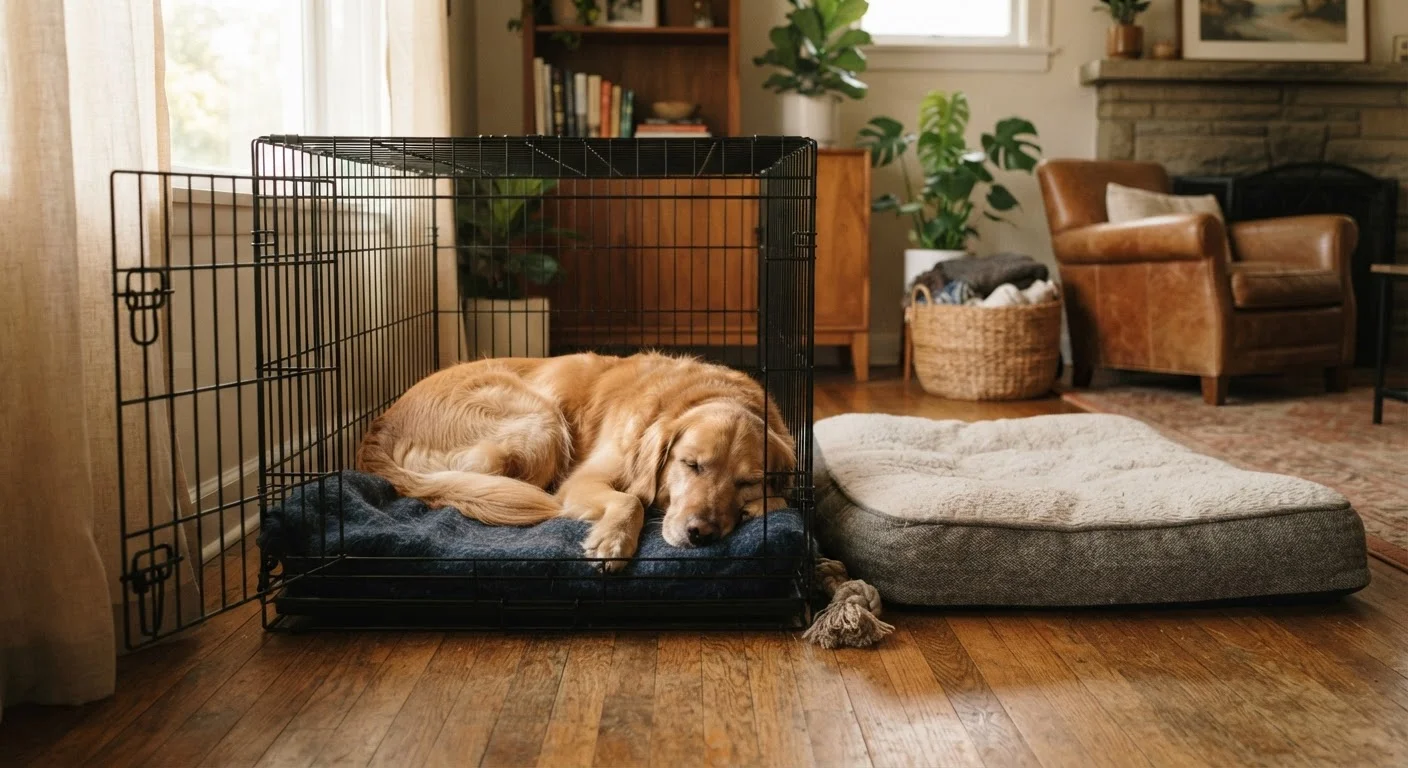
Option A
Crate Training
The structured, den-like approach favored for puppies and anxious dogs.
Best for: Puppies, newly adopted dogs, and dogs who benefit from a defined, secure space during unsupervised time.
Option B
Free Roaming
The open-access approach suited to calm, well-trained adult dogs.
Best for: Reliably house-trained adult dogs with no destructive tendencies or separation-related anxiety.
Understanding the Core Difference
Crate training involves confining a dog to a sized enclosure - typically a wire or plastic crate - during unsupervised periods, overnight, or during travel. Free roaming means allowing a dog unrestricted access to part or all of the home without confinement. Both approaches are legitimate, and neither is automatically preferable. What determines the right fit is the individual dog - not owner preference alone.
The case for crates rests on behavioral science: dogs are facultative den animals, meaning they can find comfort in enclosed, sheltered spaces when those spaces are introduced positively. A crate that is appropriately sized (large enough to stand, turn, and lie down) and associated with positive experiences becomes what many trainers describe as a "safe zone" rather than a punishment. If you're navigating the early weeks with a new dog, our guide on what to expect when bringing a dog home covers why this phase shapes long-term habits.
Free roaming, by contrast, places trust in a dog's self-regulation - an expectation that is only reasonable once house-training is solid and destructive behaviors have been ruled out through consistent observation.
Head-to-Head: Key Criteria Compared
The table below compares crate training and free roaming across the dimensions that matter most to everyday dog owners.
| Criterion | Crate Training | Free Roaming |
|---|---|---|
| Best life stage | Puppies and newly adopted dogs | Settled, house-trained adult dogs |
| House-training support | Strong - limits elimination opportunities | Relies on already established habits |
| Safety during unsupervised time | High - limits access to hazards | Depends on home environment and dog behavior |
| Welfare considerations | Positive when introduced correctly; harmful if overused | Positive for confident dogs; risky for anxious or untrained dogs |
| Separation anxiety risk | May help or hinder depending on the individual dog | Can increase anxiety if dog lacks coping skills |
| Owner adjustment required | Consistent training investment upfront | Ongoing vigilance and environment management |
| Flexibility over time | Can phase out as dog matures | Can be restricted if behavior issues emerge |
It's worth noting that these categories rarely have absolute right answers. A dog's individual history - including rescue background, prior socialization, and any anxiety tendencies - carries more weight than any general rule. Our article on separation anxiety in dogs outlines why some dogs are more vulnerable to confinement stress than others.
When Crate Training Makes Sense
Crate training is most strongly supported during puppyhood and the initial adjustment period after adoption. Puppies have limited bladder control - a widely cited rule of thumb is that they can hold their bladder for roughly one hour per month of age, up to a maximum of around four to five hours. A crate supports this biological reality by encouraging the pup to signal rather than simply eliminate wherever they stand.
Beyond puppies, crates serve dogs recovering from illness or surgery, dogs in multi-pet households who need a calm retreat, and dogs traveling by vehicle or air. The critical caveat: crate training works when it is introduced gradually and paired with reward-based association. Forcing a dog into a crate or using it as a timeout creates negative associations that can undermine its value entirely. Positive reinforcement principles are directly applicable to crate introduction.
~1 hr/month
Puppy bladder holding capacity by age
A commonly referenced veterinary guideline suggests puppies can hold their bladder for approximately one hour per month of age, capping around four to five hours.
14-17 hrs
Average daily sleep for adult dogs
According to the American Kennel Club, adult dogs sleep an average of 12-14 hours per day, making a comfortable, defined rest space particularly valuable.
When Free Roaming Is Appropriate
Free roaming is earned, not assumed. Most trainers and veterinary behaviorists recommend a phased approach: start with crate or tethered management, expand access room by room as trust is established, and only allow full-home access once the dog has demonstrated reliable behavior over weeks or months - not days.
Dogs who thrive with free roaming tend to share common traits: they are house-trained without exception, show no destructive chewing or counter-surfing behaviors, settle calmly when left alone, and have a stable, predictable temperament. Breed tendencies matter here too - high-energy working breeds or dogs with strong scavenging instincts may need a longer, more graduated transition than calmer companion breeds.
A common mistake is interpreting a dog's calm behavior in the owner's presence as readiness for unsupervised freedom. Dogs often behave very differently when alone. Introducing alone time progressively - starting with short absences and building up - allows owners to assess how the dog actually copes.
Crates Are Not a Solution for All Anxiety
For some dogs with significant separation anxiety, confinement can intensify distress rather than alleviate it. Signs such as excessive vocalization, attempts to escape, or self-injury in the crate warrant prompt consultation with a veterinary behaviorist or certified applied animal behaviorist. A crate should never be used as the sole intervention for anxiety-driven behavior. General information here is not a substitute for professional behavioral assessment.
Practical Transition: Moving From Crate to Free Roaming
The transition from crate to free roaming is not a single event - it's a process. A structured approach reduces the chance of regression. Begin by leaving the dog alone in one puppy-proofed room for short periods while the crate remains available as an optional retreat. Gradually extend the area and duration. If the dog makes an error - chewing, eliminating indoors, or showing signs of distress - that signals the transition is moving too quickly, not that the dog has "failed."
Keeping a crate available even after a dog has transitioned to free roaming is worthwhile. Many adult dogs voluntarily return to their crates to rest, especially if the positive association was built carefully early on. The crate stops being a management tool and becomes a chosen resting space - which is arguably the best outcome of crate training done well.
For further context on how early experiences shape long-term behavior, our piece on socialization windows and temperament development is worth reading alongside this guide.
The content on this site is provided for informational purposes only and should not be considered a substitute for professional advice. While we strive to provide accurate and up-to-date information, we make no guarantees regarding its completeness or accuracy. Always consult a qualified professional for advice specific to your circumstances before making any decisions.