

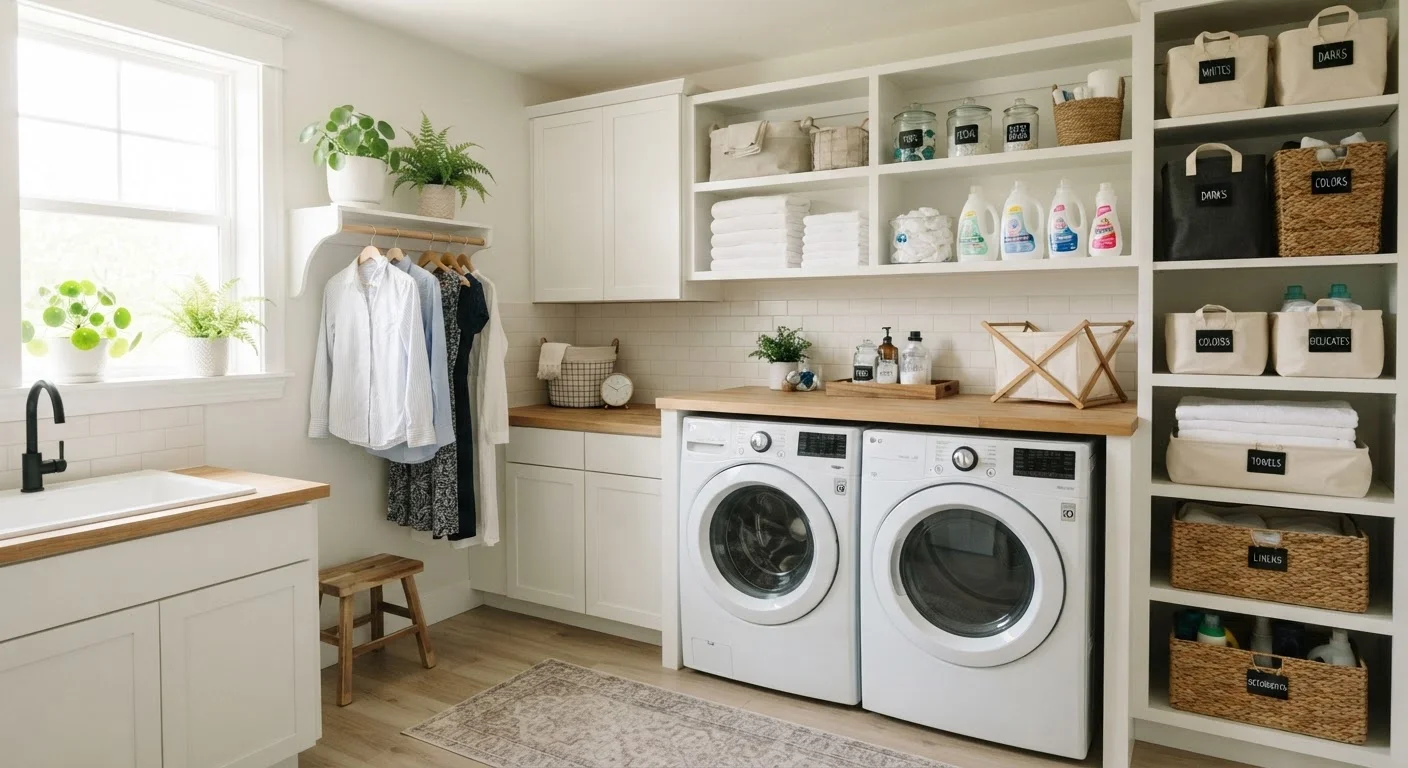
Why Laundry Rooms Fall Into Disorder
The laundry room is one of the hardest-working spaces in any home, yet it rarely gets the organisational attention given to kitchens or living areas. Items accumulate because the room is out of the main traffic flow - stray socks, half-empty detergent bottles, mystery items pulled from pockets - and without a deliberate system, each load adds a little more chaos.
The root cause is almost always a mismatch between how the space is set up and how laundry actually gets done. Most people do laundry in stages - collecting, sorting, washing, drying, folding, and putting away - and each stage needs a dedicated place to happen. When those places don't exist, every task bleeds into the next. Before buying a single bin or shelf, map your real workflow. This principle applies across the home: as the room-by-room organisation reference notes, systems built around actual behaviour last far longer than systems built around ideal behaviour.
Small Spaces Benefit Most From Vertical Thinking
If your laundry area is a closet or a narrow alcove, look up before looking sideways. Wall-mounted drying rods, stacked shelving tiers, and over-door storage can triple usable storage without touching the floor. The same principles that make small kitchens work - see small-space storage strategies - translate directly to compact laundry areas.
What You'll Need Before You Start
Gathering the right tools before reorganising saves multiple trips and prevents half-finished projects.
What you will need
Measuring tape
Measure wall space, cabinet interiors, and appliance clearances before purchasing any storage hardware.
Multi-compartment laundry sorter
Allows sorting of lights, darks, and delicates at drop-off rather than at wash time.
Wall-mounted shelving or floating shelves
Moves storage off the floor and countertop, freeing up workspace and reducing visual clutter.
Airtight canisters or uniform containers
Decant loose detergents, dryer sheets, and pods into matching containers for a cleaner, easier-to-use setup.
Label maker or adhesive labels
Clearly marks zones and containers so every household member knows where items belong.
Over-door organiser
Adds storage to the back of the laundry room door for small items like stain removers and lint rollers.
Folding table or wall-mounted fold-down surface
Provides a dedicated flat surface for folding, preventing clean laundry from piling on appliances.
Step-by-Step: Organising Your Laundry Room
Follow these steps in sequence. If you skip the early assessment steps and jump straight to storage purchases, you risk buying solutions that don't fit your actual space or habits - a common and costly mistake.
Empty and audit the entire space
Remove everything from the laundry room - shelves, cabinets, on top of appliances, behind the door. Discard empty bottles, expired products, and items that don't belong in this room. Group what remains into categories: detergents, fabric care, stain treatment, cleaning supplies, linens in transit, and miscellaneous.
This audit reveals what you actually use versus what simply accumulates. Just as a kitchen equipment audit helps cut through tool clutter, this step prevents you from building storage around items you don't need.
Measure and sketch your available space
Use your measuring tape to record the room's dimensions, wall heights, door swing clearance, and any fixed obstructions (pipes, vents, electrical panels). Note the depth of your washer and dryer and how much countertop or folding surface currently exists. Sketch a simple floor plan - it doesn't need to be precise, just proportional.
Identify which walls can accept shelving, where the lighting is strongest (ideal for the folding zone), and whether vertical space above the appliances is usable.
Define your functional zones
Every laundry room needs at minimum three zones: a dirty laundry zone (hampers or sorters near the entry point), a washing and drying zone (the appliances themselves, with immediate access to detergents), and a clean laundry zone (folding surface plus a staging area for items to be put away). In larger rooms you can add a hand-wash sink zone or an ironing zone.
Mark these zones on your sketch. They don't need to be physically separated - they just need to be mentally distinct so that clean and dirty laundry never occupy the same surface.
Install vertical storage before replacing items
Before restocking shelves, install any new wall-mounted shelving, pegboards, or over-door organisers. This is the step most people skip - they put everything back first, then try to work around it. Mounting shelves in an occupied room is significantly harder.
Anchor wall shelves into studs or use appropriate hollow-wall anchors rated for the expected load. Shelves holding full detergent bottles can carry significant weight; check the anchor rating before loading them. For any electrical or plumbing modifications - such as adding an outlet above a counter or relocating a utility sink - consult a licensed electrician or plumber. Do not attempt this work yourself.
Decant and label supplies
Transfer loose detergents, pods, and dryer sheets into uniform, airtight containers. Label each container clearly, including any usage instructions if you're switching someone else in the household to a new system. Group like items together: all stain-treatment products on one shelf tier, all detergents on another.
Keep only a reasonable supply on hand - bulk quantities belong in a pantry or storage closet, not in a small laundry room where they consume prime space.
Set up a sorting system at the entry point
Place a multi-compartment sorter near wherever dirty laundry enters the room. Label each compartment by category - lights, darks, delicates, towels - and make it a household habit to sort at drop-off. This single change eliminates the pre-wash sorting step entirely, which is one of the most time-consuming friction points in the laundry routine.
If space is extremely tight, a stackable two-bin system mounted on a wall-hung rack occupies far less floor space than a freestanding sorter.
Establish a clean-laundry staging protocol
Designate a specific surface - a countertop, a wall-mounted fold-down table, or a rolling cart - as the folding station. Clean laundry should move directly from the dryer to this surface, get folded immediately, and then move to a staging basket for each household member. Baskets lined up on a shelf by name or room make it clear who is responsible for putting their clothes away.
Avoid letting folded laundry sit on the folding surface overnight. Once this surface becomes a default resting place, the system breaks down quickly - a pattern well documented in the habit-based approach to preventing clutter rebound.
Wall Mounting Requires Proper Anchoring
Shelves loaded with detergent, fabric softener, and other supplies can become very heavy. Always anchor shelving into wall studs when possible. If studs aren't accessible, use hollow-wall anchors rated for the specific load you plan to place on them - the rating is usually printed on the anchor packaging. Improperly anchored shelving can fail suddenly and cause injury or appliance damage.
Maintaining the System Over Time
Organisation is not a one-time project; it's an ongoing habit. The most common reason laundry rooms revert to clutter is that items introduced after the initial setup have no designated home. Apply the same logic used in building a system for what comes in: every new product or tool that enters the laundry room should displace something or have a clearly defined spot.
Schedule a brief quarterly review - ten to fifteen minutes - to check that containers are correctly stocked, labels are accurate, and the zones are still serving their purpose. Households change: new family members, different detergent formats, or a new appliance can all shift what the space needs to do. Treat the layout as a living document rather than a permanent fixture.
If you're planning broader home improvements that could affect the laundry room's plumbing or electrical layout, review permit and trade requirements carefully. The bathroom renovation planning guide covers how to sequence trades and manage inspections - much of that logic applies to laundry room upgrades involving wet or electrical work, which should always be handled by a licensed professional.
The content on this site is provided for informational purposes only and should not be considered a substitute for professional advice. While we strive to provide accurate and up-to-date information, we make no guarantees regarding its completeness or accuracy. Always consult a qualified professional for advice specific to your circumstances before making any decisions.