

Reading Your Sun Path Before You Build Anything
The single most common mistake in outdoor space design is placing a seating area, shade structure, or garden bed without first understanding how the sun actually moves across that specific property. The sun's arc is not fixed - it shifts significantly between summer and winter, rising higher in the sky in June and lower in December. That means a spot that feels perfectly shaded in August may be in direct afternoon glare by early October.
Before committing to any permanent structure, spend a few days observing your yard at three key moments: early morning (around 8-9 a.m.), solar noon (roughly 12-1 p.m.), and mid-afternoon (3-4 p.m.). Note where shadows fall from your house, fences, and existing trees. Free online sun-path tools - searchable by your ZIP code - can map solar angles hour by hour for any date, giving you a fuller picture without waiting through seasons.
This observation step is especially important if you plan to install hardscape elements like a patio or pergola, since those are expensive and difficult to relocate once built.
10-15°F
Potential temperature reduction under well-designed shade
Research from urban heat studies suggests that shaded surfaces can be 10-15°F cooler than unshaded ones on hot days, though actual results vary with humidity, material type, and shade coverage.
5 mph
Wind speed at which cooling effect becomes perceptible
Human comfort research generally indicates that air movement above approximately 5 mph creates a measurable cooling sensation, even when ambient temperature is unchanged.
~30%
Cooling load reduction from strategic tree placement
The U.S. Department of Energy has noted that well-placed deciduous trees can reduce cooling loads on nearby structures, with estimates typically ranging up to roughly 30% depending on placement and climate zone.
Choosing and Positioning Shade Structures
Once you understand your sun path, you can match a shade solution to the actual problem. The main categories are fixed overhead structures (pergolas, solid roof covers), flexible fabric systems (sail shades, retractable awnings), and planted shade (trees, large shrubs, climbing vines on frames).
Fixed structures offer the most reliable shade but require the most planning. A solid roof cover blocks sun effectively but can create a hot, stagnant pocket below if airflow is restricted. If you enclose three or more sides of a covered space, consider including open lattice panels or gaps at the roofline to allow convective air movement - hot air needs somewhere to escape upward.
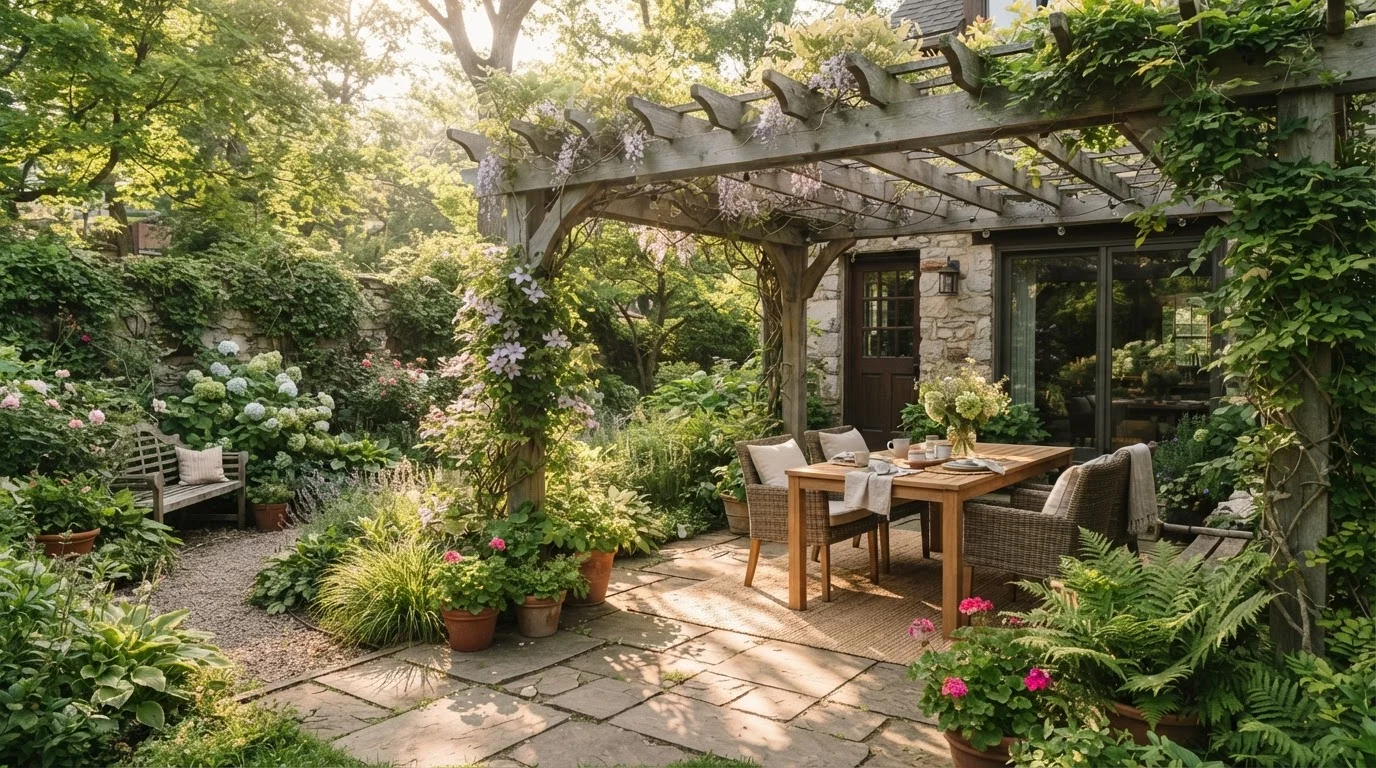
Pergolas with open slat roofing strike a middle ground. Orienting slats east-to-west blocks high overhead summer sun while allowing lower-angle morning and evening light through. Adding a deciduous climbing vine like wisteria or Virginia creeper provides seasonal shade that adjusts naturally - dense in summer, bare in winter.
Sail shades and retractable awnings give you flexibility. A sail shade angled at approximately 20-30 degrees (rather than flat) sheds heat more efficiently and resists wind better than a horizontal installation. Retractable awnings let you adapt to changing conditions throughout the day.
Test Before You Commit to Structure
Before purchasing a pergola or permanent shade structure, try positioning a large patio umbrella in your intended location and observe it across several days at different times. This low-cost trial reveals whether your chosen spot actually stays in shade when you need it - and whether airflow feels adequate - before any money is spent on installation.
Managing Airflow: The Overlooked Comfort Factor
Shade alone does not make an outdoor space comfortable on a hot, still day. Air movement is equally important - even a gentle 5 mph breeze can make air temperatures feel several degrees cooler to the human body. The challenge is that fences, walls, and dense plantings meant to create privacy can also block the breeze you're relying on for comfort.
Solid fencing on the prevailing wind side of your property creates a dead-air zone on the leeward side. Consider replacing sections of solid fence with open-board or lattice panels, or leaving a low gap beneath a fence to allow air to skim through at ground level. Gates positioned on the windward side can funnel breeze directly into a seating area when left open.
Plantings can work the same way. A mixed hedge of varying heights and densities filters and slows wind without stopping it entirely - more effective for comfort than a solid wall of foliage. To find your prevailing wind direction, local weather station data is more reliable than general assumptions, since urban and suburban terrain, nearby water, and topography all affect local patterns.
Hardscape choices also matter. Different paving materials absorb and release heat at different rates. Dark concrete or asphalt retains substantial heat and radiates it back into your space well after sunset. Lighter-colored or permeable materials - including gravel, permeable pavers, or wood decking - tend to stay cooler and release heat more quickly, contributing to a more comfortable evening environment.
Integrating Plants for Dynamic, Living Climate Control
Trees and large shrubs are the most powerful long-term tools for modifying your outdoor microclimate - and they improve over time. A deciduous shade tree planted on the west or southwest side of a patio will, within several years, block the hottest late-afternoon sun while allowing winter light through bare branches. This kind of deliberate placement is a core principle of passive cooling design.
Where plants will grow also depends on soil conditions, so it's worth understanding your site's foundation. See our guide on soil health if you're preparing new planting areas. Similarly, if you want to use the cooler, shadier edges of your outdoor space productively, many herbs and edible plants thrive in partial shade - our article on growing herbs outdoors covers placement in detail.
For a broader seasonal perspective on how shade, sun, and planting interact throughout the year, year-round outdoor living strategies can help you plan beyond summer. The goal is a space that works with natural systems rather than against them - one that stays comfortable and useful across the full arc of the day and the year.
A homeowner notices their west-facing patio becomes unbearable by 3 p.m. in summer. They install a retractable awning on the western exposure and observe a significant improvement in afternoon usability.
A family builds a fully enclosed pergola with solid side panels for privacy, then finds the space stifling even in moderate temperatures.
A gardener plants a row of arborvitae along the north property line thinking it will shelter the patio from cold winds, but the patio ends up feeling stuffy in summer.
A renter adds a sail shade over a small concrete balcony and notices the floor still feels hot through sandals at 6 p.m.
Frequently Asked Questions
Stand in your yard at morning, midday, and late afternoon at different times of year and note where shadows fall. Free sun-path calculator tools online let you enter your address and see solar angles by date and hour, which helps you anticipate seasonal shifts without guessing.
Effectiveness depends on your goals. Solid roofed structures block the most sun but can trap heat if airflow is poor. Pergolas with climbing plants or adjustable louvers offer a balance of shade and ventilation. Sail shades are flexible and affordable but provide less cooling on hot days.
Yes, strategically placed shrubs and hedges can deflect or channel prevailing winds. A dense hedge on a windward side can slow strong gusts, while a gap or angled planting can funnel breeze toward a seating area. The effect depends on plant density and height relative to wind direction.
Dark or dense hardscape materials like concrete, brick, and stone absorb heat during the day and release it slowly after sunset - a property called thermal mass. Lighter-colored surfaces, permeable pavers, or wood decking tend to release heat faster and feel cooler underfoot in the evening.
Deciduous trees - those that lose leaves in fall - are often preferable for patios because they provide dense summer shade when you need it most and allow warming winter sun through bare branches. Evergreens are better suited to blocking wind or providing year-round visual privacy.
The content on this site is provided for informational purposes only and should not be considered a substitute for professional advice. While we strive to provide accurate and up-to-date information, we make no guarantees regarding its completeness or accuracy. Always consult a qualified professional for advice specific to your circumstances before making any decisions.