

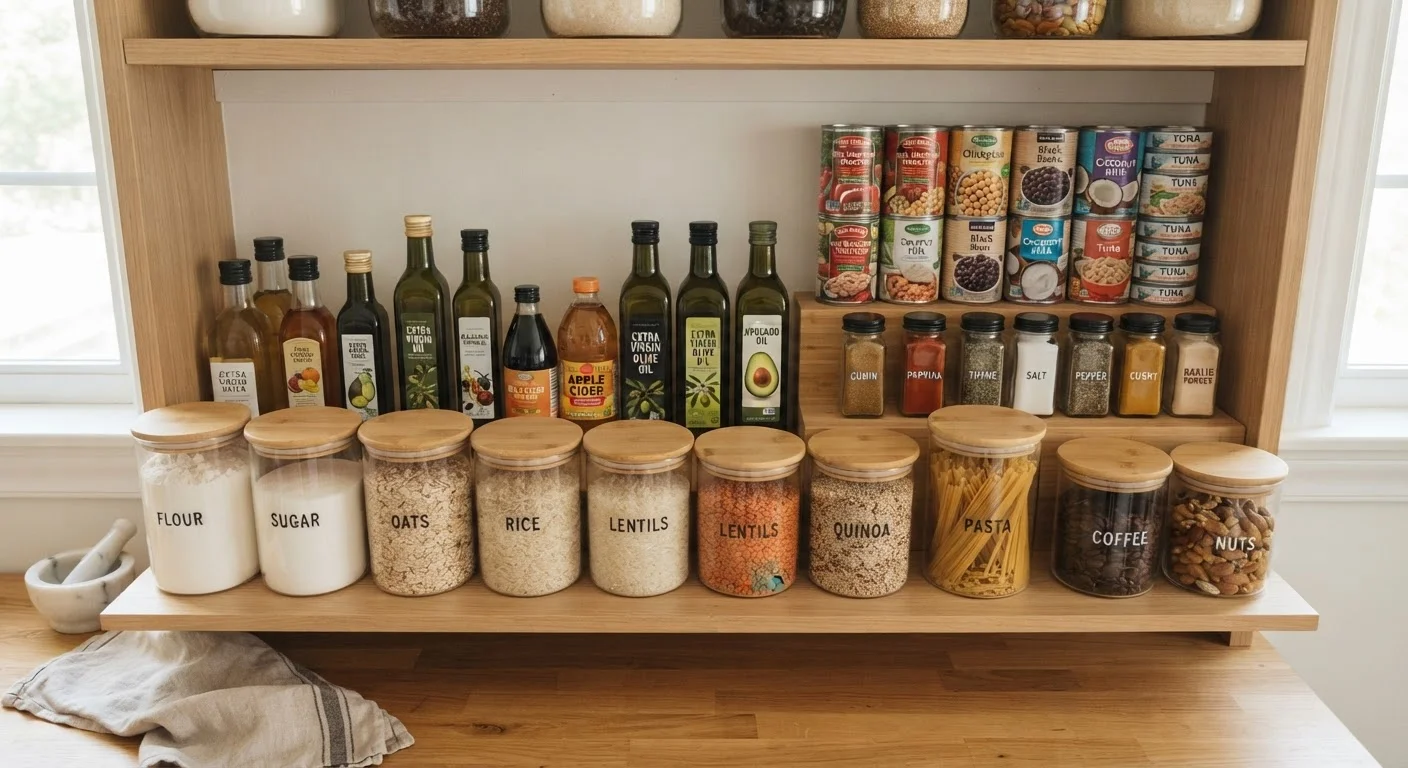
Why Most Pantries Are Overstocked and Underperforming
The average American pantry holds dozens of items, yet most weeknight cooks pull from the same handful of ingredients every time. The rest sit in the back of shelves until they expire or get tossed during a refrigerator-style purge. This isn't a shopping failure - it's a stocking strategy problem.
Earning shelf space means doing more than just being shelf-stable. A true pantry workhorse shows up across cuisines, cooking methods, and meal types. It fills functional roles: adding fat, providing acid, building depth, or delivering heat. When an ingredient can only serve one narrow purpose, its claim to permanent residence weakens considerably.
If you've ever wondered whether your pantry is actually supporting your cooking or just collecting clutter, this end-to-end pantry guide offers a systematic way to evaluate what's working. Below, we break down the categories and specific staples that consistently justify their footprint - and explain exactly why.
Extra-Virgin Olive Oil
Few ingredients pull as much weight across as many applications. Extra-virgin olive oil functions as a cooking fat, a finishing drizzle, a salad dressing base, a marinade component, and a bread accompaniment. Its flavor profile - ranging from grassy and peppery to mild and buttery depending on origin - adds dimension that neutral oils simply don't.
Quality varies widely. Look for oils in dark glass or tin containers, which protect against light degradation, and pay attention to harvest dates when listed. An opened bottle is best used within a few months for peak flavor, so buy in a size you'll actually cycle through.
Extra-virgin olive oil is one of the few single ingredients that contributes meaningfully to nearly every course.
Kosher Salt
Salt is the foundational seasoning of all cooking, but not all salts perform the same way. Kosher salt - named for its use in koshering meat - has a larger, flakier crystal structure that makes it easier to pinch, control, and distribute evenly. It dissolves predictably, seasons pasta water efficiently, and draws moisture from vegetables for roasting or salting.
The key practical point: different salt types have very different densities. A teaspoon of table salt delivers significantly more sodium than a teaspoon of coarse kosher salt. If you cook by touch and taste rather than strict measurement, kosher salt's forgiving texture makes that approach more reliable.
Kosher salt's larger crystal structure makes seasoning by touch more controlled and consistent.
Canned Whole Tomatoes
Whole canned tomatoes - packed at peak ripeness - routinely outperform out-of-season fresh tomatoes for cooked applications. They're the backbone of braises, pasta sauces, shakshuka, soups, and chilis. Because they're packed in their own juice, they contribute both body and liquid simultaneously.
The advantage of whole over diced or crushed is control: you can break them down to whatever texture you want, from chunky to nearly smooth, by hand or with a spoon as they cook. Diced tomatoes are treated with calcium chloride to help them hold their shape - which means they don't break down as readily, even with long cooking. Whole tomatoes give you more flexibility. Understanding how to read and use canned goods properly extends how much value you get from every can.
Whole canned tomatoes offer more textural control than diced or crushed varieties during cooking.
Dried Pasta
Dried pasta is the quintessential pantry staple not because it's exciting on its own, but because it's an extraordinary vehicle for everything else in the pantry. A pound of spaghetti plus olive oil, garlic, canned anchovies, and capers becomes a complete and satisfying meal. The same package supports cream-based, tomato-based, and oil-based sauces equally well.
Different shapes aren't interchangeable by accident - ridged pastas catch chunky sauces, thin strands work with delicate olive oil or cream preparations, and short tubes hold up to baked applications. Stocking two or three shapes covers most situations without requiring a dedicated cabinet section.
Dried pasta is less a single ingredient and more a platform for deploying everything else in your pantry.
Acid: Vinegar and Citrus
Acid is the most underused corrective tool in home cooking. When a dish tastes flat, vaguely wrong, or one-dimensional, the problem is often a lack of acid rather than insufficient salt. A splash of red wine vinegar, a squeeze of lemon, or a dash of apple cider vinegar can lift an entire dish in seconds.
A small collection - red wine vinegar, white wine vinegar, and a neutral rice vinegar - covers most savory applications. For fresh citrus, lemons are the most versatile: the zest adds brightness without liquid, the juice adds both flavor and acidity. If shelf space is tight, a quality red wine vinegar and reliable access to fresh lemons handle the vast majority of what acid needs to accomplish in everyday cooking. Pair this with a realistic approach to spice freshness and you'll season with genuine precision.
Acid corrects flatness in cooking faster and more reliably than adding more salt ever will.
Dried Lentils
Among dried legumes, lentils stand apart for one practical reason: they require no soaking. Red lentils dissolve into silky soups and dahls in under 20 minutes. Green and French lentils hold their shape through longer cooking, making them ideal for salads and grain-style sides. Brown lentils split the difference, working well in braises and stews.
Lentils are also one of the most protein- and fiber-dense shelf-stable foods available, which matters for cooks trying to build nutritionally complete meals from pantry ingredients alone. A bag stores easily, lasts well over a year in a sealed container, and costs very little per serving - a rare combination of convenience, nutrition, and economy.
Lentils are the only legume that delivers complete meals without the planning required by dried beans.
Fish Sauce or Soy Sauce
Fermented condiments deserve a spot in nearly every pantry because of the depth they add without visible presence. Fish sauce - made from fermented anchovies - provides a savory, umami-rich base note that disappears into a dish while making everything around it taste more complex. Soy sauce does similar work with a slightly different flavor profile and broader application across East Asian cuisines.
Neither ingredient is limited to its cuisine of origin. A small amount of fish sauce enriches tomato-based sauces, bolognese, and roasted vegetables in ways that read as depth rather than fishiness. Soy sauce adds round savory notes to marinades, braises, and even some grain dishes. If space allows only one, fish sauce's flavor impact per teaspoon is arguably higher.
Fish sauce and soy sauce both add complexity that registers as depth, not as a specific identifiable flavor.
Building From These Foundations
No pantry staple operates in isolation. The items above work best when they support each other - acid brightening fat, heat sharpened by salt, umami deepened by a splash of something fermented. Once you recognize these functional relationships, restocking becomes more deliberate and less reflexive.
Rotate Before You Restock
Before adding anything new to your pantry, move older items to the front and check dates on anything you haven't used recently. This simple habit prevents duplicate purchasing and ensures you're cooking with ingredients at their best quality. A well-organized pantry supports this naturally - see smart small-kitchen storage principles for layout approaches that make rotation effortless.
This same evaluative mindset applies beyond the pantry. Whether you're assessing canned goods - see how to get more from canned and jarred foods - or auditing the tools cluttering your counters, the question is always the same: does this item reliably earn what it costs in space, money, and mental load? For a practical look at how to apply that lens to equipment, our kitchen equipment audit walks through the same logic for gear. Stock with intention, and your pantry stops being a source of friction and starts being one of the most useful tools in your kitchen.
The content on this site is provided for informational purposes only and should not be considered a substitute for professional advice. While we strive to provide accurate and up-to-date information, we make no guarantees regarding its completeness or accuracy. Always consult a qualified professional for advice specific to your circumstances before making any decisions.