

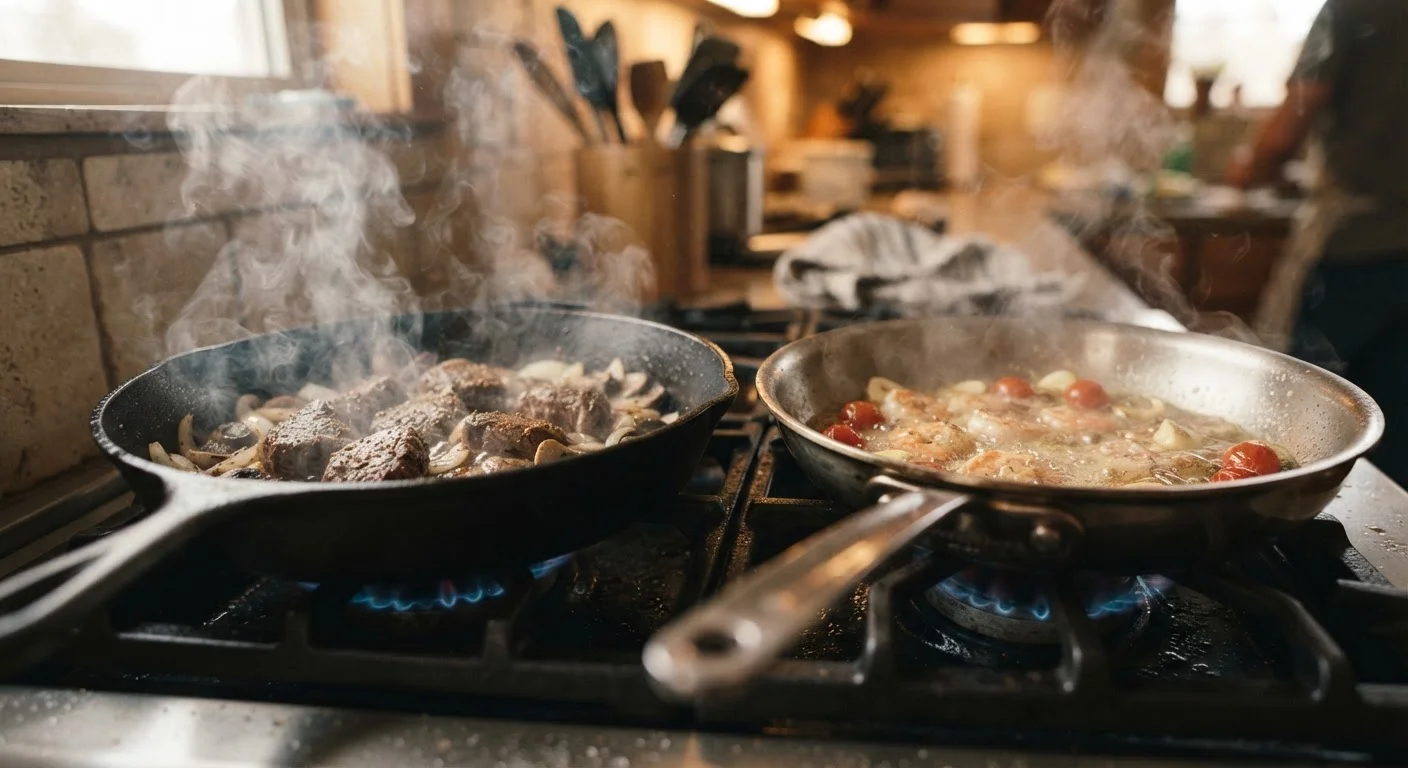
Why Heat Retention Matters at the Stove
When you place a cold steak into a hot pan, the pan's temperature drops - sometimes dramatically. How much it drops, and how quickly it recovers, is determined almost entirely by heat retention. A pan that holds heat well barely flinches; one that doesn't can drop below the threshold needed for browning before the first side is even done.
This matters because browning - the Maillard reaction - requires sustained surface temperatures above roughly 280°F (138°C). If your pan can't maintain that range under the thermal load of a cold protein, you get steam and gray meat instead of a sear. Understanding retention is one of the clearest ways to connect cookware choice to cooking outcomes. See how browning chemistry works in our article on the Maillard reaction and flavor development.
~280°F
Minimum surface temp for Maillard browning
Food science literature broadly identifies temperatures above roughly 280°F (138°C) as necessary for Maillard reaction browning to occur at a meaningful rate.
3-5x
Greater heat capacity: cast iron vs. aluminum
Cast iron's specific heat capacity and density give it substantially more thermal mass than aluminum at equivalent pan dimensions, meaning it stores significantly more energy at a given temperature.
5+ min
Recommended cast iron preheat time on medium heat
Culinary guides and cookware manufacturers generally recommend preheating cast iron for at least five minutes over medium heat to achieve even, stable cooking temperature throughout the pan.
How Different Materials Compare
Not all cookware holds heat the same way. Here's how common kitchen materials behave:
- Cast iron has exceptional heat retention due to its high mass and density. It heats unevenly but holds temperature reliably once up to temp - making it well-suited for searing, pan-frying, and baking. It's also slow to cool, which allows residual cooking after the burner is off. If you use cast iron regularly, proper seasoning is essential - see how to season a cast iron pan correctly.
- Carbon steel behaves similarly to cast iron but is lighter and heats more evenly. Retention is strong, and it's a common choice in professional kitchens for exactly that reason.
- Stainless steel has moderate retention and responds more quickly to burner adjustments. Thicker, clad versions (with aluminum or copper cores) improve heat distribution without fully matching cast iron's staying power.
- Aluminum heats extremely fast and loses heat quickly. It's excellent for tasks that demand responsive temperature control - like sautéing or reducing sauces - but isn't suited for high-heat searing.
- Copper is the most thermally responsive of common metals. It heats and cools almost instantly, which gives precise control but minimal retention.
The key insight is that no single material is universally superior. Retention is a feature when you need it and a liability when you don't.
Preheat Before You Need the Heat
For cast iron and carbon steel, always preheat the pan on medium - not high - for several minutes before adding oil or food. This allows heat to distribute more evenly through the dense material. Adding food to a properly preheated pan means the stored energy does the work; cranking the burner at the last second rarely compensates for inadequate preheating.
Matching Retention to Technique
Matching your pan to the technique is one of the most practical applications of understanding heat retention. A few examples make this concrete:
Searing proteins: Use high-retention cookware - cast iron or carbon steel. Preheat thoroughly before adding food. The pan's stored heat compensates for the temperature drop that cold food causes.
Sautéing vegetables: Lower-retention pans, like thin stainless or aluminum, are easier to control. You can reduce heat quickly if the pan gets too hot, preserving texture and color.
Simmering sauces: Moderate retention is useful here - enough to maintain a gentle bubble without constant adjustment, but responsive enough to pull back from a hard boil with a burner turn.
Baking in cast iron: Skillets and Dutch ovens transition from stovetop to oven well precisely because their retained heat contributes to even, consistent baking - especially for breads and deep-dish preparations. For a broader look at how heat variables interact in baking, see our guide on temperature, timing, and texture in baking science.
More techniques and method-level guidance are available in our Cooking Techniques hub.
Preheating and the Retention Equation
Preheating isn't just a convention - it's the mechanism that activates a pan's retention potential. A cast iron skillet placed over medium heat for three to five minutes before use stores enough thermal energy to handle a cold load. Skipping this step means the pan's theoretical retention advantage never materializes in practice.
The same logic applies to oven cooking. Preheating a cast iron vessel in the oven before adding batter or dough creates an immediate burst of bottom heat that affects rise and crust formation - a principle used in artisan bread baking.
It's also worth noting that retention affects cleanup and safety: high-retention pans stay dangerously hot long after cooking ends. Always use appropriate protection and allow adequate cooling before handling or washing.
For a fuller picture of how to interpret doneness and temperature during cooking, what your kitchen thermometer is actually telling you offers a practical reference.
Frequently Asked Questions
Heat retention refers to how long and how steadily a pan holds its temperature after reaching it. High-retention pans stay hot when cold food is added; low-retention pans cool quickly. This property is largely determined by the material's density and mass.
Not always. High retention is ideal for searing and frying, where you need consistent high heat. For delicate tasks like sautéing vegetables or making sauces, quick temperature response is more useful - so lower-retention pans often perform better there.
Proteins and sugars bond to metal surfaces more readily when heat is uneven or insufficient. Adding food before a pan is properly preheated - or in a low-retention pan that drops temperature quickly - increases sticking. Proper preheating gives the surface time to stabilize.
Yes. Thicker pans hold more thermal mass and therefore retain heat better. A thick cast iron skillet retains far more heat than a thin stainless steel pan of the same diameter, even if both start at the same temperature.
Yes, and this is one of the practical advantages of cast iron and carbon steel. After removing from heat, these pans stay hot long enough to carry foods - particularly proteins - through the final stages of cooking without an active flame.
It can. A pan that holds heat well requires less continuous energy input to maintain cooking temperature. On the other hand, it also takes longer to cool down, which can be a drawback if you need to adjust quickly mid-cook.
The content on this site is provided for informational purposes only and should not be considered a substitute for professional advice. While we strive to provide accurate and up-to-date information, we make no guarantees regarding its completeness or accuracy. Always consult a qualified professional for advice specific to your circumstances before making any decisions.