

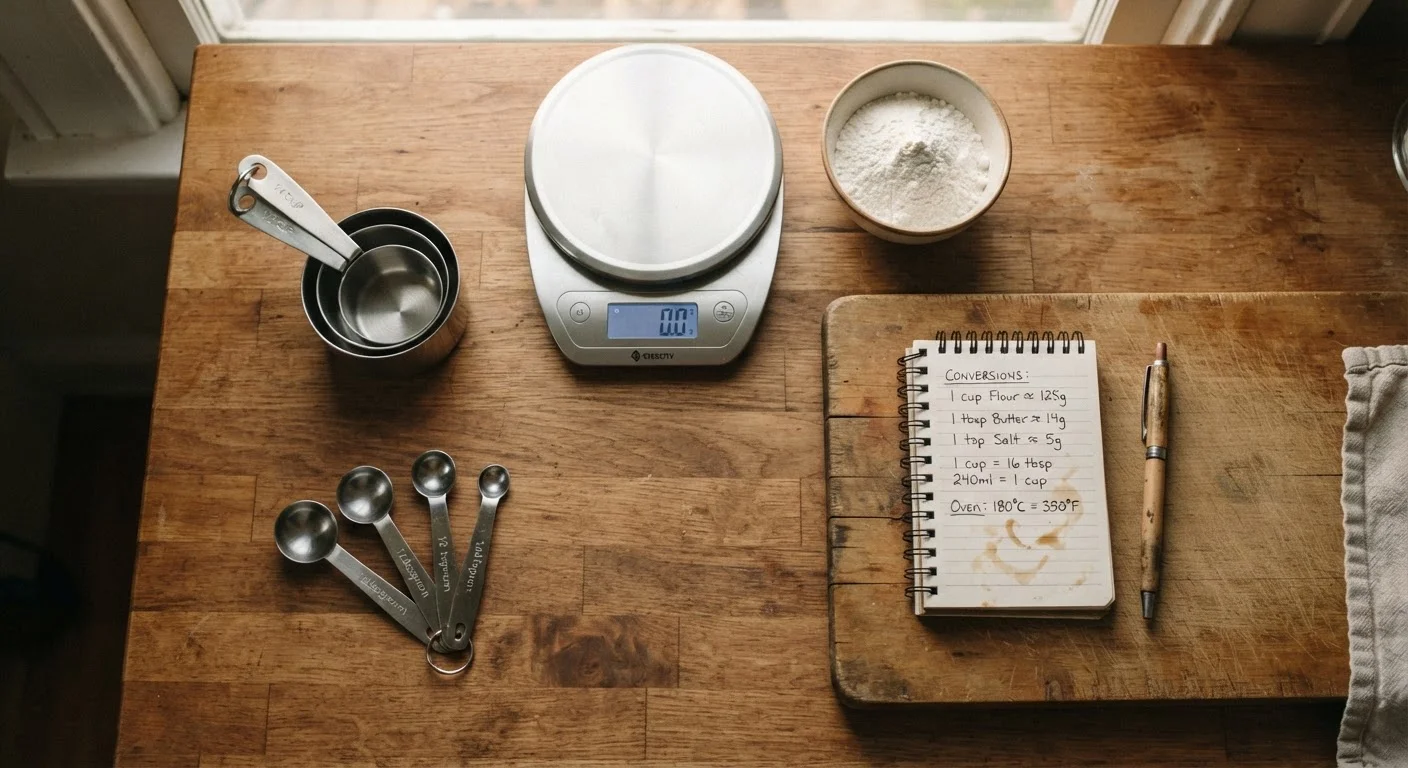
Volume Conversions You'll Use Every Day
Most U.S. recipes measure liquid and dry ingredients by volume, so these relationships are worth memorizing. The foundational chain runs like this:
- 3 teaspoons = 1 tablespoon
- 4 tablespoons = ¼ cup
- 8 tablespoons = ½ cup
- 16 tablespoons = 1 cup
- 2 cups = 1 pint
- 2 pints = 1 quart
- 4 quarts = 1 gallon
The most practically useful anchor points are the tablespoon-to-cup relationships. When a recipe calls for ⅓ cup and your measuring cups are buried in the dishwasher, knowing that equals about 5 tablespoons plus 1 teaspoon gets you through without panic.
For liquid measures, fluid ounces follow a parallel system: 8 fluid ounces = 1 cup. A standard mason jar holds 2 cups (16 fl oz); a typical wine bottle holds roughly 3⅓ cups (25 fl oz). These real-world anchors make improvising much easier.
| Teaspoons in 1 tablespoon | 3 tsp |
| Tablespoons in 1 cup | 16 tbsp |
| Fluid ounces in 1 cup | 8 fl oz |
| Grams in 1 ounce | ≈ 28 g |
| Grams in 1 pound | ≈ 454 g |
| Moderate oven temperature | 350°F / 175°C |
| Cups in 1 quart | 4 cups |
| ⅓ cup in tablespoons | 5 tbsp + 1 tsp |
Weight, Temperature, and the Metric Bridge
Baking recipes increasingly list ingredients by weight, and for good reason - a cup of all-purpose flour can weigh anywhere from 120 g to 160 g depending on how it's scooped. A kitchen scale removes that variable entirely. For the science behind why weight matters in baking, that precision is the difference between a tender crumb and a dense brick.
Key weight conversions to know:
- 1 ounce = 28.35 grams (round to 28 g for everyday use)
- 16 ounces = 1 pound = approximately 454 grams
- 1 kilogram ≈ 2.2 pounds
For temperature, the Fahrenheit-to-Celsius formula is °C = (°F − 32) ÷ 1.8 - useful to know, but a handful of fixed reference points are more practical day-to-day:
- Water freezes: 32°F / 0°C
- Water boils: 212°F / 100°C
- Moderate oven: 350°F / 175°C
- Hot oven: 425°F / 220°C
- Broil/grill high: 500°F+ / 260°C+
For internal doneness temperatures across proteins, the kitchen thermometer reference guide covers every category in detail.
Fluid ounce
A unit of volume (not weight) used to measure liquids in U.S. recipes. Eight fluid ounces equals one cup; it is not interchangeable with a weight ounce.
Tare
The function on a digital scale that resets the display to zero after placing a container, so only the ingredient weight is recorded. Using tare lets you measure multiple ingredients into the same bowl without removing it from the scale.
Mise en place
A French culinary term meaning 'everything in its place.' It refers to the practice of measuring, prepping, and organizing all ingredients before cooking begins, reducing errors and rushed decisions mid-recipe.
Dry measure vs. liquid measure
Dry measuring cups are designed to be filled to the brim and leveled off; liquid measuring cups have a spout and are read at eye level. Using the wrong type for an ingredient can introduce meaningful inaccuracies, especially in baking.
Putting It All Into Practice
Knowing these numbers is one part of confident cooking - having an organized workspace to apply them is the other. Before you start a recipe, the habit of mise en place - measuring and arranging all ingredients in advance keeps you from scrambling mid-cook when precision matters most.
If your measuring tools are incomplete, a well-considered kitchen equipment plan can identify what's actually worth owning. At minimum, a dry-measure cup set, a liquid measuring pitcher with a spout, a set of measuring spoons, and a digital kitchen scale cover virtually every recipe you'll encounter.
Pantry accuracy matters too. Ingredients like baking powder, kosher salt, and spices are often specified in small quantities where a teaspoon off makes a real difference. A reliable pantry of staple ingredients paired with accurate measurement habits gives you a strong foundation for almost any recipe.
Tape a condensed version of the volume and temperature tables inside a cabinet door - that single step eliminates the need to search online mid-recipe for conversions you'll look up dozens of times a year.
The content on this site is provided for informational purposes only and should not be considered a substitute for professional advice. While we strive to provide accurate and up-to-date information, we make no guarantees regarding its completeness or accuracy. Always consult a qualified professional for advice specific to your circumstances before making any decisions.