

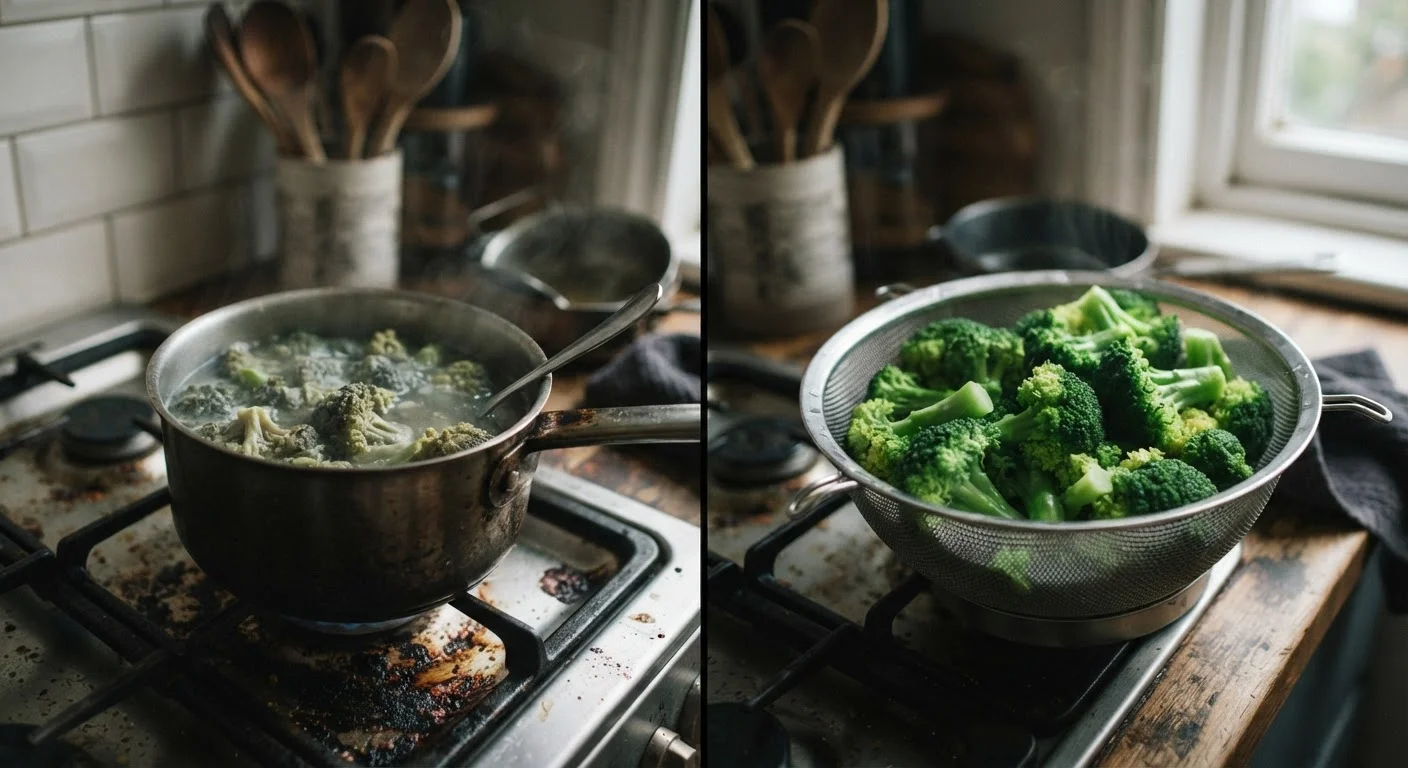
Why Vegetables Go Wrong So Easily
Vegetables are among the most time-sensitive ingredients in the kitchen. Their cell walls begin to break down quickly under heat, and the window between just right and past it is often less than two minutes. Unlike a roast that has some tolerance for a few extra minutes in the oven, a pan of green beans does not wait.
Most of the damage is structural and chemical. Green vegetables owe their colour to chlorophyll, a pigment that breaks down into a dull olive compound called pheophytin when exposed to prolonged heat or acid. Meanwhile, cell walls made of pectin soften rapidly once temperatures climb, turning firm textures into mush. Both processes happen faster than most home cooks expect, which is why understanding the why behind the mistakes is more useful than a list of rules to memorise.
The good news: nearly every overcooking problem is correctable once you know what's causing it. The mistakes below are the most common culprits - and each has a straightforward fix. For a broader look at how heat affects food chemistry, see our piece on how heat transforms flavour.
The Most Common Overcooking Mistakes
Work through these habits honestly. Most cooks recognise at least two or three in their own routine.
Adding vegetables to cold or barely simmering water instead of a full, rolling boil.
Why it happens: Cooks often start vegetables before the water has fully come to temperature, either through impatience or uncertainty about what a proper boil looks like.
Skipping the ice bath after blanching, letting carry-over heat continue cooking the vegetables.
Why it happens: Many home cooks drain vegetables and consider the job done, unaware that residual heat inside the food keeps the cooking process going for another minute or two.
Crowding the pan during roasting or sautéing, causing vegetables to steam rather than brown.
Why it happens: Doubling a recipe without upsizing the pan is the usual culprit. Vegetables release moisture as they heat, and a crowded pan traps that steam, stewing the contents instead of browning them.
Cutting vegetables into inconsistent sizes, so small pieces overcook while large pieces are still underdone.
Why it happens: Knife work is often hurried, and the importance of uniformity isn't always understood - it seems like a chef's concern rather than a practical one.
Cooking green vegetables with an acidic ingredient - like tomatoes or lemon juice - from the start.
Why it happens: Recipes often instruct cooks to add all ingredients together, and the colour-destroying effect of acid on chlorophyll isn't widely known.
Relying on appearance alone rather than testing vegetables for doneness.
Why it happens: Colour seems like a reliable indicator, but many vegetables look done before they are - or look fine even when overcooked, particularly in dim kitchen lighting.
Salt Your Blanching Water Generously
Under-salted water is a silent contributor to bland vegetables. Water should taste noticeably seasoned - roughly as salty as mild broth - before vegetables go in. Salt also raises the boiling point slightly and helps vegetables retain their colour. Don't be shy: most of the salt stays in the water, not on the vegetable.
Choosing the right method matters as much as timing. Our guide to dry heat vs. moist heat cooking explains when to roast, steam, or blanch for the best result with different vegetables.
Putting the Fixes into Practice
Correcting these habits doesn't require new equipment or advanced technique - it mostly requires attention and a timer. A few principles that tie everything together:
- Use a timer without exception. Even experienced cooks misjudge elapsed time when distracted. A one-minute error can mean the difference between tender-crisp and limp.
- Taste earlier than you think you need to. Pull a piece of vegetable from the pan 60-90 seconds before you expect it to be done. It will carry over slightly from residual heat.
- Keep your knife consistent. Uniform cuts aren't about presentation; they're about ensuring everything cooks at the same rate.
- Match the method to the vegetable. Delicate greens like spinach need seconds over high heat. Dense root vegetables benefit from lower, steadier heat. Treating every vegetable the same is itself a common error.
40-50%
Vitamin C lost through boiling
Research published in food science literature has consistently shown that water-soluble vitamins like vitamin C can decrease by 40-50% when vegetables are boiled for extended periods compared to shorter steaming.
2-3 min
Window for green vegetable blanching
For most green vegetables - broccoli, green beans, asparagus - the optimal blanching window sits between two and three minutes at a full boil before colour and texture begin to degrade noticeably.
With practice, these adjustments become instinctive. The reward is vegetables that taste genuinely good on their own - not just a vehicle for sauce or seasoning. And if you're growing your own produce, starting a vegetable garden from scratch means you'll have fresh, nutrient-dense ingredients worth cooking carefully.
The content on this site is provided for informational purposes only and should not be considered a substitute for professional advice. While we strive to provide accurate and up-to-date information, we make no guarantees regarding its completeness or accuracy. Always consult a qualified professional for advice specific to your circumstances before making any decisions.