

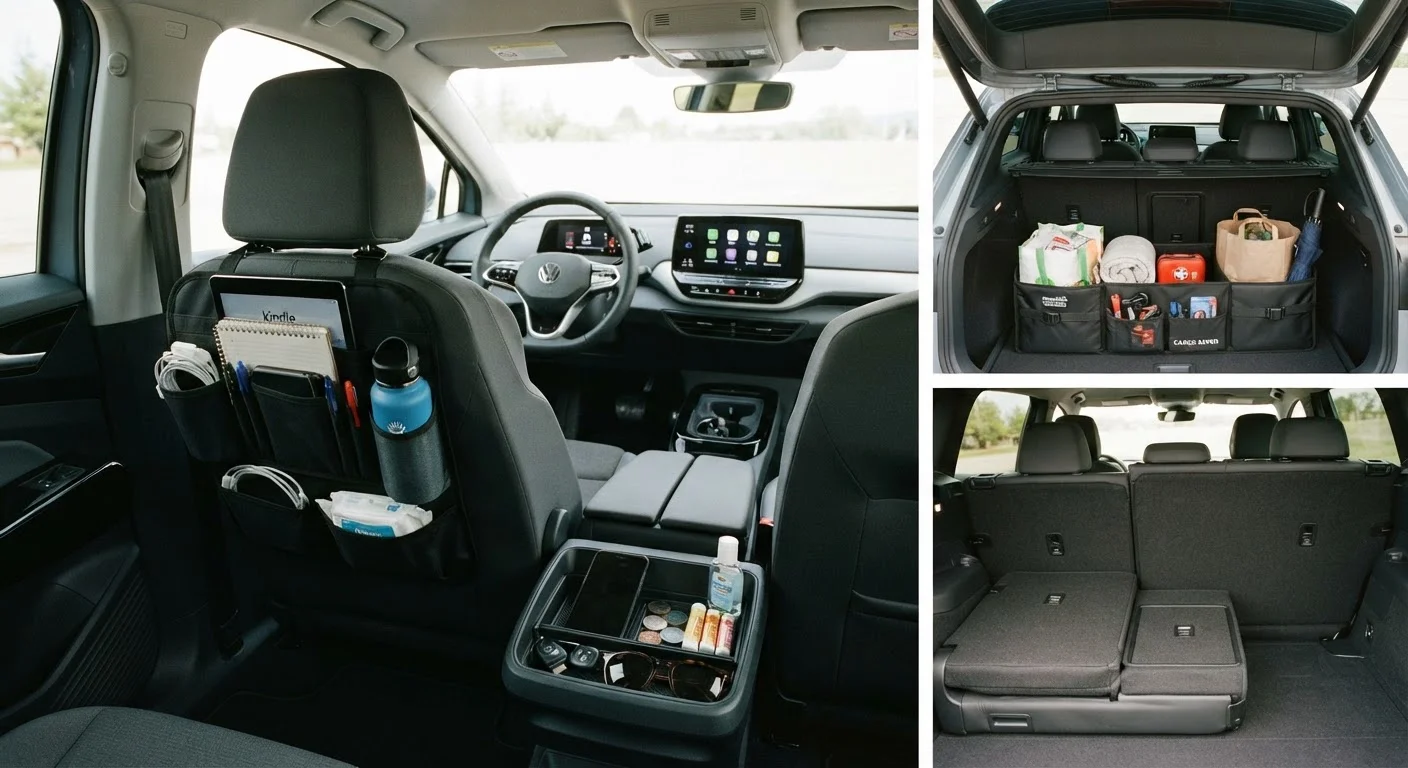
Why Organiser Type Matters Before You Buy
Not all car organisers solve the same problem. A boot bag excels at containing grocery runs; a seat-back pocket protects rear passengers from loose snacks and tablets; a console tray keeps the driver's immediate reach zone clutter-free. Choosing the wrong type means the organiser sits unused or creates new frustrations - like a bulky boot insert that blocks the spare tyre access panel.
The practical starting point is identifying where clutter accumulates in your specific vehicle and who generates it. Family vehicles with rear passengers have fundamentally different needs than a solo commuter's sedan or a tradesperson's pickup. This reference breaks down each major category so you can match the solution to the actual problem.
For a broader look at which add-ons genuinely earn their keep versus those that don't, see Car Accessories Explained.
Boot Bags and Cargo Organisers
Boot organisers sit in the rear cargo area and typically come in three forms: collapsible totes, rigid trunk-floor inserts, and modular cargo dividers. Collapsible totes are lightweight, fold flat when empty, and suit sporadic use - grocery runs, sports gear, reusable shopping bags. Rigid inserts create permanent compartments and resist tipping, making them better for anyone who regularly transports bottles, cleaning supplies, or tools.
Modular dividers use adjustable partitions secured with hook-and-loop or hook anchors to the existing cargo floor anchor points found on most modern SUVs, crossovers, and wagons. These work poorly in sedans with shallow, curved trunks where the dividers can't stand upright without tipping.
Vehicle fit considerations: Measure your cargo floor depth and width before selecting a rigid insert - manufacturers typically publish interior dimensions in the owner's manual or on the automaker's website. Subfloor spare-tyre access is a critical check: confirm the organiser can be lifted or moved without tools in an emergency.
Cargo Divider
An adjustable partition placed in the boot or trunk to separate and stabilize different load categories, typically secured using factory cargo anchor points.
Headrest Post
The metal rod (or rods) connecting the removable headrest to the seat back. Seat-back organisers loop straps over these posts to stay in position.
Console Tray Insert
A subdivided bin or tray designed to drop inside an existing center console compartment, creating dedicated slots for small items like coins, cables, and cards.
Gap Filler
A narrow organiser sized to fit the gap between the seat cushion and center console, preventing small items from falling into an otherwise unreachable space.
Vehicle-Specific Fitment
An organiser engineered to precise measurements for a particular make, model, and trim, resulting in a closer fit and reduced rattling compared to universal alternatives.
Seat-Back Pocket Organisers
Seat-back pockets attach to the back of front seats via adjustable straps and hook over the headrest posts. They are almost universally useful in vehicles carrying rear passengers, especially children. Most designs include a combination of mesh pockets (visible contents at a glance), zippered compartments (small valuables), and a tablet sleeve or clear window for in-car entertainment.
Key spec to check: headrest post diameter and spacing. Universal-fit models accommodate most modern headrests, but some sport seats with fixed, integrated headrests (common on performance trims) have no exposed posts, making attachment impossible without a different mounting solution.
Seat-back organisers add thickness between the seat back and the rear passenger's knees. In compact cars with limited rear legroom, a thick organiser can meaningfully reduce passenger comfort. Look for slim-profile designs in those vehicles.
This category pairs naturally with other interior additions discussed in Interior Car Accessories Worth Having in Every Season.
Console Trays and Between-Seat Organisers
Console organisers sit in or around the center console - the area between the driver and front passenger. Two distinct sub-types exist: tray inserts that drop into the existing console bin to create subdivided compartments, and gap fillers that occupy the narrow gap between the seat and center console to catch dropped items.
Tray inserts are sized to specific vehicle makes and models; vehicle-specific fitment versions fit precisely and don't rattle. Universal inserts exist but often leave dead space or overhang the bin edge. Gap fillers are largely universal because the gap width across most vehicles falls within a narrow range, though some trucks with wide bench seats require wider versions.
A third variant - the between-seat organiser - bridges the full console area for vehicles that lack a factory center console (older trucks, minivans with bench-style front seating). These typically include cup holders, phone cradles, and small item pockets, and they rest on the seat cushion itself secured by the seat belt buckle slot.
Just as the organizing principles that apply to a kitchen can transfer to other contexts - see small-space storage principles - the core idea of designating a fixed home for each category of item applies equally inside a vehicle.
For a broader framework on sensible vehicle upgrades, the complete car accessories guide covers how to evaluate any addition before committing.
The content on this site is provided for informational purposes only and should not be considered a substitute for professional advice. While we strive to provide accurate and up-to-date information, we make no guarantees regarding its completeness or accuracy. Always consult a qualified professional for advice specific to your circumstances before making any decisions.