

Our Verdict
Robot vacuums deliver real, practical value for routine floor maintenance - especially in homes with hard floors, low-pile carpet, and pets that shed moderately. However, they fall short in multi-story homes, rooms with thick rugs, and spaces with heavy clutter. Setting accurate expectations upfront is the key to satisfaction.
Single-story homes with mostly hard flooring or low-pile carpet, especially households with pets that shed regularly and owners who want to reduce day-to-day vacuuming effort.
How Robot Vacuums Actually Work
Robot vacuums use a combination of sensors, brushrolls, and suction to pick up debris from floors autonomously. Most modern units navigate using infrared sensors, cliff detection, and - in higher-end models - laser mapping or camera-based vision systems (often called LiDAR or VSLAM). They follow cleaning paths, return to their dock when battery runs low, and many can be scheduled or triggered through a smartphone app.
Understanding this mechanical reality matters, because a robot vacuum is fundamentally a flat, disc-shaped device roughly 3-4 inches tall and 12-14 inches wide. That shape defines both what it can do and exactly where it fails. For homes considering broader automation, see routines that make smart home ownership genuinely useful.
Rugs: The Most Misunderstood Challenge
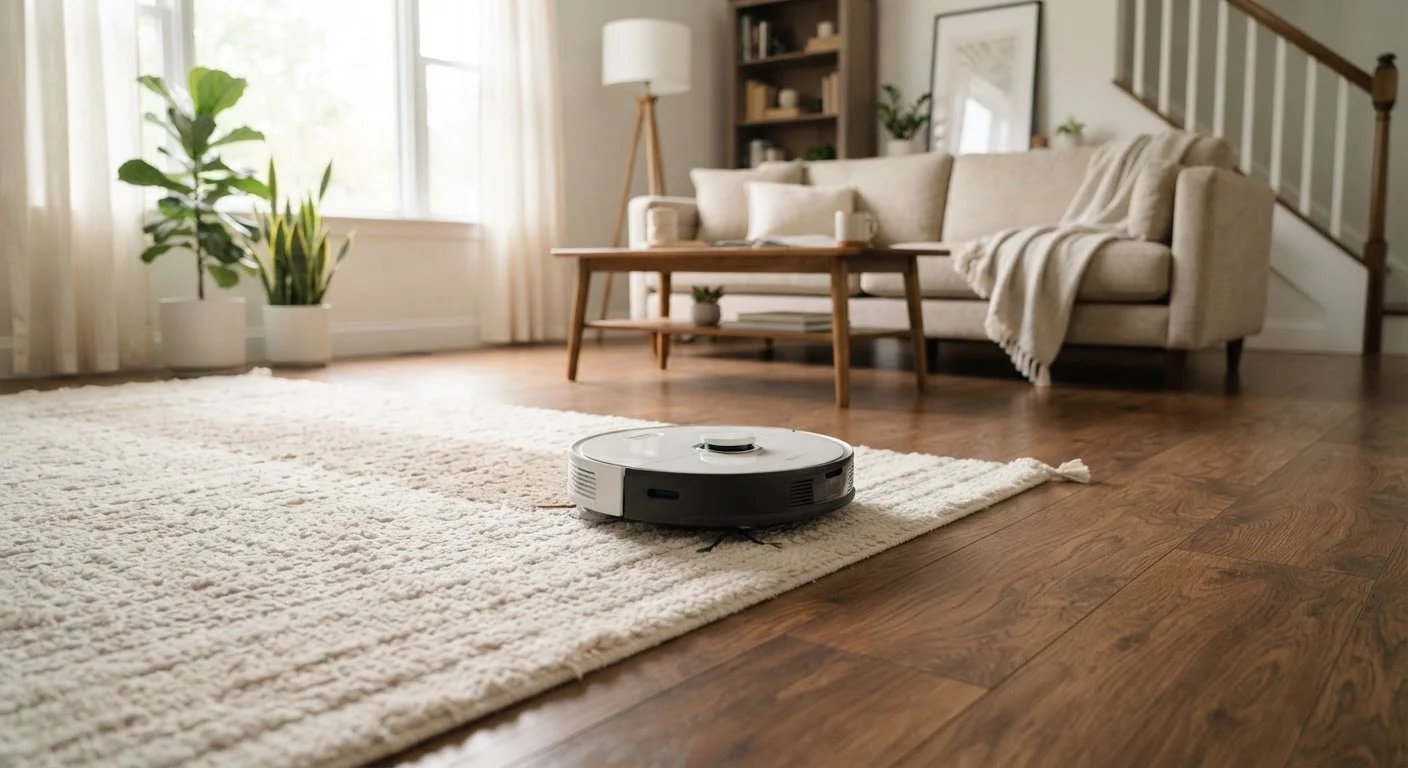
Robot vacuums and rugs have a complicated relationship. On low-pile area rugs - those with a pile height under roughly half an inch - most units transition smoothly from hard floor and clean adequately. The problem begins with thicker rugs.
High-pile or shag rugs often cause robot vacuums to slow significantly, stall, or get stuck entirely. The brushroll can catch on long fibers, and the suction seal breaks against an uneven surface. Some models automatically increase suction when they detect carpet, which helps on medium-pile surfaces but can drain the battery faster and shorten run time.
Rug edges and tassels present another consistent issue. Fringe and loose edges are frequently caught by brushrolls, causing the robot to tangle and stop - sometimes pulling the rug itself across the floor. If your home has several large area rugs with fringe or high pile, a robot vacuum will require active supervision or physical barriers to function reliably.
Automates routine floor maintenance with minimal effort
Scheduled cleaning runs keep debris, dust, and pet hair from accumulating daily, reducing the frequency of manual vacuuming on hard floors and low-pile carpet.
Handles light-to-moderate pet shedding effectively
Most models pick up pet hair reliably from hard floors and short-pile carpet, making them particularly practical for households with moderate shedders.
Navigates under furniture human vacuums can't reach
The low-profile design allows robot vacuums to clean under beds, sofas, and cabinets - areas often missed during standard vacuuming routines.
Integrates with smart-home scheduling and voice control
Many models connect to home automation ecosystems, allowing users to trigger cleaning remotely or build it into daily schedules without manual activation.
Stairs: A Hard No
No robot vacuum on the market today can clean stairs. This is not a limitation waiting to be solved with a software update - it is a fundamental constraint of the hardware form factor. Robot vacuums use cliff sensors to detect drop-offs and stop before falling, which means stairs are simply treated as an edge to avoid.
For multi-story homes, this means a robot vacuum can only clean one level at a time, and moving it between floors requires manual intervention. If the majority of your home's carpeted area is on a second floor and the robot lives on the first, its practical utility drops considerably. For households equipping a new home, this is worth factoring in early - see which appliances to prioritize first.
Mapping Technology Helps - But Has Limits
Higher-end robot vacuums with LiDAR or camera-based mapping can create floor plans, remember room layouts, and avoid obstacles more reliably than sensor-only models. However, even the most advanced mapping systems cannot compensate for physical limitations like stairs or deep-pile rugs. Mapping improves navigation efficiency and reduces stuck incidents, but it does not expand the device's fundamental operating range.
Pet Hair: Better Than Expected, With Caveats
Pet hair is arguably where robot vacuums earn the most goodwill. Regular, automated cleaning cycles prevent fur from accumulating into visible clumps on hard floors and low-pile carpet - particularly valuable for households with heavy shedders.
However, long pet hair (from dogs like golden retrievers or cats with thick coats) wraps around brushrolls quickly. Many units now include tangle-resistant or rubberized brushrolls specifically designed to reduce this, but no model eliminates the problem entirely. Owners of long-haired pets should expect to clean the brushroll every few uses rather than just emptying the dustbin.
Allergen filtration varies widely between models. Some include HEPA-style filters that trap fine particles; others use basic filters that may redistribute fine dander into the air. If pet allergies are a concern in the household, filter quality is worth researching specifically. For further context on managing pet care at home, common grooming missteps owners make offers useful related perspective.
Cannot navigate or clean stairs at all
Cliff sensors stop robot vacuums at stair edges by design, making multi-story homes require manual relocation between floors for each cleaning session.
Struggles with high-pile rugs and rug fringe
Thick or shag rugs frequently cause stalling, reduced suction effectiveness, or tangled brushrolls - especially rugs with loose fringe or tassels.
Long pet fur wraps around brushrolls frequently
Despite improvements in brushroll design, long animal hair still tangles over time, requiring owners to manually clear the brushroll every few cleaning cycles.
Requires a relatively clutter-free floor to function
Cords, small toys, clothing left on the floor, and low-hanging objects can all cause a robot vacuum to stall, tangle, or get stuck mid-cycle.
Does not deep-clean carpet the way upright vacuums do
Robot vacuums lack the sustained suction pressure and agitation of upright or canister models, making them less effective at extracting embedded dirt from carpet fibers.
Where Robot Vacuums Genuinely Excel
Strip away the edge cases and the core value proposition is clear: robot vacuums are excellent at maintaining clean floors between deeper cleaning sessions. Scheduled daily or every-other-day runs on hard floors - kitchen tile, hardwood, luxury vinyl plank - keep crumbs, dust, and light pet hair from building up. This is where the technology consistently delivers.
Open floor plans with minimal furniture obstacles and predominantly hard-surface floors are the ideal environment. Homes with a single level, few area rugs, and one or two moderate-shedding pets represent the use case where robot vacuums come closest to replacing a traditional vacuum for day-to-day tasks.
For households where a traditional vacuum is still needed - particularly for stairs, thick rugs, or deeper cleaning - understanding that trade-off upfront leads to far greater satisfaction. A direct comparison of vacuuming approaches is covered in corded vs. cordless vacuum trade-offs.
~3-4 in.
Typical robot vacuum height clearance
Most robot vacuums measure between 3 and 4 inches tall, which determines whether they can pass under furniture and limits how they interact with thick rugs.
0
Current models capable of cleaning stairs
As of the time of writing, no commercially available robot vacuum is designed or rated to clean stair treads - cliff sensors prevent them from attempting it.
The content on this site is provided for informational purposes only and should not be considered a substitute for professional advice. While we strive to provide accurate and up-to-date information, we make no guarantees regarding its completeness or accuracy. Always consult a qualified professional for advice specific to your circumstances before making any decisions.