

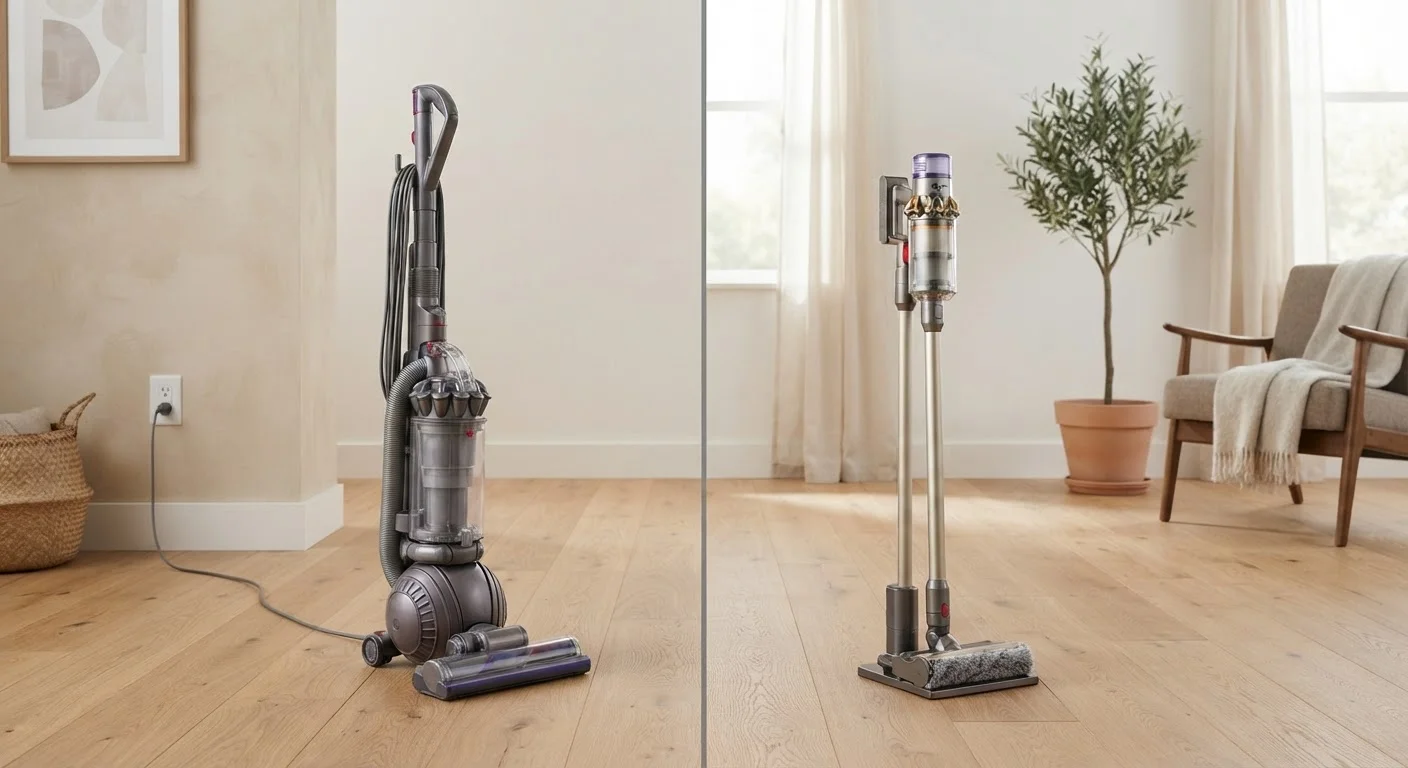
Option A
Corded Vacuum Cleaners
The reliable, high-power workhorse for thorough whole-home cleaning.
Best for: Larger homes, high-pile carpets, pet owners, and anyone who needs consistent suction without interruption.
Option B
Cordless Vacuum Cleaners
The nimble, convenient option for quick cleanups and flexible reach.
Best for: Smaller spaces, hard floors, multi-level homes, and users who value grab-and-go ease over raw power.
The Core Difference: Power Source and What It Means
The fundamental distinction between corded and cordless vacuums isn't just about a cable - it's about how each design manages power, and every other trade-off flows from that. A corded vacuum draws electricity directly from your wall outlet, giving it effectively unlimited runtime and consistent motor performance. A cordless vacuum runs on a rechargeable lithium-ion battery, which means you're always working within a finite window of energy.
That distinction shapes suction consistency, weight distribution, maintenance needs, and long-term cost. Neither design is objectively superior - they're optimized for different use cases, and understanding the engineering helps you predict how each will behave in your specific home.
| Criterion | Corded Vacuum | Cordless Vacuum |
|---|---|---|
| Power source | Wall outlet (unlimited runtime) | Rechargeable battery (20-60 min) |
| Suction consistency | Steady throughout session | May taper as battery depletes |
| Weight | Heavier (10-20+ lbs typical) | Lighter (3-8 lbs typical) |
| Best floor type | Carpet and mixed surfaces | Hard floors and low-pile rugs |
| Cord management | Required - limits reach | None needed |
| Long-term maintenance | Filter and belt replacement | Filter plus battery replacement |
| Typical dustbin capacity | Larger (1-2 liters) | Smaller (0.3-0.7 liters) |
| Stair cleaning ease | More cumbersome | Easier and safer |
Suction Power and Cleaning Performance
Corded vacuums have historically dominated on raw suction. Because motor size isn't constrained by battery weight, manufacturers can engineer more powerful airflow - particularly useful for lifting embedded debris from deep-pile carpet or extracting pet hair from upholstery fibers. Suction remains steady from the first pass to the last.
Cordless vacuum technology has advanced considerably. Many current models generate strong suction adequate for hard floors, low-pile rugs, and light debris on carpet. However, some cordless models reduce motor speed as battery charge drops to conserve energy, which can mean slightly diminishing performance near the end of a cleaning session. If your home has thick carpet throughout, this is worth factoring in. For hard floors - tile, hardwood, laminate - the gap between corded and cordless performance is much narrower in practice.
Also worth noting: cordless vacuums that convert into handheld units are particularly versatile for spot-cleaning upholstery, car interiors, or countertops - tasks where a full-size corded machine would be impractical. For a different kind of hands-free convenience, see our look at robot vacuum limitations to understand how automation compares.
Battery Life, Runtime, and Long-Term Reliability
Most cordless vacuums offer between 20 and 60 minutes of runtime per charge, depending on the power mode selected. High-suction modes drain batteries faster - sometimes cutting runtime to under 20 minutes. That's often sufficient for a small apartment or a targeted cleanup, but could fall short mid-session in a larger home.
Battery degradation is a real factor to plan for. Lithium-ion cells lose capacity over charge cycles, meaning a vacuum that runs 45 minutes when new might deliver noticeably less after two or three years of regular use. Replacement battery packs are available for many models but add ongoing cost. This parallels a challenge familiar to anyone who has dealt with aging laptop batteries - the runtime gap between advertised specs and real-world use tends to widen over time, as explored in what affects battery runtime.
20-60 min
Typical cordless vacuum runtime per charge
Runtime varies significantly by power mode - high-suction settings can reduce this to under 20 minutes on many models.
~500 cycles
Approximate lithium-ion charge cycles before capacity noticeably drops
Battery degradation timelines vary by battery quality, usage patterns, and storage conditions - this is a general industry reference point.
3-6 lbs
Common weight range for cordless stick vacuums
Corded full-size uprights often weigh 12-20 pounds, making the portability difference substantial for stair and multi-room cleaning.
Corded vacuums sidestep battery concerns entirely. Their motors can run for hours without any performance change, and there are no cells to replace. For households with heavy or frequent cleaning demands, that consistency is a genuine advantage.
Portability, Weight, and Ease of Use
Cordless vacuums are almost always lighter and more maneuverable than their corded counterparts. Stick-style cordless models can weigh as little as 3-6 pounds, making them easy to carry upstairs, reach ceiling corners, or tuck into closets between uses. There's no cord to manage, unwind, or accidentally pull from the socket mid-room.
Corded uprights and canisters tend to be heavier and bulkier, and cord management adds a step to every cleaning session - particularly on stairs or in rooms far from an outlet. That said, the physical design of a full-size corded vacuum often includes a larger dustbin capacity, reducing how often you need to empty it.
If mobility and flexibility across multiple surfaces are priorities - much like weighing portability in any tool-versus-fixed-setup decision - the cordless format has a clear ergonomic edge for most users who don't need continuous deep-carpet power.
The content on this site is provided for informational purposes only and should not be considered a substitute for professional advice. While we strive to provide accurate and up-to-date information, we make no guarantees regarding its completeness or accuracy. Always consult a qualified professional for advice specific to your circumstances before making any decisions.