

What Thumping Actually Communicates
The thump - a sharp, deliberate percussion of the hind feet against the floor - is one of the most misread signals in rabbit ownership. Many owners assume it signals anger, but its primary function is alarm. In the wild, rabbits thump to warn warren-mates of potential danger. In a domestic setting, the trigger might be a sudden noise, an unfamiliar person, a nearby pet, or even a scent carried from outdoors.
A single thump followed by a return to normal activity usually means a transient alert. Sustained or repeated thumping, paired with a stiff posture and flattened ears, suggests the rabbit has not resolved whatever alarmed it. In those cases, investigate the environment: check for drafts, unusual smells from cleaning products or plug-in air fresheners, or nearby activity from other animals. Chronic stress in rabbits has real health consequences, including digestive disruption - something explored in depth in our guide on rabbit gut stasis.
Thumping can also serve as a protest - for instance, after being handled in a way the rabbit dislikes. This version is typically a one-time signal with no sustained alertness behavior following it.
The Binky: Pure Expression of Joy
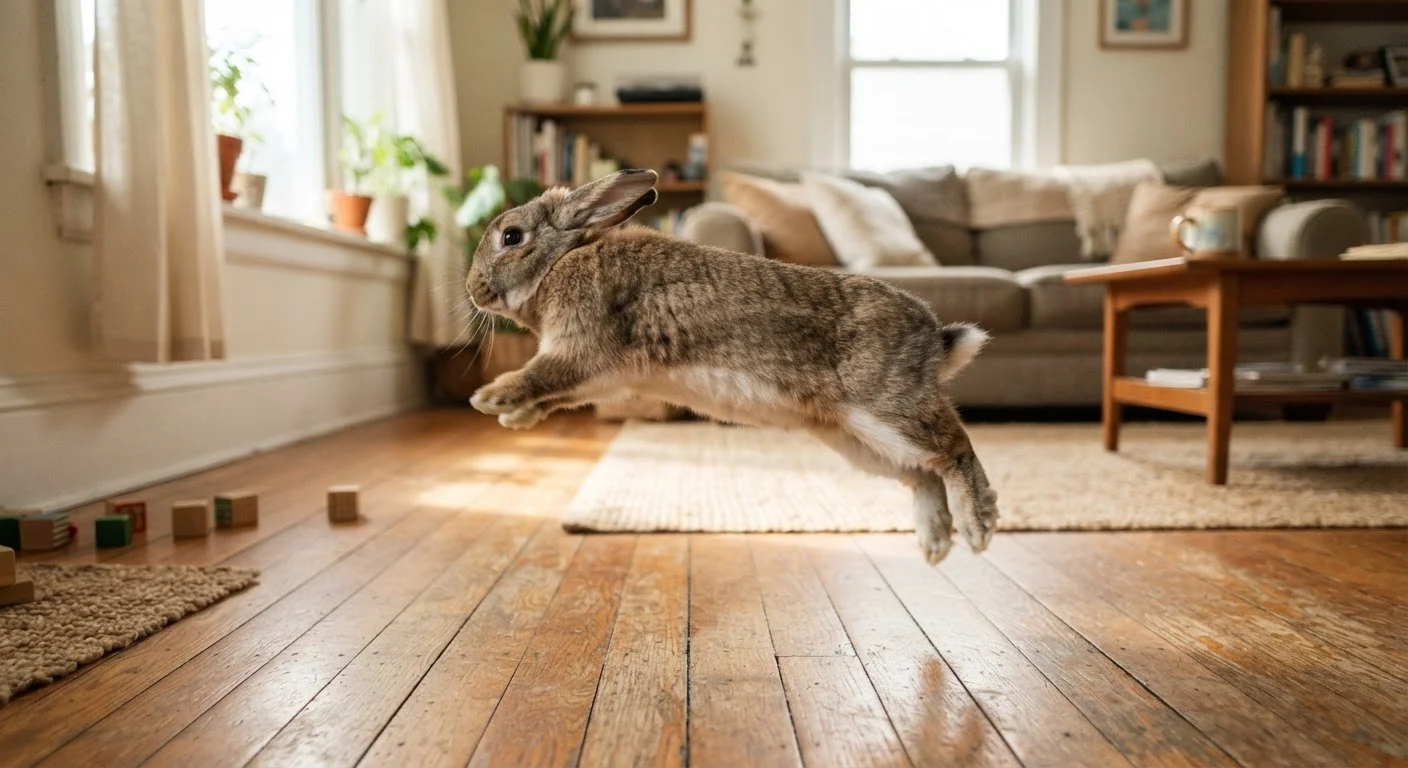
If you have never seen a binky, the first time can be startling. The rabbit launches into the air, twisting its body and flicking its hind legs, sometimes mid-sprint. There is no behavior in the domestic animal world quite like it. Rabbit behaviorists and experienced owners consistently interpret the binky as a spontaneous physical expression of happiness and wellbeing - analogous, in some ways, to a child skipping rather than walking because they simply feel good.
Binkies tend to appear during free-roam time, after a favorite food, or during play with a trusted person. A rabbit that binkies regularly is a strong indicator of good enrichment and emotional security. Conversely, a rabbit that has stopped binkying after previously doing so regularly may be signaling reduced wellbeing - worth noting alongside other behavioral changes. Understanding what positive rabbit behavior looks like also becomes crucial when introducing a second rabbit, since binkying around a bonding partner is a promising signal.
Encourage Binkying With Space and Enrichment
Rabbits are far more likely to binky when they have adequate floor space to run and feel safe doing so. A rabbit confined to a small enclosure rarely has the room or emotional security to express spontaneous joy. Regular, supervised free-roam time in a rabbit-proofed area is one of the most effective ways to promote positive behavioral expression. Tunnels, cardboard boxes, and foraging toys add novelty that further encourages active, happy behavior.
Tooth Sounds: Purring vs. Grinding
Rabbits produce two distinct tooth-based sounds that are easy to confuse but carry opposite meanings. Tooth purring is a soft, barely audible chattering produced when a rabbit is being stroked or is resting contentedly. You are more likely to feel it than hear it - a subtle vibration in the jaw when your hand rests near the rabbit's head. It is a reliable signal of comfort and trust.
Teeth grinding (sometimes called bruxism) is louder, more forceful, and almost always accompanied by a tense or hunched posture. It is associated with pain - dental problems are a common trigger, as are gastrointestinal discomfort and general distress. Because rabbits have continuously growing teeth and a complex digestive system, both dental and gut issues are genuine health risks that can escalate quickly. If you hear loud grinding, treat it as a prompt for veterinary assessment rather than a behavioral curiosity.
For broader context on how other species use sound and posture, see how cats use body language - a useful comparison for multi-pet households.
Dental Health and Tooth Sounds Are Linked
Rabbits' teeth grow continuously throughout their lives, and dental misalignment (malocclusion) is a common issue - particularly in dwarf or lop breeds with compressed skull shapes. Loud tooth grinding is frequently a dental symptom before it becomes visibly apparent. Regular veterinary dental checks, alongside a hay-heavy diet that promotes natural tooth wear, are standard preventive care recommendations. Always consult a rabbit-experienced veterinarian if tooth sounds change noticeably.
Posture, Ear Position, and the Full Picture
Body language in rabbits is rarely one signal in isolation. Reliable interpretation comes from reading multiple cues together:
- Loafed posture (tucked legs, rounded shape, eyes soft or half-closed): relaxed and comfortable.
- Flat pancake posture (pressed to the floor, ears flat, eyes wide): fear or extreme submission - not calm, despite looking still.
- Periscoping (standing tall on hind legs, ears forward): curious, alert, investigating - not alarmed.
- Chin rubbing on objects or people: territory marking, a sign of ownership and familiarity, generally benign.
- Grooming you: a significant trust signal - in rabbit social structure, mutual grooming indicates high bonding.
Ear position amplifies all of these: upright and swiveling means active attention; pinned flat against the back signals fear or aggression; relaxed ears angled slightly to the side indicate ease. Combining ear, eye, and body signals gives a far more accurate reading than any single behavior alone.
Integrating behavioral observation into your regular care routine - alongside health checks and enclosure maintenance - is something our monthly small pet care checklist addresses as an ongoing practice, not a one-time effort.
Frequently Asked Questions
Rabbits can detect vibrations, sounds, and scents that humans miss entirely. A thump that seems unprompted may be a response to a distant noise, an unfamiliar smell, or a change in air pressure. If thumping is frequent or paired with hiding and a tense posture, evaluate the environment for stressors such as nearby predator smells, loud appliances, or drafts.
In most cases, yes - a binky is widely understood by rabbit behaviorists as a spontaneous expression of joy and physical wellbeing. Very occasionally, unusual repetitive jumping could signal a neurological issue, especially if it is asymmetrical or paired with head tilt. If you are unsure, a veterinary check is always a reasonable step.
Tooth purring is a gentle, soft chattering sound produced when a rabbit is being petted or is at ease - you may feel it as a subtle vibration. Loud, audible teeth grinding (bruxism) is a different signal entirely and is commonly associated with pain or significant distress. If you hear loud grinding, consult a rabbit-savvy veterinarian promptly.
Being lifted is instinctively alarming for rabbits, as it mimics being caught by a predator. A thump after being set down is often a protest or expression of displeasure. Consistent handling practice in a calm, low-stress environment can reduce this reaction over time, though some rabbits simply dislike being picked up regardless of socialization.
Behavioral changes - reduced activity, hunched posture, reluctance to move, or loss of interest in food - can be early indicators that something is physically wrong. Rabbits are stoic animals that conceal illness. If your rabbit's normal patterns of movement or interaction shift noticeably, veterinary evaluation is strongly recommended rather than a wait-and-see approach.
A dramatic sideways flop - often sudden and seemingly lifeless - is almost always a sign of deep relaxation and trust. New rabbit owners frequently find flops alarming, but if your rabbit flops in a familiar, safe environment, it is generally a positive behavioral signal indicating comfort and contentment.
The content on this site is provided for informational purposes only and should not be considered a substitute for professional advice. While we strive to provide accurate and up-to-date information, we make no guarantees regarding its completeness or accuracy. Always consult a qualified professional for advice specific to your circumstances before making any decisions.