

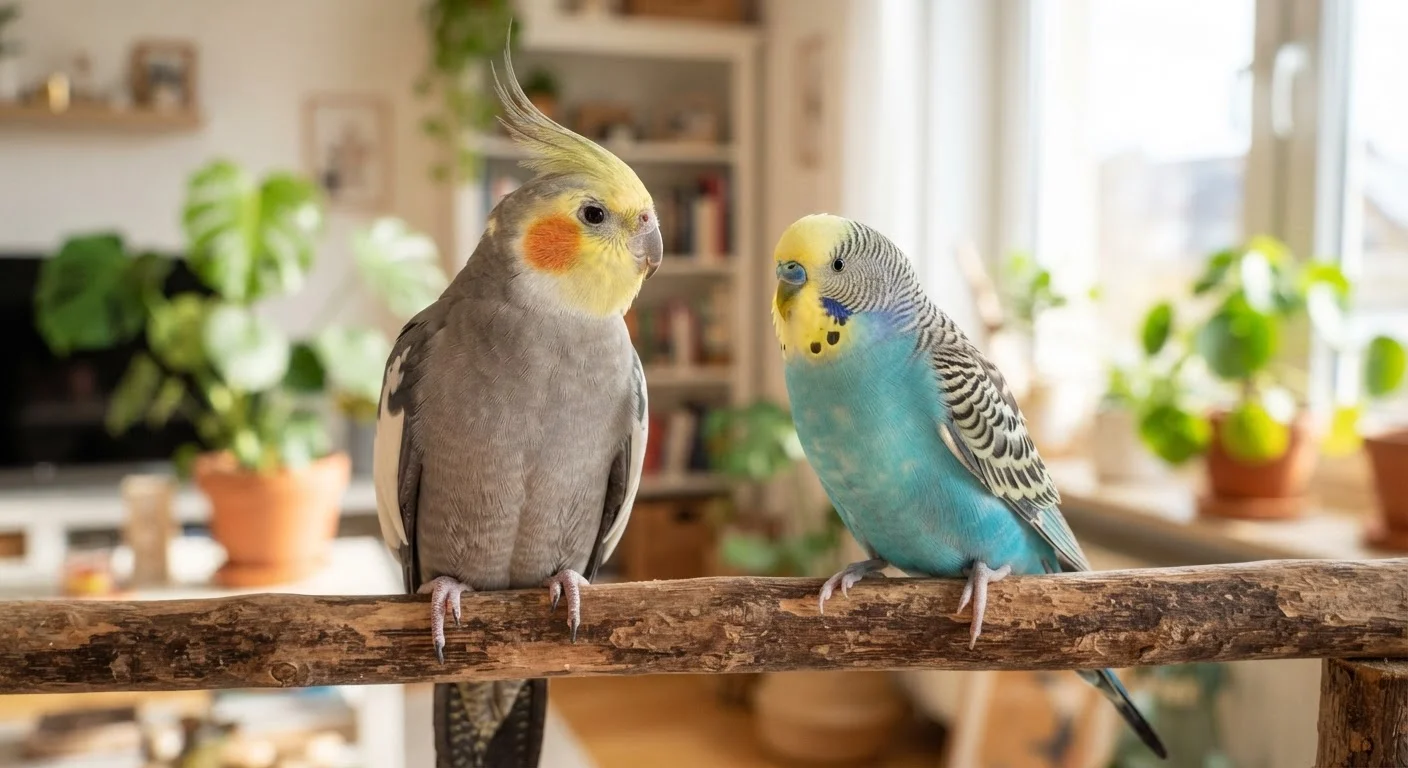
Option A
Cockatiel
The affectionate, interactive companion bird.
Best for: Owners who want a hands-on, socially engaged bird with a gentle temperament and longer lifespan.
Option B
Budgerigar (Budgie)
The compact, lively, and beginner-friendly choice.
Best for: First-time bird owners or those with limited space who still want an entertaining, vocal companion.
Temperament and Bonding: What to Expect Day to Day
Cockatiels and budgerigars are both psittacines - members of the parrot family - but their personalities diverge in ways that matter enormously for everyday life.
Cockatiels are widely regarded as one of the most affectionate small parrots available to US pet owners. They tend to seek physical closeness, will often perch on a trusted owner's shoulder for extended periods, and can become visibly distressed when deprived of attention. This makes them deeply rewarding companions, but also means they have a genuine daily social requirement that owners must meet consistently.
Budgerigars are social and lively, but their bonding style is different. They are naturally flock animals, and a single budgie without adequate stimulation - either from its owner or a cage companion - can develop stress-related behaviors. Many budgie owners keep pairs to address this need. A paired budgie may be less focused on human interaction than a solo bird, which suits some owners perfectly and frustrates others.
For a broader look at what daily small-pet ownership actually demands, see our guide to small pet ownership realities before committing to either species.
| Criterion | Cockatiel | Budgerigar (Budgie) |
|---|---|---|
| Typical lifespan | 15-20 years | 7-10 years |
| Average adult size | ~12 inches (including tail) | ~7 inches |
| Minimum cage size | 24" W × 18" D × 24" H | 18" W × 18" D × 18" H |
| Temperament | Affectionate, bonds closely | Social, flock-oriented |
| Talking ability | Limited words, good whistler | Strong vocabulary potential |
| Noise level | Moderate to loud (whistles) | Moderate (constant chattering) |
| Feather dust | High | Moderate |
| Best kept | Solo or bonded pair | Solo (with owner focus) or pair |
| Beginner-friendliness | Moderate | High |
Space, Noise, and Practical Care Requirements
Cage size is a non-negotiable welfare factor for both species, though the requirements differ. Cockatiels need a cage that is at minimum 24 inches wide, 18 inches deep, and 24 inches tall - and bigger is always better. Budgies can be housed in smaller enclosures, but horizontal space for flight is still essential; a cage that is too narrow restricts natural movement and contributes to health problems.
On noise, both birds are vocal - but in different registers. Budgies produce a near-constant chattering that many owners find pleasant and easy to tune out. Cockatiels can whistle loudly, particularly at dawn and dusk, and a startled or lonely cockatiel will produce a sharp contact call that carries clearly through walls. Neither species is suited to noise-sensitive living situations without management.
Lifespan is a significant practical difference. Well-cared-for cockatiels commonly live 15-20 years; budgerigars typically live 7-10 years. The longer commitment of a cockatiel should factor into any housing, travel, and life-stage planning decisions.
15-20 yrs
Typical cockatiel lifespan in captivity
Avian veterinary sources consistently cite this range for cockatiels receiving proper nutrition and care.
7-10 yrs
Typical budgerigar lifespan in captivity
Budgies with seed-only diets often fall short of this range; pelleted diets are associated with better longevity.
~1,700
Words a budgie can reportedly learn
Budgerigars hold records for vocabulary among small parrots, according to ornithological and avian behavior literature.
Both species shed feather dust - cockatiels notably more so than budgies. Owners with respiratory sensitivities or allergies should discuss this with a healthcare provider before acquiring either bird. Regular cage cleaning and good ventilation are standard care baselines for both.
Enrichment is equally important for both. Boredom and under-stimulation in pet birds can lead to feather plucking and other behavioral issues. Our article on bird enrichment strategies covers practical approaches that apply to both cockatiels and budgies.
Diet, Health Considerations, and Veterinary Needs
Both species thrive on a diet built around high-quality pelleted food supplemented with fresh vegetables, leafy greens, and limited fruit. Seed-only diets - still commonly marketed for both birds - are nutritionally inadequate on their own and are associated with fatty liver disease and shortened lifespans. This is an area where veterinary consensus is clear and well-established.
Fresh water, daily foraging opportunities, and calcium sources such as cuttlebone round out a solid baseline for either bird. Avocado, onion, garlic, chocolate, and caffeine are toxic to both species and must be kept entirely out of reach.
Veterinary care should include a wellness exam at least annually with an avian-experienced vet. Neither cockatiels nor budgies display illness obviously until a condition is often quite advanced - a characteristic of prey animals - making routine check-ups more important than many new owners realize. Budgies are particularly prone to tumors and thyroid issues; cockatiels are susceptible to respiratory infections and nutritional deficiencies if diet is poor.
This article is for general informational purposes only and does not constitute veterinary advice. Always consult a qualified avian veterinarian for guidance specific to your bird's health needs.
The content on this site is provided for informational purposes only and should not be considered a substitute for professional advice. While we strive to provide accurate and up-to-date information, we make no guarantees regarding its completeness or accuracy. Always consult a qualified professional for advice specific to your circumstances before making any decisions.