

Why Phased Introductions Matter
Cats are territorial animals whose stress responses are closely tied to their sense of spatial control. Introducing a new cat abruptly into a home with established residents - whether other cats, a dog, or small pets - bypasses the gradual scent-based communication that felines rely on to assess safety. The result is often fear-driven aggression, hiding, inappropriate elimination, or chronic anxiety that can persist for months.
Structured introductions work because they allow each animal to process information at a manageable pace. Scent is processed before sight, and sight before contact - mirroring how cats naturally gather information in the wild. The same principle applies when a cat enters a home with a resident dog; the dog's prey drive and energy level add complexity that a slow approach helps to manage.
If you are still deciding which cat to bring home, our article on kitten vs. adult adoption can help you weigh how a cat's life stage affects compatibility with existing pets.
What you will need
Step-by-Step: Managing the Introduction
The following steps apply primarily to cat-to-cat and cat-to-dog introductions. If your household includes rabbits, birds, or other small animals, review our guidance on small pet ownership realities before proceeding, and consult your veterinarian about whether cohabitation is advisable for your specific species combination.
Small Pets and Prey Drive Require Extra Care
Cats have a natural predatory instinct that can be triggered by small animals such as rabbits, birds, guinea pigs, and fish. If your household includes small pets, introductions between a new cat and those animals should be handled with a much higher level of caution - in many cases, complete permanent separation is the safest approach. See our small pets care hub for species-specific guidance.
Baby gate or pet gate
Creates a visual barrier that allows animals to see each other while remaining physically separated during early introductions.
Soft cloths or worn t-shirts
Used to transfer scent between animals during the scent-swapping phase without direct contact.
Carrier or crate
Provides a secure containment option for the new cat during supervised face-to-face sessions.
Puzzle feeder or interactive toy
Redirects energy and creates positive associations during shared space time.
Pheromone diffuser (feline synthetic pheromone type)
May help reduce anxiety in the new cat's room and shared areas during the transition period.
Set up the new cat's isolation room
Before bringing your new cat home, prepare a dedicated room where it will spend the first several days. Stock it with food, fresh water, a litter box, a scratching post, a hiding spot, and bedding. Keep the door closed at all times. This room gives the cat time to decompress and establishes its scent in one contained area, preventing immediate territorial competition with resident pets.
Begin scent swapping
After 24-48 hours, rub a soft cloth on the new cat's face and cheeks, then place that cloth near your resident pets' resting areas. Do the reverse with a cloth carrying resident pets' scents and place it in the isolation room. Repeat daily for several days. This step allows each animal to investigate the other's scent profile in a completely non-threatening context before any visual contact occurs.
Feed on opposite sides of the closed door
Place food bowls on each side of the isolation room door - far enough away that both animals eat comfortably without stress. Over several days, gradually move bowls closer to the door. Pairing food with the other animal's scent and presence builds a mild positive association that lays the groundwork for a calmer first visual meeting.
Introduce a visual barrier - sight without contact
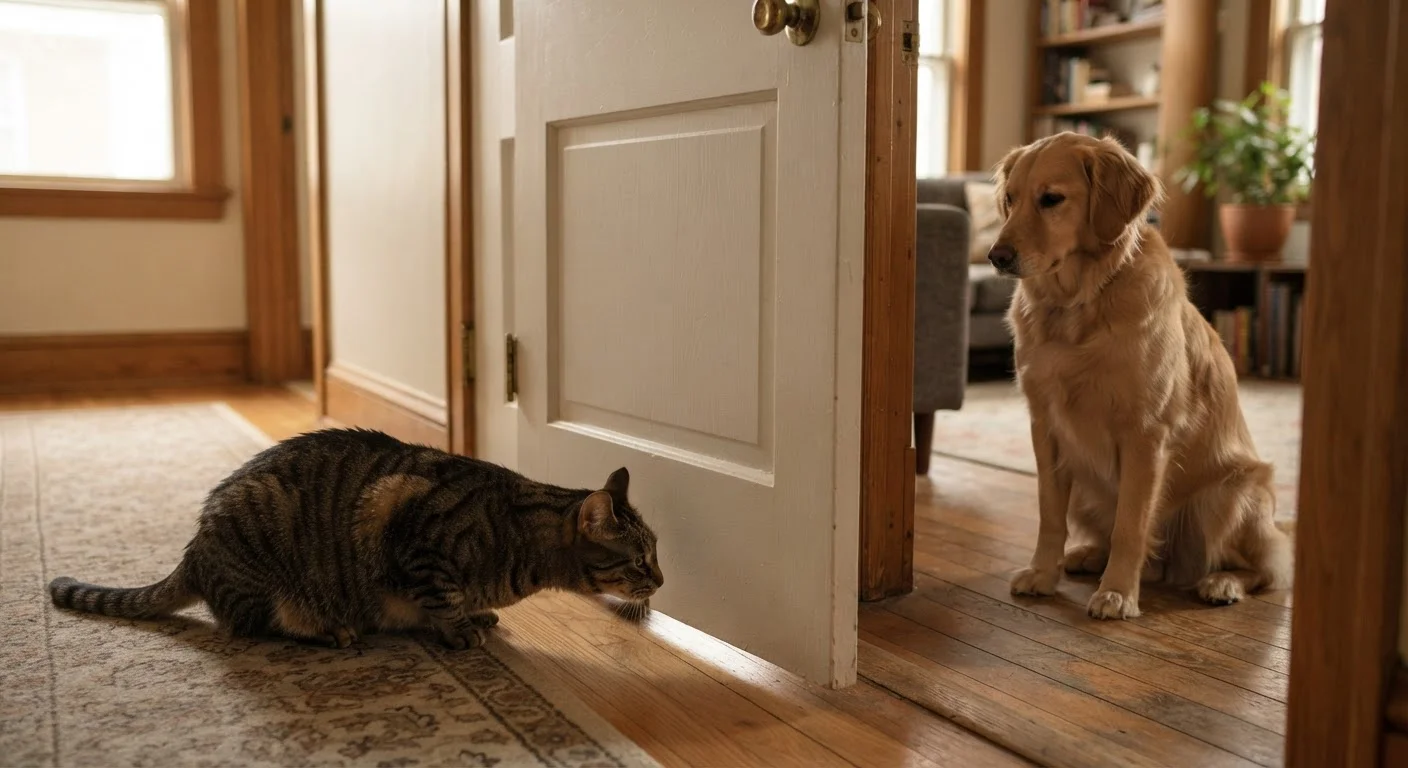
Replace or crack the closed door with a baby gate, a cracked door secured with a doorstop, or a screen door. Allow animals to see and smell each other freely while physical contact remains impossible. Supervise these sessions and keep them short - five to ten minutes initially. End each session on a calm note, before tension escalates. Repeat and extend duration as both animals show relaxed or neutral behavior.
Allow supervised free interaction
Once both animals consistently show relaxed body language through the barrier - loose posture, normal breathing, willingness to eat nearby - allow them into the same shared space with close supervision. Keep early sessions brief and distraction-free. Never leave them unsupervised until you have observed weeks of peaceful coexistence. Provide escape routes and elevated spaces so the cat can retreat at will.
Maintain separate resources long-term
Even after successful introductions, continue providing separate feeding stations, multiple litter boxes, and individual resting areas. Resource competition is a leading cause of chronic stress and inter-pet conflict in multi-pet homes. Keeping resources abundant and spatially separated removes the primary trigger for territorial behavior over the long term.
Patience Is the Most Important Tool
The full introduction process typically takes one to three weeks, though some cats and dogs require longer. There is no universal timeline. Rushing any phase - especially skipping scent swapping - significantly increases the likelihood of conflict that is harder to undo. If progress stalls, returning to an earlier phase is always the right move.
Reading the Room: Signs of Progress and Signs of Trouble
Progress looks like: brief mutual sniffing followed by disengagement, both animals eating normally, relaxed tail positions, and willingness to rest in shared areas without vigilance. Trouble signs include sustained stalking, flattened ears, puffed fur, sustained hissing beyond the first few days, and any instance of redirected aggression toward people.
Chronic stress in a multi-pet home can also affect a cat's physical health - watch for changes in appetite, litter box habits, or grooming patterns. These signals warrant a conversation with your veterinarian.
Never Force Physical Contact
Forcing animals together before they are ready - including holding them close or physically restraining them - can cause lasting fear associations that make cohabitation significantly harder. A single traumatic first encounter can set the introduction process back by weeks. Always let each animal set the pace of approach.
For households where a new cat will eventually share outdoor access, understanding the trade-offs involved is worthwhile. Our article on indoor vs. outdoor cat decisions covers the key considerations.
The content on this site is provided for informational purposes only and should not be considered a substitute for professional advice. While we strive to provide accurate and up-to-date information, we make no guarantees regarding its completeness or accuracy. Always consult a qualified professional for advice specific to your circumstances before making any decisions.