

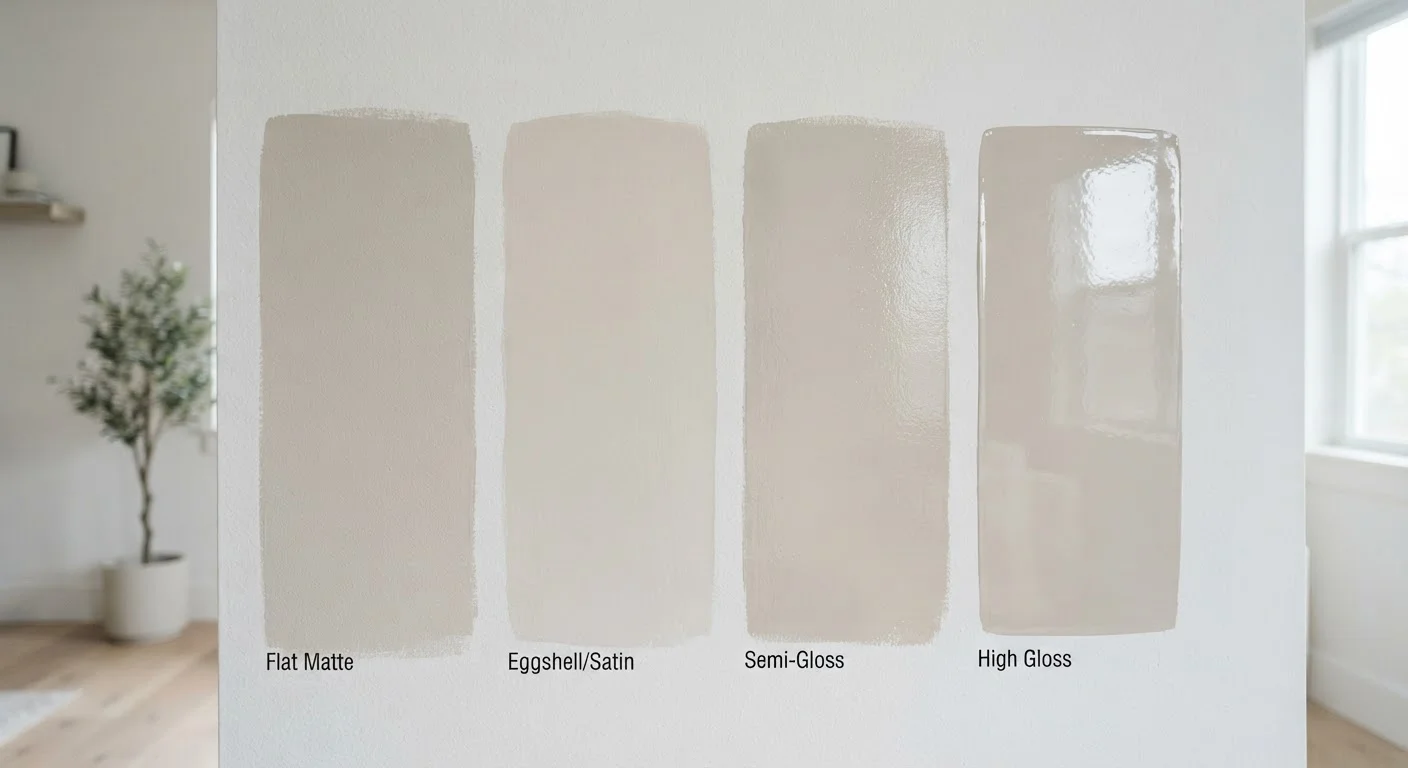
What a Paint Finish Actually Means
When a paint label says "eggshell" or "semi-gloss," it's describing sheen level - how much light the dried paint surface reflects. Sheen affects not just appearance but also how durable, washable, and forgiving a painted surface will be in real-world use.
Finishes are typically ranked on a spectrum from lowest to highest reflectivity: flat/matte → eggshell → satin → semi-gloss → gloss. Each step up the scale adds durability and washability but also makes surface imperfections more visible. Choosing a finish is always a trade-off between aesthetics and practicality.
Surface condition matters too. A rough or patchy wall amplifies any sheen, while smooth, well-prepped drywall looks more consistent at higher gloss levels. Before selecting a finish, inspect your walls carefully - skip-trowel or textured surfaces may look unintentionally highlighted under semi-gloss.
Sheen
The degree to which a dried paint surface reflects light. Higher sheen means more light bounces back to the eye, giving a shinier appearance.
Flat / Matte Finish
The lowest sheen level, reflecting minimal light. Best at hiding wall imperfections but least resistant to washing or scrubbing.
Eggshell Finish
A low-sheen finish with a slight luster similar to the surface of an eggshell. More washable than flat paint while still appearing relatively subdued.
Satin Finish
A mid-range sheen with a soft, velvety look. Durable enough for moderate-traffic areas and resists moisture better than eggshell.
Semi-Gloss Finish
A higher-sheen finish that is highly washable and moisture-resistant. Commonly used on trim, doors, and in humid rooms like bathrooms.
Primer
A preparatory coating applied before paint to improve adhesion, even out porosity, and help the topcoat achieve a uniform sheen and color.
The Four Main Finishes and Where They Belong
Here's how each finish performs and which spaces it suits best:
Flat / Matte
Reflects very little light, hiding surface flaws, roller marks, and minor wall imperfections effectively. It's the go-to for bedroom ceilings and low-traffic walls. The trade-off: flat paint is the hardest to clean - scrubbing can lift or burnish the surface. Avoid it in kitchens, bathrooms, or kids' rooms.
Eggshell
Named for the faint luster of an eggshell, this finish sits just above flat. It offers a gentle warmth while being meaningfully more washable than matte. Eggshell works well on living room and bedroom walls where occasional cleaning is needed without a shiny look.
Satin
The workhorse of interior painting. Satin has a soft, velvety sheen that holds up to regular wiping and moderate humidity. It's suitable for hallways, kids' rooms, and kitchen walls (not backsplashes). Many painters default to satin for almost any vertical surface in a home because it balances durability and aesthetics well.
Semi-Gloss
Higher reflectivity makes semi-gloss highly durable and moisture-resistant. It's the standard choice for trim, doors, window casings, and bathrooms. The sheen highlights any brushstroke or surface flaw, so prep work matters more here. For a full bathroom renovation context, see our bathroom renovation planning guide.
Practical Guidance for Choosing and Applying
A few principles help simplify the decision:
- Match sheen to traffic. Higher-traffic spaces benefit from higher sheen. Hallways and mudrooms take a beating; satin or semi-gloss holds up.
- Use lower sheen on ceilings. Flat ceiling paint minimizes the appearance of texture variations and reduces glare from overhead lighting.
- Prep determines outcome. Any sheen above eggshell will reveal dents, patches, and sanding marks more clearly. Fill, sand, and prime before applying satin or semi-gloss to walls.
- Humidity calls for higher sheen. In laundry rooms, bathrooms, and kitchens, moisture-resistant semi-gloss or satin resists mildew and cleans more easily than flat or eggshell.
- Don't skip primer. Primer helps paint bond evenly, especially over patched drywall or previously dark colors, and ensures the final sheen reads consistently across the wall.
Keeping surfaces in good order is part of broader home upkeep - our room-by-room home reference covers maintenance habits that complement a fresh paint job in any space.
Note: Paint performance can vary by formulation and manufacturer. Always test a sample patch in your specific room before committing to a full application, as lighting conditions significantly affect how a finish looks when dry.
The content on this site is provided for informational purposes only and should not be considered a substitute for professional advice. While we strive to provide accurate and up-to-date information, we make no guarantees regarding its completeness or accuracy. Always consult a qualified professional for advice specific to your circumstances before making any decisions.