

Our Verdict
No single waterproofing approach suits every basement. Exterior membranes offer the most durable protection against groundwater but demand significant investment and excavation. Interior drainage systems are the workhorse solution for ongoing seepage, while interior coatings handle light surface condensation and minor dampness only. Identifying the actual source of moisture - not just its symptoms - is the essential first step before any investment.
| Best for | Recommended |
|---|---|
| Homes with hydrostatic pressure or persistent groundwater intrusion | Exterior waterproofing membrane |
| Finished or partially finished basements with active seepage | Interior drainage system |
| Basements with surface condensation or minor efflorescence | Interior coatings and sealers |
| Severe or multi-source moisture problems | Combined exterior and interior approach |
Why Basement Moisture Requires a Diagnosis First
Before comparing waterproofing methods, it's worth understanding that basement moisture arrives through three distinct pathways: liquid water seeping through cracks or the wall-floor joint, water vapor diffusing through porous concrete, and condensation forming on cool surfaces. Each pathway responds differently to treatment.
A simple diagnostic test helps distinguish seepage from condensation: tape a piece of plastic sheeting tightly against the suspected damp area for 24-48 hours. Moisture on the wall side of the plastic indicates water coming through the wall; moisture on the room side points to condensation from interior humidity. This distinction determines which approach - or which combination - actually makes sense for your situation.
Getting this diagnosis right also affects cost expectations significantly. Applying a surface sealer to a wall with active hydrostatic pressure (water-saturated soil pressing against the foundation) will fail within a season. Excavating for an exterior membrane when the real culprit is interior humidity is an expensive mismatch. A qualified waterproofing contractor or structural engineer can provide a professional assessment, particularly when cracks, wall bowing, or chronic flooding are involved.
Interior Coatings and Sealers: Surface-Level Protection
Interior waterproofing coatings - including crystalline sealers, cementitious coatings, and masonry paints labeled as waterproof - are applied directly to foundation walls from inside the basement. They work by filling the microscopic pores in concrete or block, reducing the passage of water vapor and minor seepage.
These products are the most accessible option for DIY application and carry the lowest upfront cost. They perform well where moisture is limited to surface dampness, efflorescence (the white, chalky mineral deposits left by evaporating water), or humidity-driven condensation. Crystalline products, in particular, chemically react with concrete to form water-blocking compounds deep within the pores.
However, interior coatings have a firm ceiling on what they can handle. They cannot resist sustained hydrostatic pressure. If the soil around your foundation is saturated after heavy rain and water is physically pushing through cracks, a coating will eventually delaminate or allow water to bypass it. They also do nothing to address the underlying drainage or grading problems that allow water to accumulate against the foundation in the first place. Think of interior coatings as appropriate for moisture management, not moisture elimination in high-pressure situations. For sealing gaps around pipes or fixtures as a complementary step, see our guide on choosing between caulk and sealant.
Check Grading and Gutters First
Before investing in any waterproofing system, evaluate two low-cost factors: soil grading and gutter drainage. The ground around your foundation should slope away from the house at roughly 6 inches of drop over the first 10 feet. Downspouts should discharge at least 4-6 feet from the foundation. Correcting these issues sometimes resolves minor moisture problems entirely and improves the performance of any waterproofing system you do install.
Exterior Waterproofing Membranes: Stopping Water at the Source
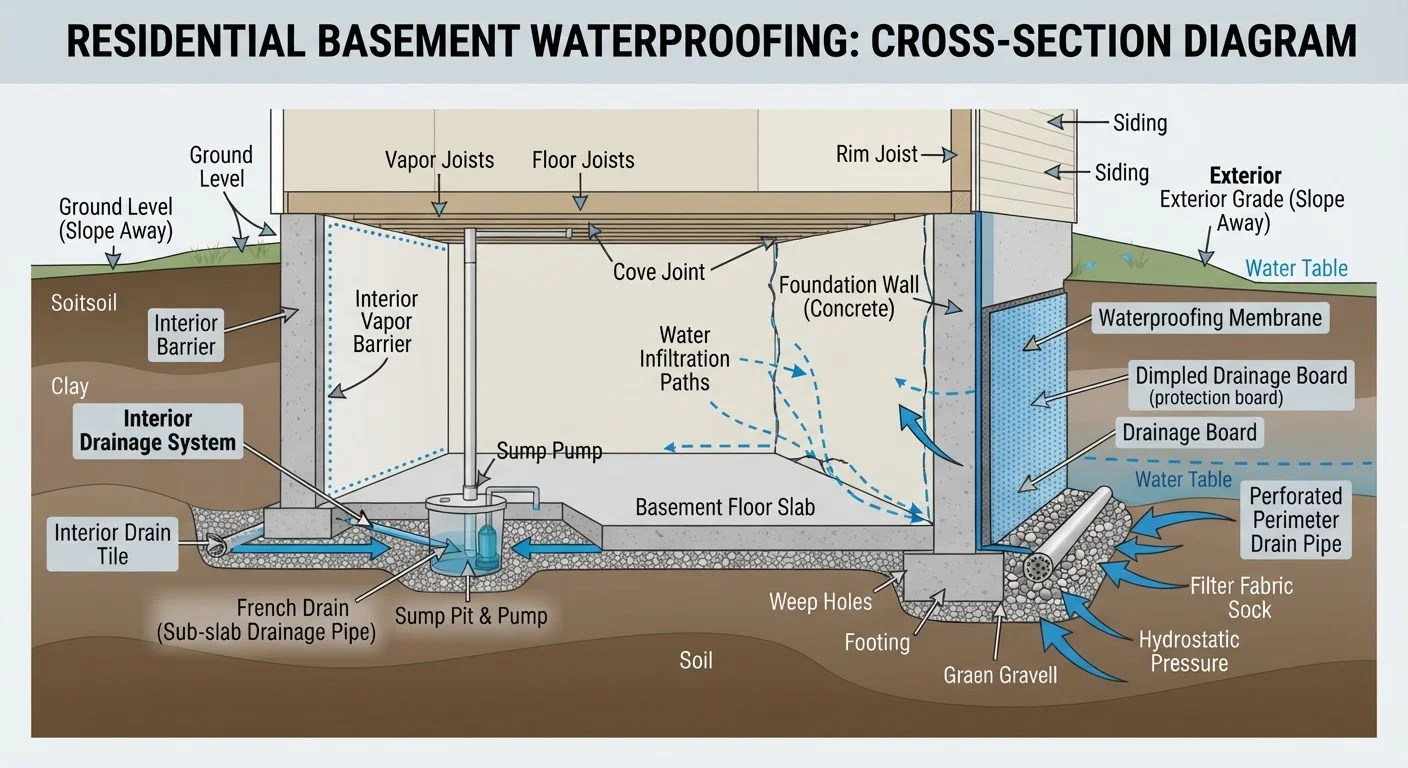
Exterior waterproofing addresses the problem where it originates - outside the foundation wall, before water ever contacts the structure. The process involves excavating the soil around the foundation down to the footing, cleaning the wall surface, applying a waterproof membrane (typically a rubberized asphalt sheet, a liquid-applied polymer membrane, or a drain board system), and then backfilling with properly graded material or drainage aggregate.
This is widely regarded as the most thorough solution for chronic groundwater intrusion. The membrane creates a physical barrier that deflects water downward toward a perimeter drain rather than letting it press against the wall. When correctly installed, exterior systems address hydrostatic pressure directly and can dramatically extend the life of the foundation.
The significant tradeoff is cost and disruption. Excavation requires heavy equipment, removes landscaping, and may affect driveways, patios, or utilities. The work is almost always performed by licensed contractors, and many jurisdictions require permits for this level of foundation work. Homeowners should verify local permit requirements before any excavation begins. The investment is substantial, but for homes with serious water intrusion, it often represents the most durable long-term resolution.
| Interior Coatings | Exterior Membranes | Interior Drainage Systems | |
|---|---|---|---|
| Problem addressed | Vapor, minor dampness | Groundwater, hydrostatic pressure | Active seepage, ongoing water entry |
| Installation complexity | DIY-accessible | Professional, excavation required | Professional, interior concrete work |
| Disruption level | Minimal | High - landscaping removed | Moderate - floor perimeter cut |
| Permit typically required | Usually not | Often yes | Varies by jurisdiction |
| Effectiveness vs. hydrostatic pressure | Low | High | Moderate - manages, not blocks |
| Relative upfront cost | Lowest | Highest | Mid-range |
| Ongoing maintenance | Reapplication over time | Minimal if intact | Sump pump servicing required |
Interior Drainage Systems: Managing Water That Enters
Interior drainage systems - commonly called French drains or interior perimeter drain systems - take a fundamentally different philosophy: instead of blocking water, they collect it and redirect it harmlessly away. A channel is cut into the concrete floor along the perimeter of the basement, a perforated pipe is installed at the footing level, and the trench is filled with gravel and re-covered with concrete. Water that enters through the wall-floor joint or through the wall itself flows into the drain and is directed to a sump pump, which discharges it away from the foundation.
This approach is particularly practical when exterior excavation isn't feasible - in homes with finished landscaping, attached structures, or limited access - and it handles ongoing seepage reliably once installed. Sump pump systems have become highly reliable, and battery backup units help maintain function during power outages, which often coincide with heavy rainstorms.
The key limitation is that an interior drain system doesn't stop water from entering the wall; it manages it after entry. Walls may still experience some moisture exposure over time. That said, for many homeowners with moderate to significant seepage, interior drainage combined with a properly maintained sump pump provides practical, lasting relief without the full scope of exterior excavation. For homeowners also considering basement insulation as part of a broader improvement, the complete homeowner's guide to insulation covers how moisture management interacts with insulation choices.
This article provides general educational information about waterproofing approaches. For structural concerns, active flooding, or work requiring permits, consult a licensed waterproofing contractor or structural engineer familiar with your local building codes.
The content on this site is provided for informational purposes only and should not be considered a substitute for professional advice. While we strive to provide accurate and up-to-date information, we make no guarantees regarding its completeness or accuracy. Always consult a qualified professional for advice specific to your circumstances before making any decisions.