

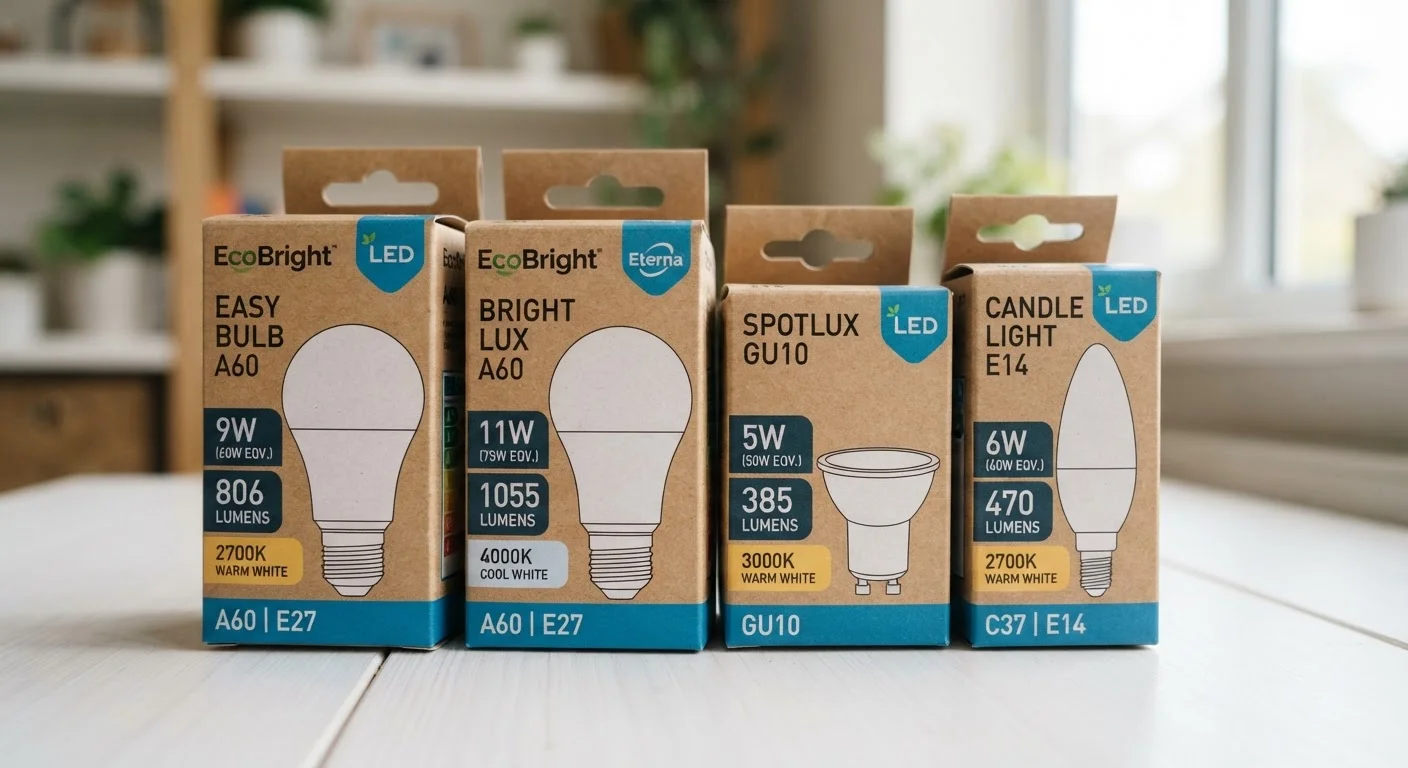
Why the Old Watt Shortcut No Longer Works
For decades, shoppers chose light bulbs by a single number: watts. A 60-watt bulb went in the living room lamp; a 100-watt bulb lit the garage. That shortcut worked because all incandescent bulbs converted energy to light at roughly the same efficiency, so wattage reliably predicted brightness.
LEDs changed that relationship permanently. A modern LED can produce the same 800 lumens of light as a 60-watt incandescent while drawing only 8 to 10 watts - roughly one-seventh the energy. If you shop by watts alone today, you risk buying a bulb that is far dimmer, or far brighter, than you intended.
The shift is similar to learning that a food's calorie count doesn't tell you much about its nutritional value - both require reading the full label rather than relying on a single proxy figure. Just as reading a nutrition label correctly reveals what a food actually contains, understanding a bulb label reveals what a bulb actually does.
~75%
Energy saved by LEDs vs. incandescents
The U.S. Department of Energy estimates LED bulbs use at least 75% less energy than traditional incandescent bulbs for the same light output.
25x
Longer rated lifespan of LEDs
According to the U.S. Department of Energy, LED bulbs can last 25 times longer than incandescent bulbs under typical conditions.
2700K-3000K
Most common residential colour temperature range
Warm white bulbs in the 2700K-3000K range remain the most widely used choice for living spaces in U.S. homes, replicating the familiar glow of traditional incandescents.
Lumens: The Real Measure of Brightness
Lumens quantify the total amount of visible light a bulb emits. The higher the lumen count, the brighter the light. Here are common reference points that make the number meaningful:
- 450 lumens - roughly equivalent to a 40-watt incandescent; good for accent or decorative fixtures
- 800 lumens - equivalent to a 60-watt incandescent; standard for table lamps and most ceiling fixtures
- 1,100 lumens - equivalent to a 75-watt incandescent; useful for reading areas and task lighting
- 1,600 lumens - equivalent to a 100-watt incandescent; appropriate for kitchens, workshops, and high-traffic rooms
When planning a room, consider lumens per square foot. A general guideline for ambient (overall) lighting is around 10-20 lumens per square foot, though task-heavy spaces like kitchens may benefit from higher levels. Always treat these as starting points - personal preference and ceiling height affect perception significantly.
Colour Temperature: Setting the Mood with Kelvin
Colour temperature is measured in Kelvin (K) and describes the hue of the light a bulb emits - not its heat. The scale runs from warm (yellowish) to cool (bluish), and matching it to a room's function makes a noticeable difference in comfort and usability.
Common Colour Temperature Ranges
- 2700K-3000K - Warm White
- Produces the familiar golden glow of traditional incandescents. Well-suited to bedrooms, living rooms, and dining areas where a relaxed, welcoming atmosphere is the goal.
- 3500K-4100K - Neutral or Cool White
- A crisp, neutral light that feels neither warm nor cold. Often chosen for kitchens, bathrooms, and home offices where clarity matters without the harshness of daylight bulbs.
- 5000K-6500K - Daylight
- A bright, blue-tinged light that mimics natural daylight. Useful in garages, workshops, craft rooms, or anywhere accurate colour rendering is a priority. Can feel overly clinical in living spaces.
Match Colour Temperature to Room Function
A simple rule of thumb: use warm whites (2700K-3000K) in rooms where you relax, and cooler whites (3500K-5000K) in rooms where you work or need visual clarity. Keeping all bulbs in the same space within a consistent Kelvin range also avoids the jarring look of mismatched light tones.
One practical tip: keep colour temperature consistent within a single open-plan space. Mixing a 2700K bulb in a floor lamp with a 5000K bulb in a ceiling fixture creates an uneven, visually distracting effect.
Other Numbers Worth Noticing
Beyond lumens, watts, and Kelvin, the Lighting Facts label typically includes a few more data points that can guide smarter choices.
Color Rendering Index (CRI)
CRI is a 0-100 scale measuring how faithfully a bulb reveals the true colors of surfaces and objects under its light, compared to natural sunlight. A CRI of 80 is generally considered acceptable for most household uses. A CRI of 90 or higher is preferable for spaces where colour accuracy matters - kitchens, dressing areas, or art studios. Most standard LEDs fall in the 80-90 range.
Estimated Yearly Energy Cost
This figure, printed on U.S. Lighting Facts labels, uses a standardized calculation based on a national average electricity rate and three hours of daily use. It allows apples-to-apples cost comparisons between bulb types. Your actual cost will vary with local electricity rates and actual usage hours, but the relative difference between two bulbs stays directionally accurate.
Bulb Life (Hours)
LED bulbs are commonly rated for 15,000 to 25,000 hours - compared to roughly 1,000 hours for a standard incandescent. That said, rated life is a laboratory estimate under controlled conditions; real-world results can vary based on heat, vibration, and how often a bulb is switched on and off.
If energy efficiency labeling interests you more broadly, the Energy Star certification guide explains how that program evaluates appliances using similar efficiency principles.
A homeowner replaces a bedroom lamp's 60-watt incandescent with an LED labeled '800 lumens, 2700K, 9W.'
A home cook installs new under-cabinet lighting in the kitchen and chooses between two LED strip options: one at 3000K and one at 5000K.
A renter notices that a ceiling fixture has a 'Max 60W' label inside the socket but finds LEDs sold as '60-watt equivalent' using only 9 actual watts.
Frequently Asked Questions
800 lumens is roughly equivalent to the brightness once produced by a traditional 60-watt incandescent bulb. Lumens are the true measure of visible light output, so an LED rated at 800 lumens will appear just as bright as that older bulb while using far less energy.
Higher Kelvin numbers mean cooler, bluer light. A bulb rated around 2700K produces warm, amber-toned light similar to traditional incandescents. A bulb at 5000K or above produces a crisp, daylight-like white that can feel stark in living spaces but works well in task-focused areas.
You can replace it with any LED that is labeled '60-watt equivalent' or that produces approximately 800 lumens. Always verify that the LED's actual wattage does not exceed your fixture's maximum watt rating, which is printed inside the fixture socket area.
CRI stands for Color Rendering Index, a scale from 0 to 100 that measures how accurately a bulb renders the colors of objects compared to natural daylight. A CRI of 90 or above is considered excellent for tasks like cooking, applying makeup, or artwork.
The estimated annual energy cost on the Lighting Facts label gives you a standardized way to compare running costs between bulbs. It is calculated using a national average electricity rate and assumes roughly three hours of daily use, so your actual cost may vary depending on local rates and usage habits.
Wattage matters for two reasons: it tells you the bulb's energy draw, and it must stay within your fixture's maximum watt rating for safety. However, wattage no longer predicts brightness the way it did with incandescents - always look at lumens for that information.
The content on this site is provided for informational purposes only and should not be considered a substitute for professional advice. While we strive to provide accurate and up-to-date information, we make no guarantees regarding its completeness or accuracy. Always consult a qualified professional for advice specific to your circumstances before making any decisions.