

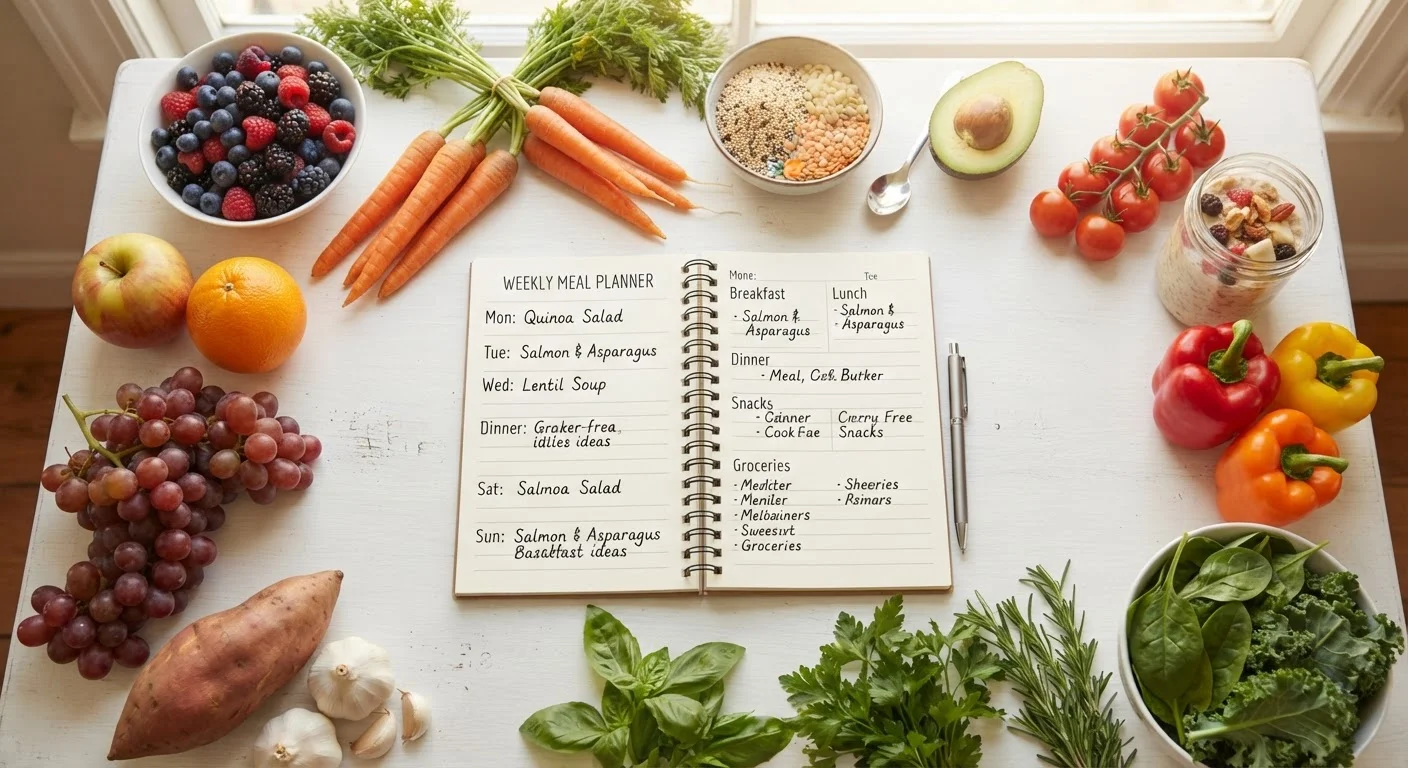
Why Meal Planning Supports Nutritional Balance
Nutritional balance rarely happens by accident. Without some degree of intentional planning, meals tend to cluster around convenience foods, repeat a narrow set of ingredients, and drift toward whatever is fastest to prepare under pressure. Over time, these patterns can lead to gaps in key nutrients - particularly fiber, vitamins from varied produce, and adequate protein distribution across the day.
Weekly meal planning doesn't require a nutrition degree or calorie-counting software. At its core, it's the practice of deciding in advance what you'll eat and making sure the ingredients are available when you need them. That single shift - from reactive to proactive - changes what ends up on your plate.
If your goal is also to align your nutrition with an active lifestyle, our weekly exercise planning framework offers a complementary structure for movement that works alongside your food habits.
Meal Plans Are Not Medical Prescriptions
The guidance in this article reflects general nutrition principles for healthy adults. It is not a substitute for personalized advice from a registered dietitian or healthcare provider. If you have a specific health condition, food allergy, or dietary restriction, consult a qualified professional before making significant changes to your eating patterns.
What You'll Need to Get Started
Effective meal planning requires very few tools, but having the right ones in place makes the process significantly smoother. Below are the core resources to gather before you begin your first planning session.
Weekly meal planner template
Maps out breakfasts, lunches, dinners, and snacks across seven days in one view.
Grocery list (paper or app)
Tracks ingredients needed based on the finalized meal plan to prevent duplicate purchases and gaps.
Kitchen scale or measuring cups
Helps with portioning during batch cooking, particularly for grains and proteins.
Airtight storage containers
Keeps batch-cooked components fresh and ready to assemble into meals throughout the week.
What you will need
With these items in place, you're ready to work through the planning steps below.
Step-by-Step: Building Your Weekly Meal Plan
Follow these steps in order during your first planning session. Once the process is familiar, most steps take only a few minutes each. The full session - from auditing your schedule to finalizing your grocery list - typically takes 20 to 45 minutes.
Audit your week before you plan your meals
Before choosing a single recipe, look at your actual week. Identify which evenings are rushed, which days allow more cooking time, and whether any meals will be eaten away from home. A plan that ignores your real schedule will collapse by Tuesday.
Note your longest and shortest cooking windows. If Wednesday is packed, that's a night for a five-minute assembly meal - not a new recipe.
Build each meal around a simple plate framework
Use a consistent structural approach rather than tracking individual nutrients. A practical framework supported by mainstream dietary guidance divides a plate roughly into: half non-starchy vegetables, a quarter lean or plant-based protein, and a quarter whole-grain or starchy carbohydrate, with a small amount of healthy fat included.
This isn't a rigid prescription - it's a reference point. For a deeper foundation, see our guide on nutrition fundamentals for beginners.
Prioritize variety in protein and vegetable sources
Eating a range of protein sources - poultry, fish, legumes, eggs, dairy, or plant proteins - helps cover the full spectrum of amino acids and micronutrients no single food provides. The same applies to vegetables: rotating colors and types introduces different fiber types and phytonutrients.
If you follow a plant-forward or plant-exclusive approach, our article on plant-based protein sources covers how to combine foods for a complete amino acid profile.
Identify two or three batch-cook anchors
Batch cooking doesn't mean preparing every meal in advance. Instead, identify two or three versatile components you can cook once and repurpose: a large pot of whole grains, a sheet pan of roasted vegetables, or a batch of cooked legumes. These become building blocks for multiple meals.
A well-stocked pantry supports this approach significantly. Our functional pantry guide covers the staples worth keeping on hand.
Write your grocery list from the plan - not from memory
Once your meals are mapped out, extract every ingredient you'll need and consolidate into a single list organized by store section (produce, grains, proteins, dairy, pantry). Shopping from a plan-derived list reduces impulse purchases and ensures you have what you need when cooking time arrives.
Cross-reference against what's already in your kitchen before finalizing - this avoids buying duplicates of pantry staples you already have.
Review and adjust at the end of each week
Spend five minutes at the end of the week noting what worked and what didn't. Which meals were actually eaten? What got skipped? Were there consistent nutritional gaps - very few vegetables on weekdays, for example, or protein-light breakfasts?
Patterns across a few weeks reveal more useful insight than any single day's intake. You might also find it useful to consider how eating patterns interact with energy and digestion as you refine your approach.
Nutrition Labels as a Planning Tool
When evaluating packaged ingredients for your meal plan, knowing how to read the nutrition facts panel helps you make more informed comparisons. Our guide to reading a nutrition label without getting confused breaks down each section in plain language.
Common Pitfalls and How to Avoid Them
Even well-intentioned meal plans derail. The most common reasons are overambition (planning elaborate meals on busy nights), under-planning snacks and lunches, and failing to account for food already in the kitchen. Treat your first few weekly plans as drafts, not finished products.
Consistency Beats Complexity Every Time
Research on dietary patterns consistently suggests that long-term adherence matters more than short-term dietary perfection. A simple, repeatable plan you can maintain is nutritionally superior to an elaborate plan you abandon by week two. Start with a structure you can realistically sustain, then build from there.
Another frequent gap is neglecting to consider how stress, schedule changes, and energy fluctuations affect eating behavior. Exploring how to build a personal stress-response plan can surface patterns that affect your food choices in ways a meal plan alone won't address.
This article is for general informational and educational purposes only. It is not intended as medical or dietary advice. Individuals with specific health conditions, nutritional needs, or concerns should consult a qualified healthcare provider or registered dietitian before making significant changes to their diet.
The content on this site is provided for informational purposes only and should not be considered a substitute for professional advice. While we strive to provide accurate and up-to-date information, we make no guarantees regarding its completeness or accuracy. Always consult a qualified professional for advice specific to your circumstances before making any decisions.