

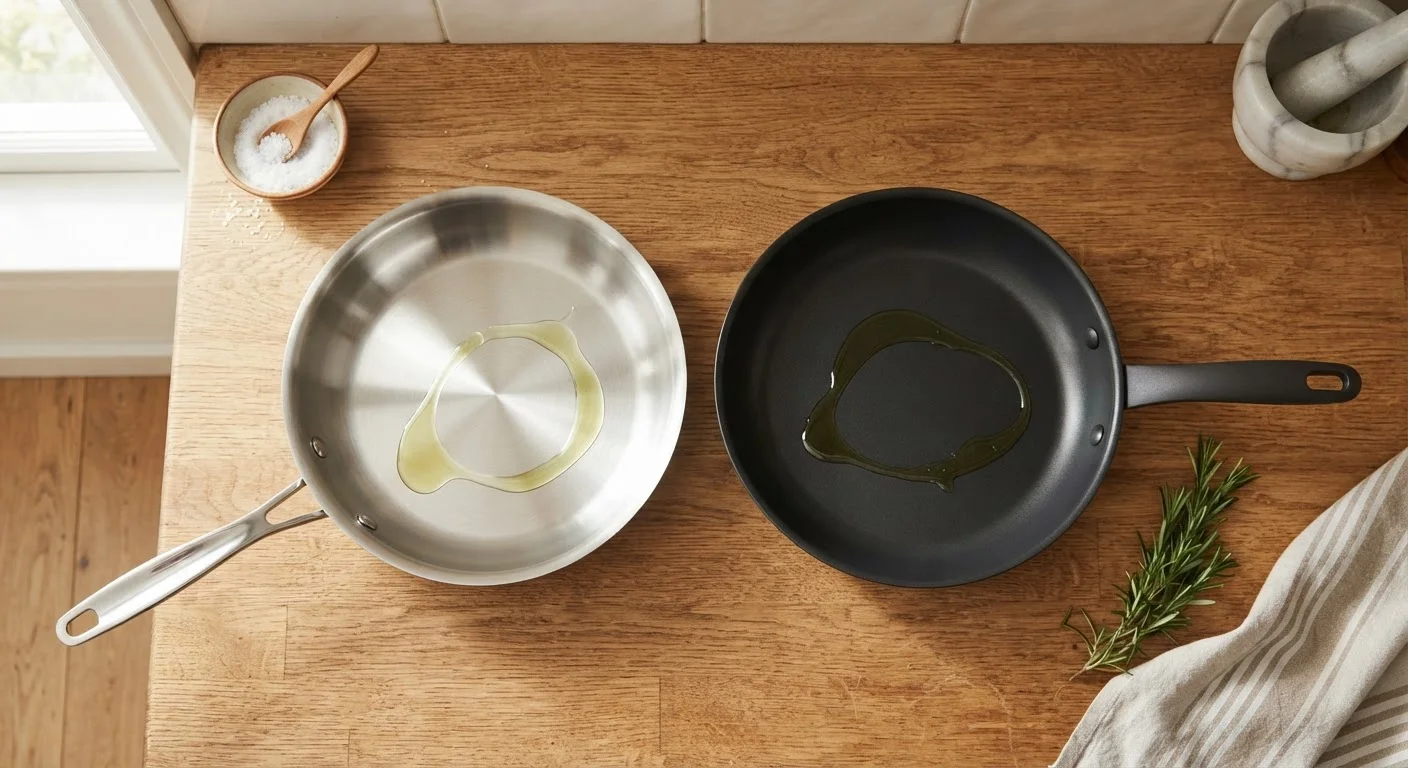
Option A
Stainless Steel Cookware
The durable, high-heat workhorse for serious cooking.
Best for: Searing, deglazing, browning, and high-heat techniques where fond development and oven versatility matter.
Option B
Nonstick Cookware
The low-fuss surface for delicate, everyday cooking.
Best for: Eggs, fish, pancakes, and other delicate foods that release cleanly without added fat.
What Sets These Two Pan Types Apart
Stainless steel and nonstick pans look similar hanging in a store, but they behave very differently once they hit a burner. Understanding the underlying differences - surface material, heat response, and what each pan does to food - makes it easier to pick the right tool rather than defaulting to whichever pan is closest.
Stainless steel is an alloy, most commonly steel bonded with chromium and sometimes nickel, often layered over an aluminum or copper core to improve heat distribution. The cooking surface is uncoated, meaning food can and will stick if the pan isn't properly preheated or lubricated. That sticking, counterintuitively, is part of what makes stainless so effective for certain tasks: those browned bits that cling to the surface - called fond - are packed with flavor and form the base of pan sauces. Understanding how heat retention works helps explain why stainless steel rewards a patient preheat before adding food.
Nonstick pans, by contrast, are typically aluminum pans coated with polytetrafluoroethylene (PTFE), commonly known by the trade name Teflon, or with ceramic-based coatings. The slick surface reduces friction between food and pan, making it easy to cook without much fat and to release food cleanly - but it comes with meaningful limitations around heat and durability.
| Criterion | Stainless Steel | Nonstick |
|---|---|---|
| Surface material | Bare metal alloy (no coating) | PTFE or ceramic coating |
| Stick resistance | Requires fat and technique | Low-stick with minimal fat |
| Heat tolerance | High - oven-safe at most temperatures | Limited - typically max 400-500°F |
| Browning / fond development | Excellent | Poor to moderate |
| Durability | Decades with basic care | 3-5 years typical lifespan |
| Utensil compatibility | Metal utensils safe | Requires non-metal utensils |
| Cleanup | Moderate - may need soaking | Easy - food releases cleanly |
| Dishwasher-safe | Generally yes | Hand-wash recommended |
Where Each Pan Performs - and Where It Doesn't
Stainless steel excels at tasks that require high heat or benefit from browning. A properly preheated stainless pan develops a deep sear on proteins, handles deglazing with wine or stock without warping or off-gassing, and can move directly from stovetop into a hot oven. It's also dishwasher-safe and resistant to scratching, meaning metal utensils won't ruin it. The trade-off is technique: without adequate preheat and a thin layer of fat, eggs and fish will stick stubbornly, and cleanup becomes harder.
Nonstick shines with delicate, everyday cooking. Eggs slide out cleanly, crepes flip without tearing, and sticky batters lift off without drama. Cleanup is fast. For beginner cooks or anyone who wants to use less oil day-to-day, nonstick makes cooking more approachable. However, most PTFE-based coatings should not be used above 500°F (260°C); exceeding that threshold can cause the coating to begin breaking down. Scratched or flaking nonstick surfaces - from metal utensils or abrasive cleaning - indicate the pan should be retired. Ceramic nonstick coatings are generally marketed as more heat-tolerant, though they tend to lose their slickness faster than PTFE.
A Note on Nonstick Coating Safety
Concerns about PTFE-based coatings have circulated for years, largely tied to a manufacturing chemical called PFOA, which was phased out of production in the US by 2013. Current PTFE cookware made without PFOA is considered safe for normal cooking use by the FDA and EPA. The main caution remains avoiding overheating: temperatures above 500°F can cause coating degradation, and pans should not be left empty on high heat. Adequate kitchen ventilation during cooking is always a sensible practice regardless of pan type.
If you're drawn to pans that go beyond these two categories, the comparison between carbon steel and cast iron offers a useful look at two alternatives with different heat characteristics and seasoning requirements.
Maintenance, Longevity, and Practical Considerations
Stainless steel is built for the long haul. With basic care - avoiding extreme thermal shock, occasional scrubbing with a non-scratch pad - a quality stainless pan can realistically last decades. Discoloration and water spots are cosmetic issues that don't affect performance and can usually be addressed with a small amount of white vinegar or a designated stainless cleaner. The pan doesn't require seasoning and has no coating to protect.
Nonstick pans have a finite life. Even with careful handling - low to medium heat, wooden or silicone utensils, hand-washing - the coating eventually loses its effectiveness. Most culinary professionals and cookware manufacturers suggest replacing nonstick pans every three to five years under regular home use, or sooner if visible scratching, peeling, or flaking appears. That lifespan difference is worth factoring in when thinking about the overall cost of each type over time.
3-5 years
Typical nonstick coating lifespan under regular home use
Most cookware manufacturers and culinary sources suggest retiring nonstick pans when visible coating damage appears, regardless of age.
500°F
Maximum safe temperature for most PTFE-based nonstick coatings
Exceeding this threshold can cause coating breakdown; stainless steel pans have no equivalent ceiling under normal cooking conditions.
For most home kitchens, the practical answer isn't choosing one over the other - it's understanding that both serve different purposes. A nonstick skillet for eggs and delicate fish, a stainless pan for searing and sauce work: that combination covers the vast majority of everyday cooking tasks without overlap or compromise.
The content on this site is provided for informational purposes only and should not be considered a substitute for professional advice. While we strive to provide accurate and up-to-date information, we make no guarantees regarding its completeness or accuracy. Always consult a qualified professional for advice specific to your circumstances before making any decisions.