

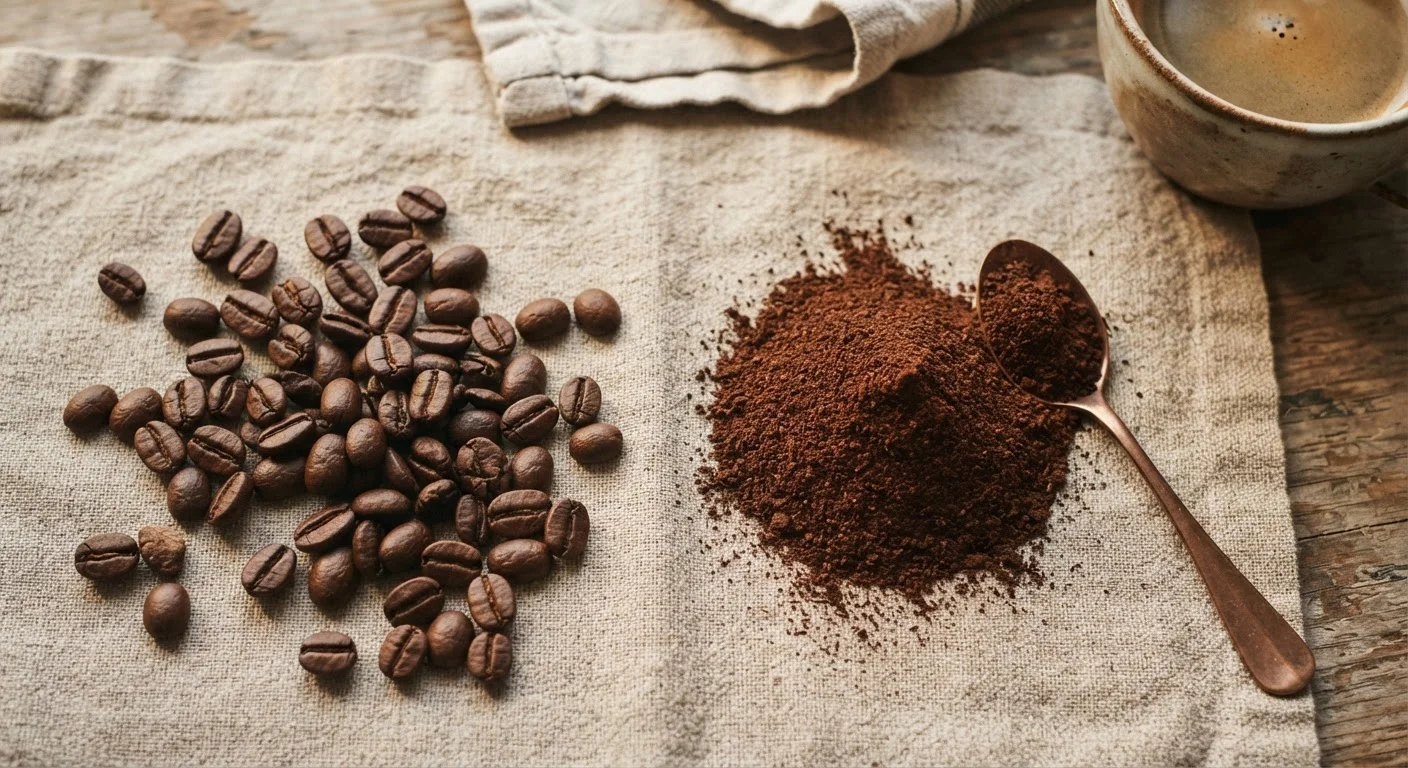
Option A
Whole Bean Coffee
The freshness-first choice for flavor-conscious drinkers.
Best for: Drinkers who want maximum aroma, flavor nuance, and control over grind size for different brew methods.
Option B
Pre-Ground Coffee
The convenient, accessible option for everyday brewing.
Best for: Anyone who wants a fast, no-equipment morning routine without sacrificing a solid cup of coffee.
Why Freshness Is the Defining Factor
Coffee flavor is largely carried by volatile aromatic compounds - hundreds of them - that form during roasting and begin dissipating almost immediately afterward. Grinding dramatically accelerates this process by vastly increasing the surface area exposed to oxygen. Research in food chemistry consistently shows that ground coffee stales far faster than whole beans under the same storage conditions.
The practical implication: a bag of pre-ground coffee sitting on a shelf - even a well-sealed one - has already shed a meaningful portion of its aromatic complexity by the time it reaches your cup. Whole beans, by contrast, act as their own protective shell, slowing oxidation until you crack them open with a grinder.
Carbon dioxide, a natural byproduct of roasting, also escapes much faster from ground coffee. That CO₂ plays a real role in brewing - it creates the bloom in pour-over and the crema in espresso. Its rapid loss in pre-ground coffee is one reason those methods can taste flatter when made with older grounds.
| Criterion | Whole Bean | Pre-Ground |
|---|---|---|
| Flavor freshness | Preserved until grinding | Begins declining after opening |
| Shelf life (opened) | 2-4 weeks post-roast | 1-2 weeks post-opening |
| Grind flexibility | Full control over size | Fixed (typically medium) |
| Equipment needed | Grinder required | No grinder needed |
| Morning convenience | Extra step involved | Ready to use immediately |
| Best for brew methods | All methods | Drip and similar |
| Aroma intensity | High (released when ground) | Moderate (partially dissipated) |
Grind Size, Brew Method, and What Pre-Ground Can't Adjust
One of the most practical arguments for whole beans is grind flexibility. Different brew methods extract coffee optimally at different grind sizes: coarse for French press, medium for drip, fine for espresso, and extra-coarse for cold brew. Pre-ground coffee is typically sold at a medium grind, which suits standard drip machines but leaves other methods underserved.
Brewing with the wrong grind size isn't just a minor inconvenience - it fundamentally changes extraction. Too fine a grind in a French press leads to over-extraction and bitterness; too coarse a grind for an AeroPress produces a weak, under-developed cup. Whole bean drinkers with a quality burr grinder can dial in precisely for each method.
Burr Grinders: A Meaningful Upgrade
If you're considering switching to whole bean, a burr grinder is worth the investment over a blade model. Burr grinders crush beans between two abrasive surfaces to produce consistent particle sizes, which leads to more even extraction and a cleaner cup. Manual burr grinders offer a low-cost entry point; electric models add speed and convenience. Either type substantially outperforms a blade grinder for flavor consistency.
For drip machine users who stick to a single brew style and replace their coffee weekly, the practical gap between whole bean and pre-ground narrows considerably. The key variable shifts from format to freshness - buying smaller quantities more frequently matters as much as the bean-vs-ground question for this group.
Storage, Shelf Life, and Realistic Expectations
Sealed whole beans stored in an airtight, opaque container away from heat and light can maintain good flavor for two to four weeks post-roast. Pre-ground coffee under the same conditions typically shows noticeable flavor degradation within one to two weeks of opening. Neither format benefits from refrigeration - condensation from temperature cycling introduces moisture that accelerates staleness.
Vacuum-sealed pre-ground coffee, particularly when purchased in smaller quantities and used quickly, is a perfectly reasonable choice. The format gap is real but not insurmountable. What matters most is buying freshly roasted coffee - check for a roast date on the bag, not just a best-by date - and consuming it within a reasonable window.
Just as understanding ingredient quality shapes decisions in other food contexts - the way whole foods differ from ultra-processed ones involves understanding what's been stripped away during processing - the whole bean vs. pre-ground question is ultimately about what's preserved versus what's already lost before you brew.
Equipment, Cost, and the Realistic Trade-Off
Whole bean coffee requires a grinder. Blade grinders are inexpensive but produce uneven particle sizes that make extraction inconsistent. Burr grinders - either manual or electric - produce a uniform grind and are widely considered the better option for serious home brewing, though they represent an upfront investment.
Pre-ground coffee requires no additional equipment beyond whatever you brew with. For drinkers who already own a drip machine and want a low-friction morning routine, that simplicity is a legitimate advantage - not a compromise to apologize for.
Both formats exist across a wide range of price points and roast styles. If you enjoy experimenting with different preparations - the way plant-based milks suit different recipes and preferences - whole bean gives you the versatility to adapt. If your routine is settled and consistent, pre-ground delivers reliability without added complexity. Neither is objectively wrong; the right answer depends entirely on how you actually make and drink your coffee.
The content on this site is provided for informational purposes only and should not be considered a substitute for professional advice. While we strive to provide accurate and up-to-date information, we make no guarantees regarding its completeness or accuracy. Always consult a qualified professional for advice specific to your circumstances before making any decisions.