

Our Verdict
Sous vide is a genuinely useful technique for home cooks who care about consistent, precisely cooked proteins and have the patience for longer cook times. It isn't a replacement for traditional cooking skills - you still need to sear, season, and finish properly - but it removes a significant source of error for dishes where internal temperature is everything. The upfront equipment investment and the learning curve around food safety are real considerations that shouldn't be dismissed.
Home cooks who frequently prepare proteins like chicken breast, pork tenderloin, or steak and want repeatable, precise results without the stress of timing.
What Sous Vide Actually Does
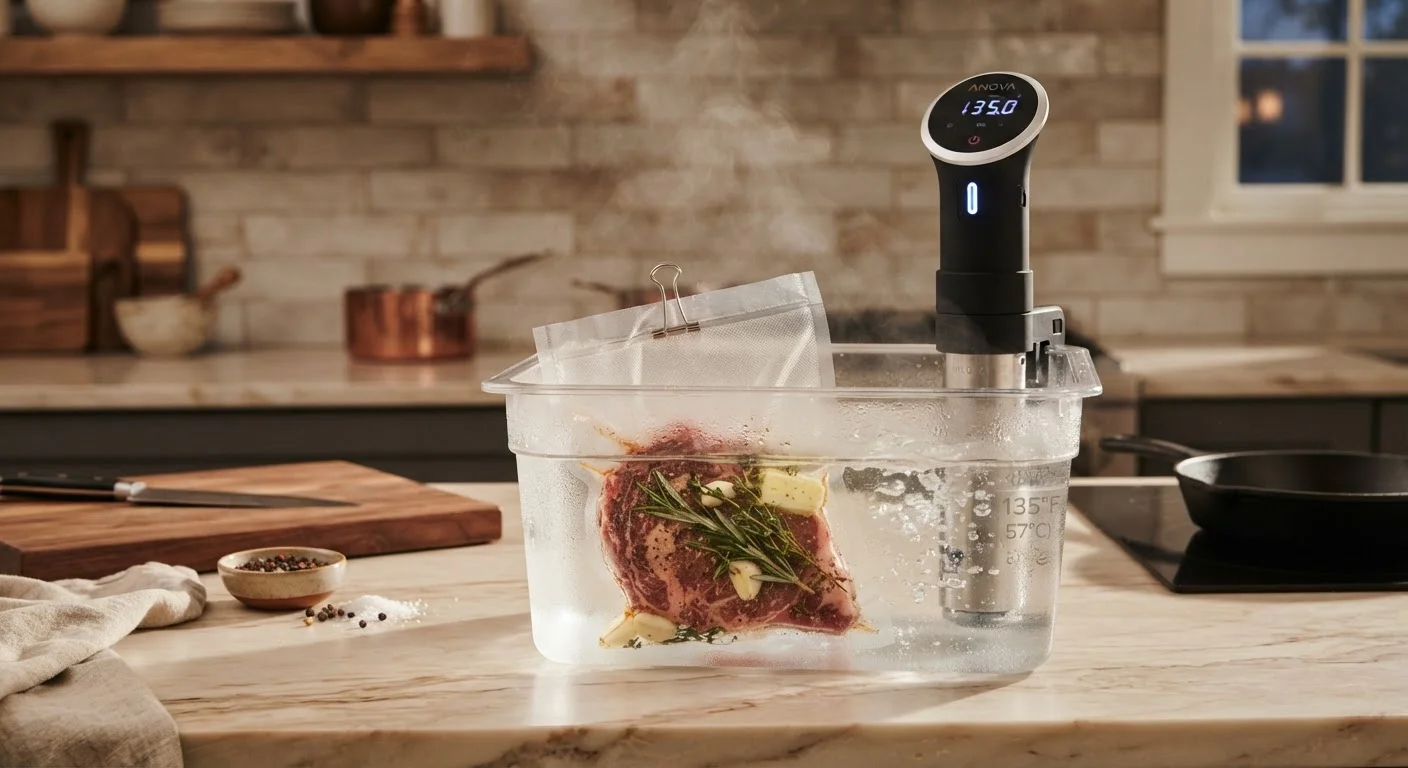
Sous vide (French for "under vacuum") involves sealing food in a bag - vacuum-sealed or simply zip-locked with air pressed out - and submerging it in a water bath held at a precise, constant temperature by an immersion circulator. Because the water temperature never exceeds the target internal temperature of the food, you can't overcook in the traditional sense. A chicken breast held at 145°F (63°C) will reach exactly 145°F throughout and stay there, whether you leave it for 90 minutes or four hours.
This is fundamentally different from oven or stovetop cooking, where the heat source is far hotter than the desired internal temperature and timing becomes a moving target. As our guide to searing science explains, heat management and surface development are separate problems - sous vide isolates the internal temperature problem so you can solve it cleanly before worrying about the exterior.
The Real Advantages
Precise, repeatable internal temperatures every time
The water bath temperature sets an absolute ceiling for the food's internal temperature, making overcooked proteins nearly impossible during the bath itself.
Eliminates the guesswork of conventional timing
Unlike oven roasting, where thickness, starting temperature, and oven variation all compound uncertainty, sous vide makes those variables largely irrelevant to doneness.
Flexible hold times fit around real schedules
Food can safely remain in the water bath beyond the minimum cook time without quality loss, reducing the pressure of precise timing that stovetop cooking demands.
Even doneness from edge to edge
Conventional cooking creates a gradient of doneness - more well-done near the surface - while sous vide produces uniform texture throughout the entire piece of food.
Well-suited to difficult proteins
Chicken breast and pork tenderloin are notoriously easy to overcook on a stove or in an oven; sous vide provides a reliable method to keep them juicy without constant monitoring.
Consistency is the core argument for sous vide. Restaurant kitchens adopted it partly because it allows the same cook to produce the same result dozens of times per service. At home, that same principle means a pork tenderloin comes out pale pink and juicy every time, without the anxiety of probing every few minutes.
Meal timing flexibility is underrated. Because food can hold safely at temperature without overcooking, sous vide fits better around an unpredictable schedule than conventional methods. Proteins can often wait an additional 30 to 60 minutes without degrading noticeably.
The Limitations You Should Know
Long cook times make spontaneous meals impractical
Even a simple steak requires one to four hours, while collagen-rich cuts targeting tenderness may need a full day or more - planning ahead is essential.
Searing is still required for flavor and texture
Without a hard sear in a very hot pan after the water bath, food emerges pale and unappealing; the browning step can't be skipped and adds time and skill back into the process.
Food safety requires validated time-temperature knowledge
Lower cooking temperatures only achieve pasteurization when held for specific durations; cooks who improvise without reference to safety guidelines risk underpasteurized food.
Minimal benefit for many vegetables and baked goods
High-heat techniques develop flavors and textures that water-bath cooking cannot replicate, making sous vide a poor fit for roasted vegetables or anything requiring browning as a primary outcome.
Requires dedicated equipment and storage space
An immersion circulator plus a suitable container represent an additional appliance commitment; cooks with limited counter or storage space need to factor this in.
Does not replace foundational cooking skills
Seasoning, searing, sauce-making, and timing still require practice and attention - sous vide solves one narrow problem and leaves the rest unchanged.
The most persistent misconception is that sous vide eliminates the need for skill. It doesn't. A proper sear after the water bath is essential - the Maillard reaction (the browning process that creates crust and depth of flavor) doesn't happen in water. Skipping or rushing the sear produces pale, textureless results regardless of how precisely the interior was cooked.
Long cook times are also a genuine barrier. A steak may take 1-4 hours; tougher cuts targeting tenderness can run 24-72 hours. This requires planning most people aren't accustomed to and doesn't suit spontaneous weeknight cooking.
Vacuum Sealing Is Not Always Required
Dedicated vacuum sealers produce the most secure seal and are useful for longer cooks, but a zip-lock bag with air displaced using the water-displacement method works reliably for most applications. The critical factor is keeping water out of the bag and ensuring the food stays fully submerged, not the specific sealing method. For very long cooks or fatty preparations, a proper seal matters more.
Food Safety: Where Intuition Can Mislead You
Traditional cooking often uses temperature as the only safety checkpoint - "cook chicken to 165°F" is a familiar rule. Sous vide operates differently: food safety is a function of both temperature and time held at that temperature. Pathogens are eliminated through sustained heat exposure, not just a single peak temperature. Cooking chicken at 145°F for the right duration achieves the same pasteurization as a higher temperature held briefly - but only if the time-temperature combination follows validated food safety guidelines, such as those published by the USDA.
Home cooks should consult reliable reference charts rather than guessing. Cooking at temperatures below 130°F (54°C) for extended periods enters zones where bacteria can multiply, making those combinations unsafe without specific expertise. This is an area where overconfidence creates real risk.
130°F-165°F
USDA safe temperature range for common proteins
The USDA defines safe internal temperatures for various proteins, with time-at-temperature combinations determining pasteurization at lower sous vide settings.
1-72 hrs
Typical sous vide cook time range by cut
Tender cuts like steak may take as little as one hour, while tough braising cuts cooked for collagen breakdown can require up to 72 hours at lower temperatures.
When the Technique Earns Its Place
Sous vide is best suited to proteins where internal temperature precision matters most: chicken breasts prone to drying out, pork cuts, duck confit-style preparations, and eggs cooked to precise custard-like textures. For these, the technique consistently outperforms conventional methods in the hands of everyday cooks.
It's less compelling for most vegetables - high-heat roasting develops flavors that water-bath cooking can't replicate - and largely irrelevant for pasta, baked goods, or anything requiring browning as a central outcome. For the latter, precision temperature science applies in entirely different ways, as our baking science guide covers in depth.
The equipment itself is a modest commitment. Immersion circulators have dropped considerably in cost over the years, and a suitable container can be a simple stockpot. For cooks interested in how small appliances open up new techniques, the question of whether sous vide fits your kitchen is worth thinking through practically - see our overview of appliances that expand your cooking for that broader context.
The content on this site is provided for informational purposes only and should not be considered a substitute for professional advice. While we strive to provide accurate and up-to-date information, we make no guarantees regarding its completeness or accuracy. Always consult a qualified professional for advice specific to your circumstances before making any decisions.