

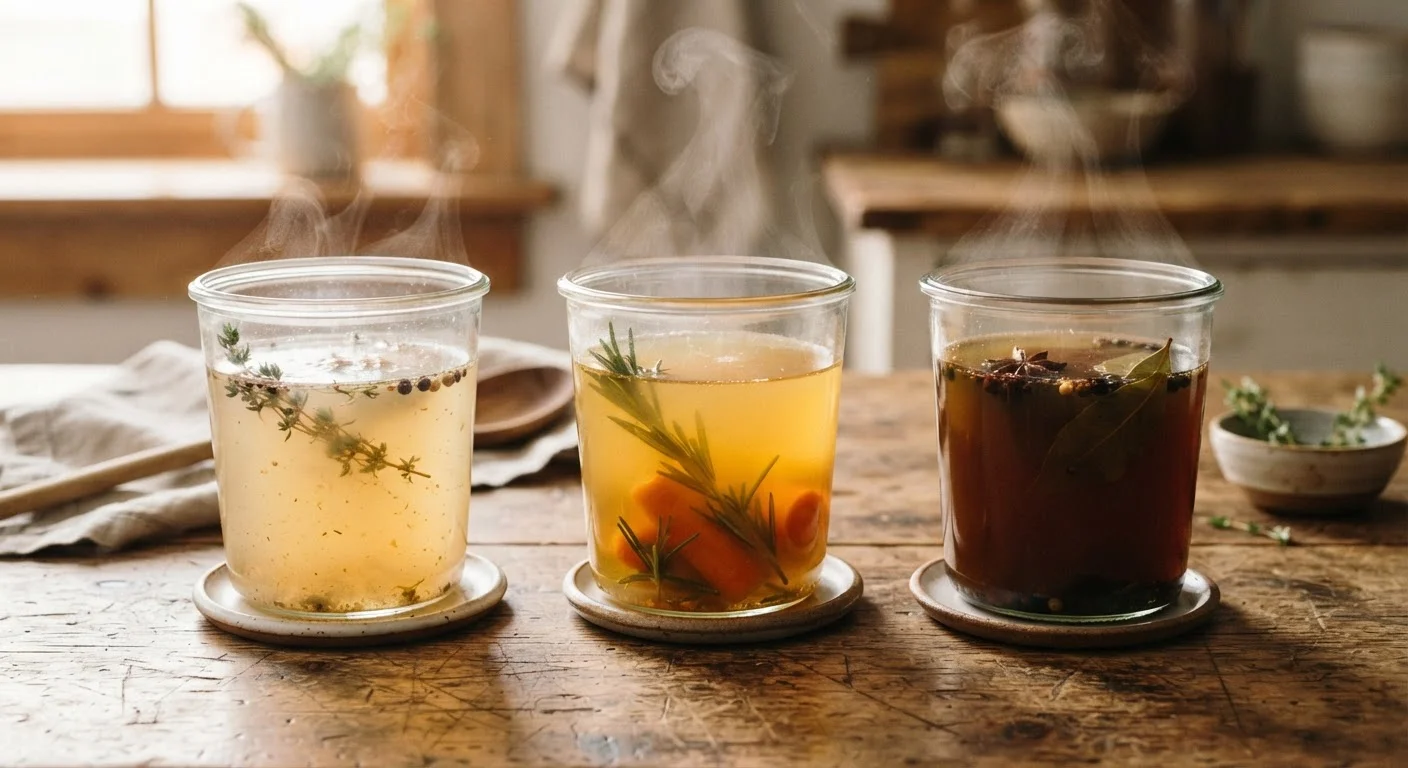
Option A
Stock
The cook's foundational building block.
Best for: Cooks who need a rich, gelatin-heavy base for sauces, gravies, braises, and risottos.
Option B
Broth
The lighter, more versatile everyday liquid.
Best for: Anyone who needs a seasoned, ready-to-use liquid for soups, poaching, deglazing, or sipping.
The Core Distinction: Bones vs. Meat vs. Time
The confusion between stock, broth, and bone broth is understandable - all three are savory liquids made by simmering animal ingredients in water. But each starts from a different place and ends up with a different character.
Stock is built primarily from bones, often roasted first for color and depth, along with aromatic vegetables (onion, celery, carrot) and herbs. The long simmer extracts collagen from connective tissue and cartilage, which converts to gelatin as the liquid cools. A well-made stock will gel when refrigerated - that's the marker of quality. Crucially, stock is left unseasoned, which gives cooks full control over salt when reducing or building sauces.
Broth takes the opposite approach, centering on meat rather than bones. Because muscle meat contains little collagen, broth stays thin and pourable even when cold. It's seasoned during cooking - often with salt and sometimes herbs or spices - so it's flavorful straight out of the pot or carton. Chicken broth, for example, is commonly used as a base for soups or as a quick deglazing liquid.
Bone broth occupies a middle ground, starting with bones (like stock) but simmering for a dramatically longer period - typically 12 to 24 hours or more. This extended cooking pulls a greater concentration of collagen, minerals, and flavor from the bones. The result is a liquid that's richer and more intensely flavored than standard stock. It may or may not be seasoned depending on the maker. See our guide to braising vs. stewing for more on how long, slow liquid-based cooking techniques differ.
| Criterion | Stock | Broth |
|---|---|---|
| Primary ingredient | Bones (with some meat) | Meat (minimal bones) |
| Gelatin content | High - gels when cold | Low - stays liquid when cold |
| Seasoning | Unseasoned | Seasoned (salted) |
| Cook time | 4-8 hours typical | 1-3 hours typical |
| Best kitchen use | Sauces, gravies, braises | Soups, quick cooking, drinking |
| Bone broth distinction | 12-24+ hours, more concentrated | N/A - broth-based, not bone-focused |
| Body / mouthfeel | Rich, silky when reduced | Thinner, lighter |
How Each One Performs in the Kitchen
Understanding these three liquids practically means knowing when to reach for each one.
Stock's gelatin content is its superpower. When you reduce a stock-based pan sauce, that gelatin concentrates and gives the finished sauce a glossy, coating consistency you simply can't get from broth. For risottos, gravies, and classic French sauces, stock is the correct tool. Because it's unseasoned, you also won't accidentally oversalt a dish during reduction.
Broth shines in seasoned applications where convenience matters. Drop it into a weeknight soup, use it to cook grains like farro or quinoa, or add it to a quick pan sauce when you need flavor without fuss. Its thinner body and pre-seasoned character make it versatile - but it won't give you the viscosity or richness that stock provides.
Bone broth works well in any recipe calling for stock but adds even more depth of flavor. Its richness makes it excellent for long braises where the liquid reduces significantly, or for sipping as a warm drink on its own. Understanding dry heat vs. moist heat cooking methods can help you decide when a rich liquid like bone broth fits your technique.
A Note on Store-Bought Labeling
The FDA does not strictly regulate the terms "stock" and "broth" on food labels, which means manufacturers use them somewhat interchangeably. Many commercial "stocks" contain added salt, and some products marketed as "bone broth" are cooked for far shorter periods than traditional recipes call for. If the gelatin content matters for your recipe, look for products that explicitly note a gelling texture, or check whether the chilled liquid sets up like a soft gel.
One practical note: commercial versions of all three often blur these definitions. Some cartons labeled "stock" contain added salt, and some "bone broths" are essentially lightly cooked broths marketed with a premium label. Reading ingredient lists and checking whether the product gels when chilled is the most reliable way to assess what you're actually buying.
What the Nutritional Differences Actually Mean
Bone broth in particular has attracted significant attention for its purported health benefits - claims that range from improved joint health to gut support. It's worth separating what's reasonably established from what remains less certain.
All three liquids contain some protein and micronutrients drawn from their ingredients. Bone broth, by virtue of its long cook time, generally contains higher concentrations of gelatin and collagen peptides than standard stock or broth. Some research suggests collagen peptides may support skin elasticity and joint health, though the evidence is still developing and the amounts in any given serving vary considerably.
The minerals often cited - calcium, magnesium, phosphorus - are present in bone broth, but typically at modest levels that won't significantly replace dietary sources. It's a nutritious food, but the more dramatic health claims often outpace the current evidence base.
For most home cooks, the flavor and texture differences between these three liquids are far more immediately relevant than the nutritional distinctions. Choose based on what your recipe needs - and enjoy whatever you make.
12-24+ hrs
Typical bone broth simmer time
Traditional bone broth recipes call for extended cooking to maximize collagen extraction from connective tissue and cartilage.
~29g
Collagen in connective tissue per 100g
Collagen is the primary structural protein in animal connective tissue and the source of gelatin in long-cooked stocks and bone broths.
4-8 hrs
Standard stock simmer time
Most culinary traditions specify a 4-8 hour simmer for chicken or beef stock to fully extract gelatin without bitterness from over-reduced solids.
The content on this site is provided for informational purposes only and should not be considered a substitute for professional advice. While we strive to provide accurate and up-to-date information, we make no guarantees regarding its completeness or accuracy. Always consult a qualified professional for advice specific to your circumstances before making any decisions.