

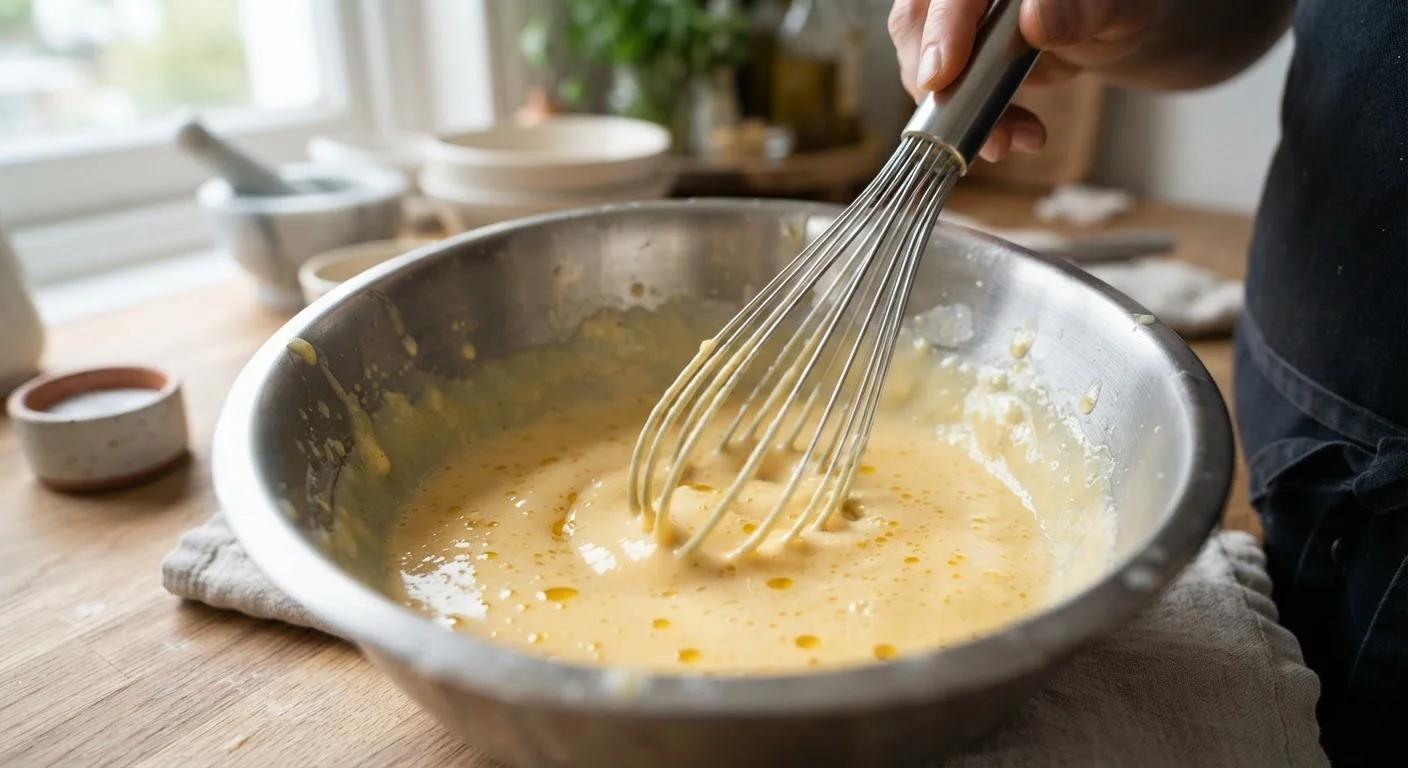
Why Sauces Split - and What's Actually Happening
Oil and water don't mix on their own. This is a basic fact of chemistry: fat molecules are nonpolar, water molecules are polar, and the two repel each other. When you shake a bottle of vinaigrette, you temporarily force them together - but without an emulsifier, they separate again within minutes. An emulsifier changes this by bridging the gap: one end of the molecule bonds with water, the other with fat, creating small, stable droplets of oil suspended throughout the liquid.
Understanding this mechanism is what separates a cook who follows a recipe from one who can troubleshoot in real time. If your hollandaise breaks, it's not because you failed - it's because the emulsifier lost its grip, usually due to excess heat or oil added too fast. The technique adjustments in this guide address those root causes directly.
Emulsions are generally grouped into two types: temporary (a vinaigrette that separates after standing) and stabilized (mayonnaise or hollandaise, where an emulsifier keeps the mixture cohesive for hours or days). Both are useful, and both respond to the same underlying principles. For more on how foundational liquids behave in the kitchen, see our guide to stocks, broths, and bone broth.
What You Need Before You Start
Successful emulsification doesn't require special equipment, but a few tools make the process significantly more reliable. Review the list below before you begin.
What you will need
Whisk
Creates the mechanical agitation needed to break oil into fine droplets and distribute them through the water-based liquid.
Stainless steel or glass mixing bowl
Provides a stable, non-reactive surface for whisking; a damp towel underneath prevents it from sliding.
Immersion blender
Speeds up emulsification dramatically for mayonnaise-style preparations by creating extremely fine droplets instantly.
Instant-read thermometer
Essential for hollandaise and warm butter sauces to keep the yolk-base below the coagulation threshold (around 160°F).
Small liquid measuring cup or squeeze bottle
Allows slow, controlled addition of oil - critical for building a stable emulsion without breaking it.
Having everything measured and at the right temperature before you start whisking is more important than any single technique step. Emulsification requires continuous attention, and stopping to find a squeeze bottle mid-stream is how sauces break.
Step-by-Step: Building an Emulsified Sauce
Raw Egg Yolk Safety
Many classic emulsified sauces - including mayonnaise and traditional hollandaise - rely on raw or lightly heated egg yolks. These carry a small risk of salmonella contamination. Pregnant individuals, young children, older adults, and anyone immunocompromised should use pasteurized eggs or choose a cooked-yolk method. If you're unsure, consult a food safety resource or healthcare provider.
Choose your emulsifier
Every stable emulsion needs an emulsifier - a molecule with one end that attracts water and another that attracts fat. For a vinaigrette, Dijon mustard (which contains mucilage compounds) or a small amount of honey works well. For mayonnaise or hollandaise, egg yolk is the standard choice: its lecithin content is one of the most effective natural emulsifiers available.
Match the emulsifier to the sauce's flavor profile. Mustard adds sharpness; egg yolk contributes richness. Using more than the minimum needed gives extra stability without noticeably affecting flavor at typical quantities.
Prepare your base and control temperature
For cold emulsions - vinaigrette, mayonnaise - ingredients should be at room temperature. Cold oil is viscous and harder to disperse; cold egg yolks don't coat droplets as effectively. Pull everything from the refrigerator at least 20 minutes before you start.
For warm emulsions like hollandaise, the goal is to gently cook the yolks over indirect heat (a double boiler or a heatproof bowl set over barely simmering water) until they thicken slightly before adding butter. Keep heat gentle and consistent - the yolks should never reach a temperature where they scramble.
Combine your acid and emulsifier first
Before introducing any oil, whisk together your emulsifier and acid base. For vinaigrette, this means combining mustard with vinegar or lemon juice. For mayonnaise, it means whisking egg yolk with a small amount of lemon juice or vinegar. This step activates the emulsifier and creates the initial aqueous phase that oil droplets will be distributed into.
Don't skip this step or combine everything at once - the emulsifier needs to be evenly distributed in the water-based liquid before oil arrives.
Add oil slowly, in a thin, steady stream
This is where most emulsions succeed or fail. Begin by adding oil drop by drop - literally individual drops - while whisking continuously. The emulsifier coats each new oil droplet as it arrives. Once the mixture visibly thickens and turns opaque (usually after about a tablespoon of oil has been incorporated), you can increase to a thin, steady stream.
If using an immersion blender for mayo, the process is faster: blend the yolk-acid base first, then slowly trickle oil in while blending, or use the standard tall-container method where oil is poured slowly down the side.
Taste, adjust, and stabilize
Once the emulsion holds together, taste before serving. Emulsified sauces often need a final acid adjustment - a few extra drops of lemon juice or vinegar brightens the flavor and can actually help reinforce stability. Season with salt and pepper last, as salt can slightly thin a sauce if added too early.
For longer storage, a small additional amount of emulsifier (an extra half-teaspoon of mustard stirred in, for example) can extend how long the sauce holds without separating.
Rescue a Broken Emulsion
If your sauce breaks, don't discard it. Place a fresh egg yolk (or a teaspoon of mustard for a vinaigrette) in a clean bowl and slowly whisk the broken mixture into it as if it were fresh oil. The new emulsifier gives the separated droplets somewhere stable to go. Patience at this stage is more effective than vigorous whisking.
Applying This Technique Across Different Sauces
The steps above apply consistently whether you're making a quick lemon vinaigrette or a classic hollandaise, but the ratios and equipment shift. A simple vinaigrette uses 1 part acid to 3 parts oil with mustard as the emulsifier; no heat required. Mayonnaise relies on egg yolk lecithin and a neutral oil, typically yielding a much thicker emulsion because more oil is incorporated relative to the aqueous phase. Hollandaise introduces heat and butter - clarified butter works particularly well because removing the milk solids gives a cleaner, more stable result.
Once you're comfortable with these basics, the same principles extend to pan sauces where a pat of butter is whisked into a wine reduction, or Caesar-style dressings built on anchovy paste and garlic acting as partial emulsifiers alongside egg. The technique scales from a single serving to batch production without changing fundamentally.
If you're evaluating the quality of the oils and condiments you're working with - a factor that genuinely affects the final sauce - our article on tasting olive oil and condiments systematically offers useful guidance. And for cooks interested in applying similar precision thinking to other techniques, our baking science guide covers how heat and timing interact in ways that parallel emulsification chemistry.
Adding Oil Too Fast Breaks the Sauce
The single most common reason a sauce breaks is rushing the oil addition. If you pour too quickly, the droplets can't be coated by the emulsifier fast enough, and the mixture separates. Start with drops, not a stream, especially in the first 30 seconds.
The content on this site is provided for informational purposes only and should not be considered a substitute for professional advice. While we strive to provide accurate and up-to-date information, we make no guarantees regarding its completeness or accuracy. Always consult a qualified professional for advice specific to your circumstances before making any decisions.