

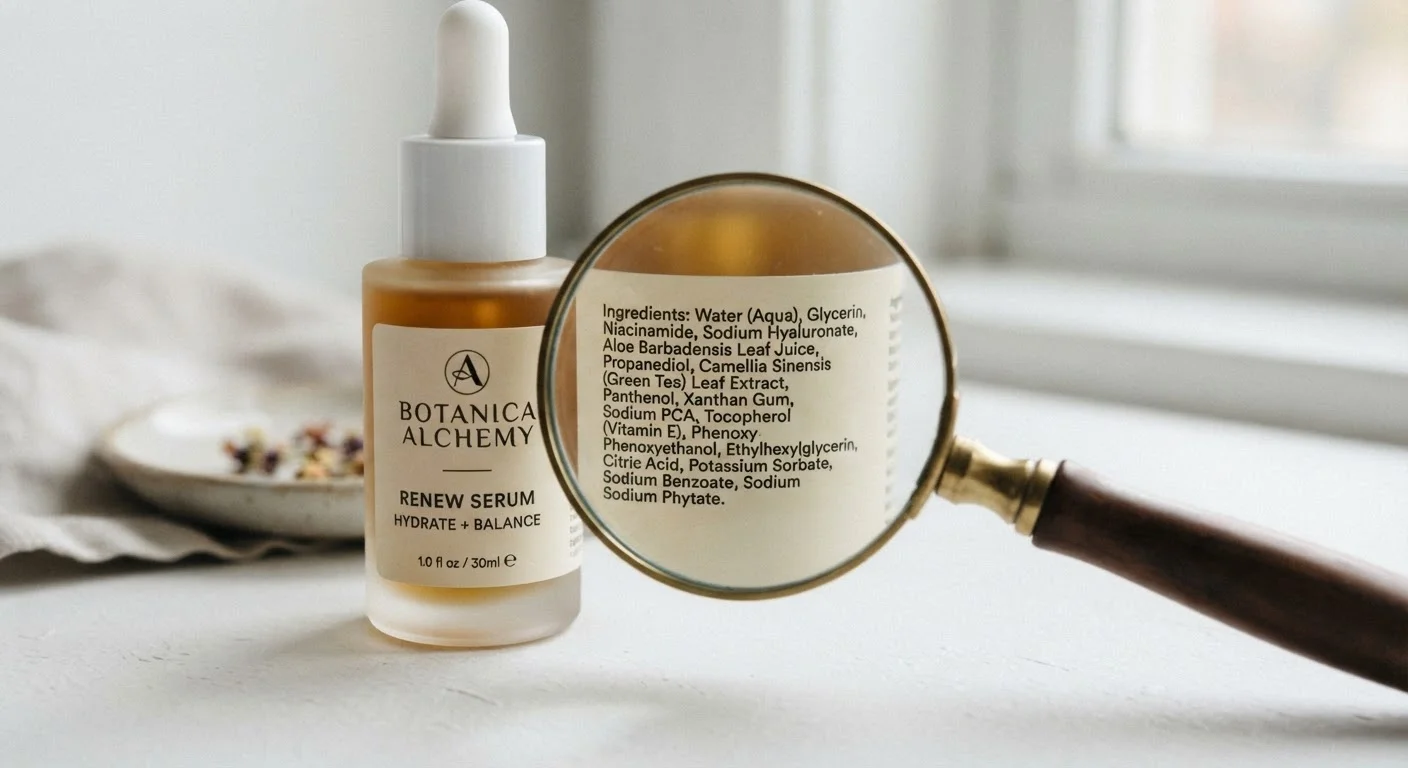
How Ingredient Lists Are Legally Structured
In the United States, the FDA requires cosmetic manufacturers to list ingredients using standardized INCI names, ordered by concentration from highest to lowest. That means the first ingredient on the list - usually water (Aqua) or an oil - makes up the largest share of the formula by weight.
Once you reach ingredients that make up less than 1% of a formula, the rules shift. Below that threshold, manufacturers may list ingredients in any order they choose. In practice, this means that actives appearing near the bottom of a long list may be present in very small amounts - or they may be more concentrated than neighbors listed beside them. There is no reliable way to tell from position alone once you are past that cutoff.
INCI names are not marketing language. Tocopherol is vitamin E. Ascorbic acid is vitamin C. Retinol is the same whether it appears in an expensive serum or a drugstore moisturizer. Learning a few of these equivalencies removes a lot of the confusion that brand naming creates. For a comparable exercise in a different context, the same principles apply to shampoo labels, where INCI names can be equally opaque.
What You're Actually Looking For
Rather than trying to recognize every ingredient, it helps to read a list in functional layers. Ask yourself four questions:
- What is the base? Water, silicones, oils, and waxes form the delivery vehicle and affect texture and feel - not necessarily efficacy.
- Where are the actives? Active ingredients such as niacinamide, hyaluronic acid, retinol, or exfoliating acids are the ones with documented skin-function effects. If a product is marketed around an active, check how early it appears in the list.
- What preserves it? Preservatives (phenoxyethanol, ethylhexylglycerin, parabens) prevent microbial growth. All preserved products contain them; their presence is a sign of a safely formulated product, not a red flag on its own.
- Is fragrance present? Listed simply as Fragrance or Parfum, this catch-all term can represent dozens of undisclosed compounds. For those with reactive or sensitive skin, it is worth noting. Our deeper look at fragrance in skincare covers the evidence in more detail.
Position Matters More for Some Actives
Exfoliating acids - AHAs like glycolic acid and BHAs like salicylic acid - are a category where position in the list matters significantly for function. A product marketed as an exfoliant should list the relevant acid well before the midpoint of the ingredient list. See our guide to skincare acids for context on what concentration ranges are typically associated with different effects.
Exfoliating acids - AHAs like glycolic acid and BHAs like salicylic acid - are a category where position in the list matters significantly for function. See our plain-language guide to skincare acids to understand what concentration ranges are typically associated with different effects.
Common Pitfalls When Reading Labels
A few habits can lead you astray when scanning ingredient lists:
- Assuming position always equals potency. A retinol listed at position 20 could still be at a functional concentration if the formula is designed around it. Conversely, a trendy ingredient listed last may be present in a negligible amount - sometimes called 'fairy dusting.'
- Conflating 'natural' with safe or effective. Plant-derived ingredients are not inherently gentler than synthetic ones, and some botanicals are significant allergens. Evaluate ingredients on what the evidence says about their function and irritation profile, not on their origin.
- Ignoring the full context. How a product is formulated - pH, ingredient ratios, vehicle - affects whether actives can actually do their job. A vitamin C serum at the wrong pH, for example, will degrade before it delivers much benefit.
New Products and Ingredient Interactions
Combining certain actives - such as vitamin C with certain forms of niacinamide at high concentrations, or retinol with strong exfoliating acids - can cause irritation or reduce efficacy. Before layering a new product into your routine, check how its key ingredients interact with what you already use. Our guide to ingredient interactions and new-product checklist are useful starting points.
If you are introducing a new product and are unsure how an ingredient will interact with what you already use, our guide to ingredient interactions is a useful reference. For a broader pre-introduction checklist, see what to check before starting any new skincare product.
Putting It Into Practice
Reading ingredient lists becomes faster with repetition. A practical starting point is to choose three to five ingredients relevant to your skin concerns and simply look for them across products you already own. Notice where they appear in each list, and cross-reference with your experience using the product. Over time, pattern recognition replaces the need to look up every name.
Once you can navigate a list with confidence, the next logical step is understanding how products work in sequence. Our guide to layering skincare products explains how formulation type affects absorption order - information that becomes much more meaningful once you can identify what a formula actually contains.
Knowing your skin type also sharpens label reading. Ingredients that are beneficial for dry skin - heavy occlusives, for example - can feel uncomfortable on oily skin. Our explanation of skin types provides a useful frame for filtering ingredient information through your own skin's needs.
This article is for general informational purposes only and does not constitute medical or dermatological advice. If you have a skin condition or experience reactions to skincare products, consult a qualified dermatologist or healthcare professional.
The content on this site is provided for informational purposes only and should not be considered a substitute for professional advice. While we strive to provide accurate and up-to-date information, we make no guarantees regarding its completeness or accuracy. Always consult a qualified professional for advice specific to your circumstances before making any decisions.