

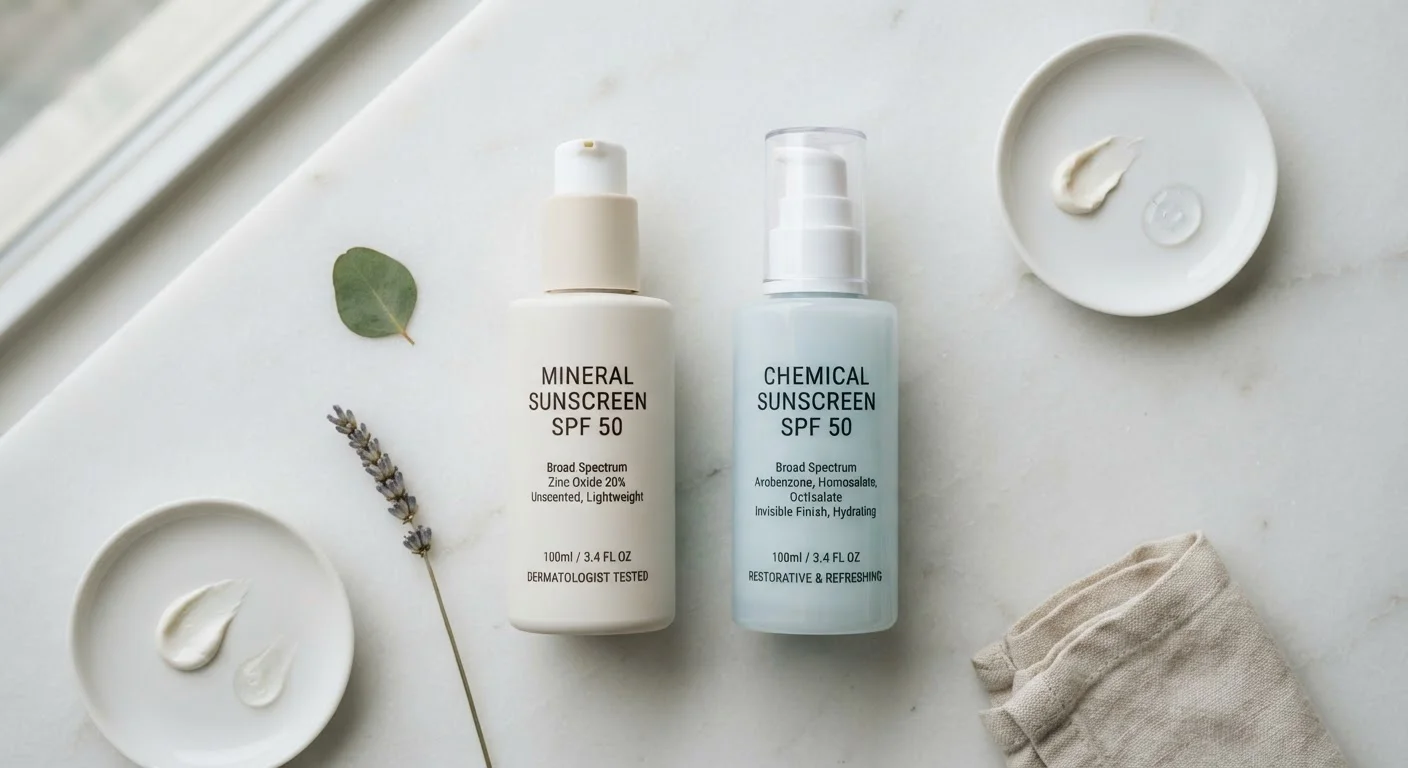
Option A
Physical (Mineral) Sunscreen
The barrier-based, broad-spectrum classic.
Best for: Best for sensitive, reactive, or acne-prone skin types that may not tolerate synthetic filter ingredients.
Option B
Chemical Sunscreen
The lightweight, invisible everyday option.
Best for: Best for those who prioritize lightweight texture and easy everyday wearability under makeup or during sports.
How Each Type of Sunscreen Actually Works
The fundamental difference between physical and chemical sunscreens comes down to mechanism of action - the way each formula interacts with UV radiation before it can damage skin cells.
Physical sunscreens (also called mineral sunscreens) rely on two active ingredients: zinc oxide, titanium dioxide, or a combination of both. These minerals form a physical layer on the skin's surface that reflects and scatters UV rays. Because they work at the surface level, they don't require absorption into the skin to be effective, and they become active immediately upon application.
Chemical sunscreens use organic (carbon-based) filter compounds - such as avobenzone, oxybenzone, octinoxate, and homosalate - that are absorbed into the skin. Once absorbed, these filters undergo a photochemical reaction: they absorb UV energy and convert it into a small amount of heat, which is then released from the skin. Because they rely on absorption, some dermatologists suggest applying chemical formulas about 15-20 minutes before sun exposure, though guidance on this varies.
Neither mechanism is inherently superior. Both can achieve high SPF ratings and broad-spectrum coverage when properly formulated. For a deeper look at what SPF numbers actually measure, see what SPF numbers actually measure.
| Criterion | Physical (Mineral) Sunscreen | Chemical Sunscreen |
|---|---|---|
| Active ingredients | Zinc oxide, titanium dioxide | Avobenzone, oxybenzone, octinoxate, others |
| How it works | Reflects and scatters UV rays | Absorbs UV and converts to heat |
| Onset of protection | Immediate upon application | Often recommended 15-20 min before exposure |
| Texture on skin | Can feel thicker; may leave white cast | Generally lighter; blends invisibly |
| Sensitive skin suitability | Generally well tolerated | Some filters may cause irritation |
| Photostability | Zinc oxide highly stable | Some filters (e.g. avobenzone) degrade faster |
| Broad-spectrum coverage | Zinc oxide covers UVA + UVB alone | Often requires multiple filters combined |
Skin Type Compatibility and Practical Considerations
Choosing between the two often comes down to skin type, lifestyle, and texture preference rather than one being objectively better than the other.
Sensitive and acne-prone skin: Mineral sunscreens are frequently recommended for people with reactive skin. Zinc oxide, in particular, has mild anti-inflammatory properties and a low sensitization profile. Chemical filters - especially oxybenzone - have been associated with contact dermatitis in some individuals, though reactions vary widely. If you're still mapping out your skin type, understanding your skin type is a useful starting point.
Texture and wearability: Chemical sunscreens tend to feel lighter and more cosmetically elegant - they absorb without residue and pair easily with makeup. Mineral formulas, depending on micronization (how finely the particles are milled), can leave a white cast that's more noticeable on medium to deep skin tones.
Stability and reapplication: Some chemical filters - particularly avobenzone - can degrade with prolonged sun exposure, which is one reason reapplication every two hours remains important regardless of the type used. Zinc oxide is generally considered more photostable.
2 hrs
Recommended sunscreen reapplication interval
The American Academy of Dermatology advises reapplying sunscreen every two hours during outdoor activity, regardless of formula type.
~1 oz
Amount needed for full-body coverage
Dermatology guidelines generally suggest the equivalent of a shot glass worth of sunscreen to adequately cover exposed adult skin.
For anyone building a more complete routine, understanding how sunscreen ingredients interact with other actives is equally important. Common skincare ingredient interactions covers combinations worth knowing about before layering products.
Reading Labels and Making an Informed Choice
When evaluating a sunscreen, the active ingredients list tells you which category it falls into - and knowing how to read that list matters. Decoding a skincare ingredient label explains how ingredient lists are structured and what to prioritize.
In the U.S., sunscreens are regulated as over-the-counter drugs by the FDA, which means their active ingredients and SPF claims are subject to established safety standards. Both physical and chemical options on shelves have met regulatory requirements for sale, though ongoing FDA reviews have prompted some discussion about the systemic absorption data for certain chemical filters - an area of active research rather than settled concern.
Practically, the sunscreen you'll use consistently is often the most effective one for your lifestyle. If texture or white cast causes you to skip application or under-apply, switching to a formula you find more comfortable may result in better real-world protection. Both categories, used correctly and reapplied regularly, can support a solid sun-protection habit.
This article is for informational purposes only and does not constitute medical or dermatological advice. Consult a qualified healthcare professional for personalized skincare guidance.
The content on this site is provided for informational purposes only and should not be considered a substitute for professional advice. While we strive to provide accurate and up-to-date information, we make no guarantees regarding its completeness or accuracy. Always consult a qualified professional for advice specific to your circumstances before making any decisions.