

Start here
Why a Grooming Routine Is Worth Building
Next
Skincare: The Non-Negotiable Foundation
Then
Hair Care: Know Your Hair, Then Work With It
Also explore
Facial Hair: Maintenance Over Transformation
Bring it home
Putting It All Together Into a Daily Rhythm
Why a Grooming Routine Is Worth Building
Grooming is often framed as vanity, but it's more accurately described as maintenance. A consistent routine protects your skin barrier, keeps your scalp healthy, and ensures your appearance reflects intention rather than neglect. The goal isn't perfection - it's sustainability.
Starting from scratch can feel overwhelming when confronted with a wall of products, but the reality is that a functional routine has very few moving parts. Most men need no more than five to seven minutes in the morning and a few minutes at night to cover the basics effectively. The payoff builds gradually: skin becomes more balanced, hair more manageable, and upkeep requires less effort over time.
Start Small, Then Build
If you're new to grooming routines, begin with just three products: a facial cleanser, a moisturizer, and a shampoo suited to your scalp. Once those three steps feel automatic - typically after two to three weeks - you can introduce additional steps without feeling overwhelmed.
If you're also thinking about building other healthy habits alongside grooming, our guide to starting a workout routine from scratch covers a similar ground-up approach for fitness.
Skincare: The Non-Negotiable Foundation
Skin is the most visible aspect of grooming and the one most men underinvest in. The core steps are cleanse, moisturize, and protect - in that order, every morning.
Skin barrier
The outermost layer of skin that acts as a protective shield, keeping moisture in and irritants out. A healthy skin barrier is the foundation of good skin.
Non-comedogenic
A term describing products formulated to avoid clogging pores, which is especially relevant for people prone to acne or blackheads.
Broad-spectrum SPF
A sunscreen rating that means the product protects against both UVA (aging) and UVB (burning) rays. SPF 30 or higher is the general recommendation for daily use.
Sebum
Natural oil produced by sebaceous glands in the skin and scalp. It provides lubrication and protection, but excess sebum can lead to oily skin or hair.
Habit stacking
A behavior-change technique that involves linking a new habit to an existing automatic behavior, making the new action easier to sustain consistently.
Clarifying shampoo
A shampoo designed to deeply cleanse buildup from the scalp and hair, including product residue, minerals, and excess oil. Best used periodically rather than daily.
Cleansing removes overnight oil buildup, sweat, and environmental residue. Choose a cleanser suited to your skin type: gel formulas work well for oily skin, cream or lotion cleansers for dry or sensitive skin. Avoid bar soaps formulated for the body - they're typically too alkaline for facial skin.
Moisturizing follows cleansing while skin is still slightly damp. Even oily skin benefits from hydration; skipping it often causes the skin to overcompensate by producing more oil. Look for non-comedogenic formulas (meaning they won't clog pores) if breakouts are a concern.
Sun protection is the step most men skip and dermatologists most consistently advocate for. A broad-spectrum SPF 30 or higher applied each morning is one of the highest-impact habits for long-term skin health. Many moisturizers include SPF, which simplifies the step.
For a deeper look at how these steps work together, see our guide on the core steps of a skincare routine. Before introducing any new product, it's also worth reviewing what to check before starting a new skincare product to avoid common irritation pitfalls.
Hair Care: Know Your Hair, Then Work With It
Effective hair care starts with understanding what your scalp and hair type actually need - not defaulting to whatever is on sale. The two key variables are scalp oiliness and hair texture.
Oily scalps produce sebum quickly and benefit from more frequent washing with a clarifying or balancing shampoo. Dry or flaky scalps need gentler, more hydrating formulas and less frequent washing. If you're noticing persistent flaking or irritation, that's a signal worth paying attention to - our article on signs your hair routine needs a reset can help you identify what's going wrong.
Conditioner is not optional for most hair types. It restores moisture stripped during washing, reduces breakage, and makes styling easier. Apply it from mid-length to ends, avoiding the scalp if your roots get oily quickly.
Styling products - pomades, clays, gels - are secondary to the health of the hair underneath. Start with clean, conditioned hair and use the smallest amount of product that achieves your desired result.
Facial Hair: Maintenance Over Transformation
Whether you prefer a clean shave, a short stubble, or a full beard, the principle is the same: defined edges and consistent upkeep make the difference between looking groomed and looking unintentional.
For men who shave, technique matters as much as tools. Shave with the grain of hair growth to reduce irritation, and always use a shaving lubricant - whether cream, gel, or oil - to protect the skin. Apply a fragrance-free moisturizer or balm immediately after to calm the skin barrier.
For beard wearers, the neckline and cheekline are your anchors. A beard that's well-edged at those two lines reads as deliberate regardless of length. Trim every one to two weeks to manage growth, and use a boar-bristle or nylon brush daily to distribute natural oils and train the direction of growth.
Beard skin (the skin underneath) is prone to dryness and occasional itchiness, especially during growth phases. A small amount of lightweight facial oil or dedicated beard oil can address this - though it's worth noting this is general guidance, and individual results vary based on skin type and beard density.
Putting It All Together Into a Daily Rhythm
The biggest barrier to a grooming routine is not knowledge - it's habit formation. The most effective strategy is habit stacking: attaching new grooming steps to behaviors you already do automatically, such as brushing your teeth or showering.
A workable framework for most men looks like this:
- Morning: Cleanse face → apply moisturizer with SPF → style hair → shave or trim if needed
- Evening: Cleanse face → apply moisturizer (no SPF required at night)
- Weekly: Exfoliate once or twice → wash hair according to your scalp type → trim beard or clean up edges
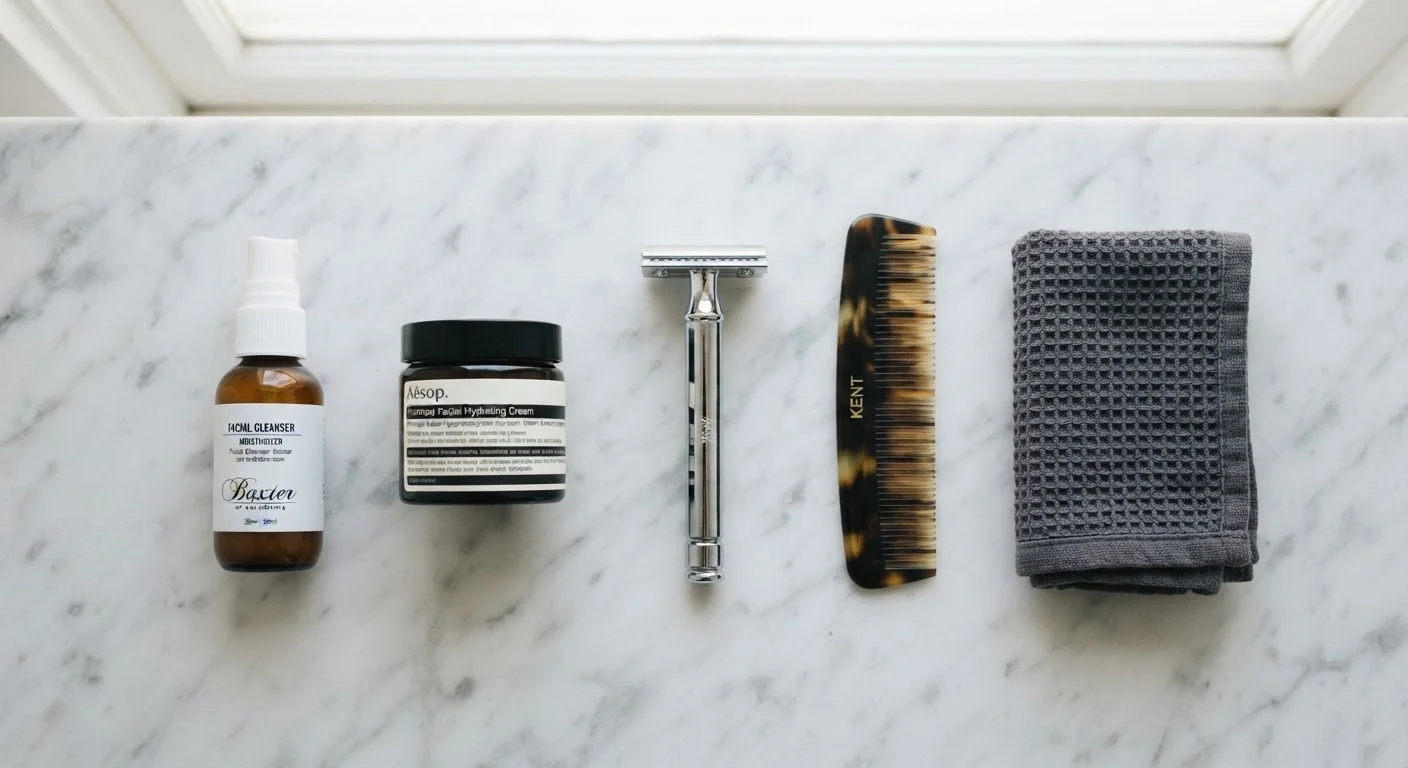
Keep your products visible and within reach. If your routine requires opening a cabinet or searching a drawer, the friction will erode consistency over time. A small tray or shelf in your bathroom that holds everything you need reduces that barrier considerably.
Grooming doesn't require an overhaul - it requires a starting point. Start with the minimum viable routine, make it consistent, and build from there only when you notice a gap the basics aren't covering.
This article provides general grooming and personal care information for educational purposes. It is not a substitute for professional dermatological or medical advice. If you have persistent skin, scalp, or hair concerns, consult a qualified healthcare or dermatology professional.
Frequently Asked Questions
For most men, three products cover the essentials: a facial cleanser, a moisturizer, and a hair shampoo suited to your scalp type. Once those are consistent habits, you can layer in additional steps like exfoliation or beard care as needed.
Twice daily - morning and evening - is the standard recommendation for most skin types. If you have dry or sensitive skin, a water rinse in the morning followed by a gentle cleanse at night may be more appropriate.
Yes. Men's skin tends to be thicker and oilier due to higher androgen levels, but it still loses moisture and is subject to environmental damage. A lightweight, unfragranced moisturizer applied after cleansing helps maintain the skin barrier regardless of skin type.
It depends on your scalp type. Oily scalps may benefit from washing every one to two days, while dry or normal scalps typically do well with two to three times per week. Over-washing can strip the scalp of natural oils and cause rebound oiliness.
Defining your neckline and cheekline clearly is the single biggest factor in a beard looking intentional. Trimming every one to two weeks to maintain your chosen length, paired with a daily brush-through, covers most of the upkeep.
Dermatologists generally consider daily SPF one of the most impactful skin-protection steps regardless of gender. A broad-spectrum SPF 30 or higher applied in the morning is a simple addition that most men's grooming routines benefit from including.
The content on this site is provided for informational purposes only and should not be considered a substitute for professional advice. While we strive to provide accurate and up-to-date information, we make no guarantees regarding its completeness or accuracy. Always consult a qualified professional for advice specific to your circumstances before making any decisions.